Blessed are you, O Lord our God, ruler of the universe, who brings forth bread from the earth. You guide us through the wilderness, to the land of your abundance. You guide us through times of trial, and lead us into the place of peace. You refresh us when we are weak, or lonely, or in despair, and give us strength to bear good news into your world.
May the words of our mouths and the meditations of our hearts and the deeds of our hands, be acceptable in your sight, O Lord, our strength and our redeemer.
America’s best soldier quit his job four times. He resigned three times from the military: first as a Colonel, second as an honorary brigadier general of the militia,and third as Commander in chief of the regular army. And fourth…
America’s best soldier made a lot of mistakes: setting up a fort in the middle of a swamp surrounded by hills…
Being defeated and retreating several times…
But when it counted, he stayed the course…
And when victory was one or the job was done or it was simply time to go
He resigned. He went home.
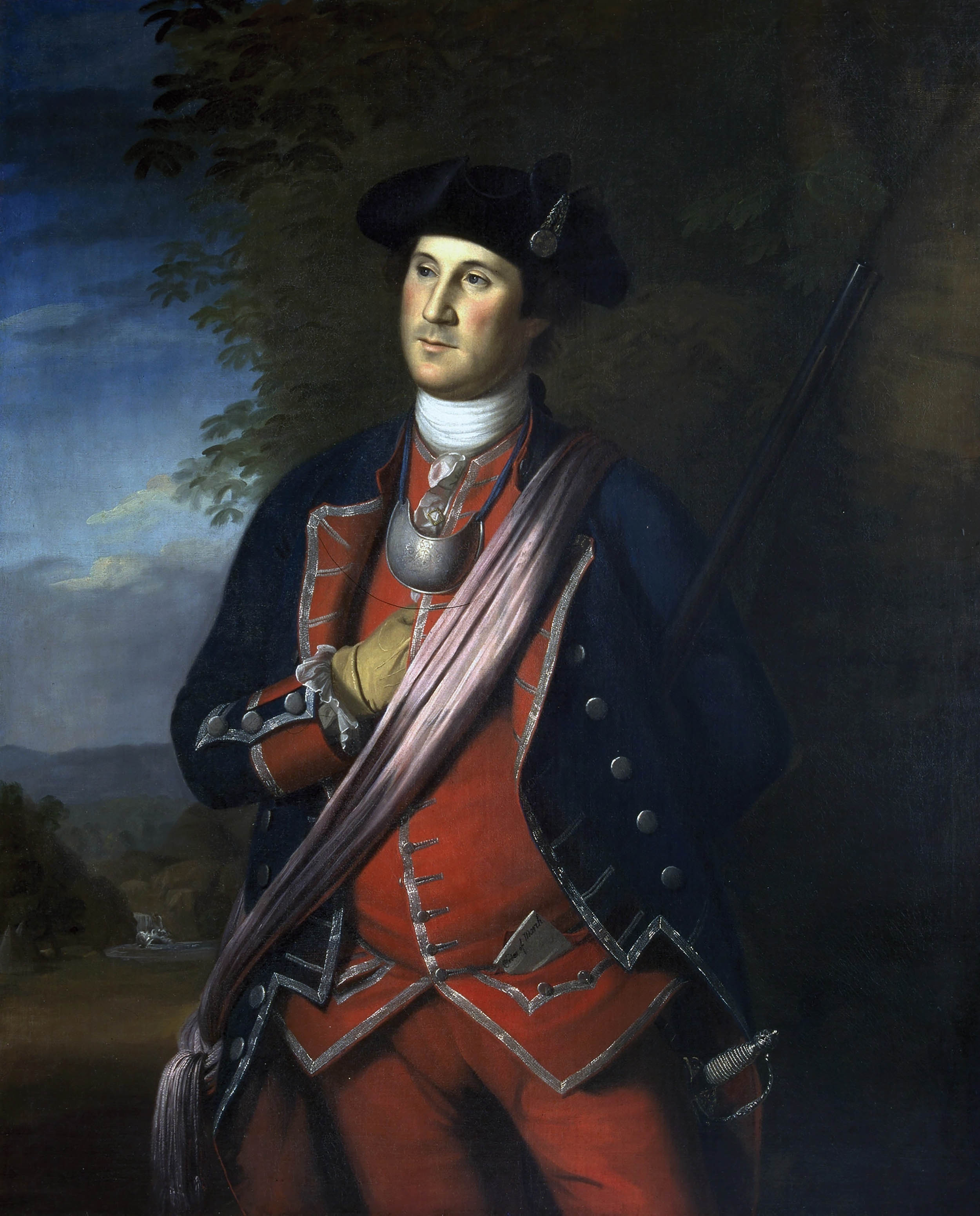
George Washington
Born February 22, 1732
When he was a young colonial officer in the Virginia militia, he was sent into the western wilderness, the wilds of Ohio beyond the Appalachian mountains, to engage in battle with the French, and I think that he was the one who ‘opened the ball’ – that is, began the first firefight– of what became the French and Indian war, known globally as the seven years war between France and England.
But it became clear to him that colonials were not held in the same respect as British regulars, and so he resigned his commission as Colonel.
But soon he was called back into service and eventually put in charge of all Virginia troops.
The time came when his work was done, and he resigned his commission and went home and got married and began the life of a gentleman farmer in Virginia.
Then it became clear to him that America needed to become independent of Great Britain, and so he put his uniform on again and became commander-in-chief of all the continental forces of the nascent United States of America.
When that job was done, and independence was won, he bid his officers farewell at Fraunces Tavern in New-York and reported to Congress in Annapolis and resigned his commission and went home…
To the life once again of a gentleman Virginia farmer.
But the United States in its infancy did not have cohesion; they were a loose confederacy and they needed a form of government that would last, and so he went to Philadelphia to serve his country once again, and presided over a convention which created a constitution.
Part of that constitution was describing the chief executive: after having described the Congress in the first article, the second article of the new constitution described the president. It was a portrait, actually, of the right person for the job.
Everyone knew who the first person to take that job should be.
But the day came when that job was done.
And he knew that it was important that power be transferred peacefully.
And he resigned.
And went home for the last time to the life of a gentleman Virginia farmer.
***
I’m bringing him up not just because this is his birthday, but because he in his day, as we in ours, struggled with temptations–
Temptations, for glory. for power, and for kingdom–
When he became president, it was a time when there was no such thing as a government without monarchy, and there were people who held out to make him King, but he refused. He refused that temptation for the good of the people, the country and his own soul.
When his men were starving in the snows of Valley Forge, he could’ve capitulated. He could’ve given it up and they could’ve walked into warm Philadelphia as prisoners, and that would’ve been the end of the United States of America.
But he resisted that temptation.
And he resisted the temptation of despair, of just giving up and hoping that God will take care of him. He resisted all temptations thrown at him.
Not to him were temptations exactly as the Temptations of Jesus.
And he was no secular Messiah.
He was the man of the hour, the father of his country, someone who had lifelong trained himself for the job and succeeded in it.
But he was not Messiah. He was a vestry member of an Episcopal Church. He was the husband of a wife, the father and grandfather to stepchildren, a soldier, a farmer, and a statesman.
***
In our time we face our own temptations as a people and individually: temptation to grasp for security, the first temptation: Jesus faced was the temptation to seek first for material security, and not for obedience to God and dependence on God.
The second temptation was simply temptation to test whether God really loved him.
Should’ve been obvious. A call to despair and doubt:
It was a test of his own fear. Do I have faith strong enough?
The third temptation Jesus faced was to subordinate himself, to the will and power of someone not God: it would’ve been so much easier to end the conflict and simply give in and be rewarded… to be a king– like Herod!
Jesus passed all the tests: he passed through the furnace of doubt, temptation, the lure of despair, the lure of ambition.
And then he was ready to serve.
###
What we see from then on, is Jesus’ acts of compassion, words of truth to power, and ability to give from apparently nothing but faith a greater abundance, suzerainty, and self-confidence, than any tempter could provide. Strength in faith.
Give us this day our daily bread. Thy kingdom come. Thy will be done. The power, the kingdom, the glory: all are yours O God.
Those are the three temptations in reverse. Power, Kingdom. Glory. All of which belong to God.
And Jesus is content to rest in the same hands that hold those three realities.
***
It goes all the way back to that first temptation. Because he lived not for himself but for us. He did not betray us for a crust of bread. He did not sell us out to rule. He did not need to prove anything, for himself or for us, and in that he showed the strength of faith that he gave us. He did not surrender to temptation. And he kept the faith to the end.
***
Of course our temptations will be different from Jesus – and George Washington. But the call to faithfulness is the same.
The challenge for us is this: are we ready to be servants of love, not rescuers; challengers of self-seeking ambition, not power-seekers; active in perseverance, not passive victims of doubt? Are we ready to live, not by bread alone, but in hope, and faith, and love, by the sure and certain promise, and presence, and challenge, of the word of God?
Are we ready to be transformed? To be servants of God? Proclaimers of his word?
To trust God, serve him only, and become bread for the world?
Lent is a call to conversion, to taking responsibility for our own growth and development as people of faith: for our own behavior, as individuals, and as a community, for all the emotional, intellectual, moral, religious, social and political, and economic aspects of our lives. That is our challenge, and our calling.
How do we in our world acknowledge that the power, the kingdom, and the glory belong to God? How do we see that kingdom come in our lives? Our world? Our community? Our church?
How do we reveal our dependence on God for our daily sustenance, thank him, and share it?
How do we share the gifts of providence, thinly spread or overwhelmingly abundant, that we have received?
How do we acknowledge that all things come from him, and in that knowledge offer our gifts?
God is the source of all blessing.
***
***
God of the desert, as we follow Jesus into the unknown, may we recognize the tempter when he comes; let it be your bread we eat, your world we serve, and you alone we worship. Amen.
(New Zealand Prayer Book, 573)
He did not betray us for a crust of bread.
--Ladislaus Boros, In Time of Temptation (translated by Simon and Erika Young)
http://edgeofenclosure.org/lent1c.html
This Sunday being "Temptation" Sunday - and the actual anniversary of the birth of our first president - I looked for a way to tie together seeking kingdom, power, and glory, for oneself, to both.
The first president had military and legislative experience, commanding Virginia militia in the French and Indian War, the Continental Army, and federal troops during an insurrection (Whiskey Rebellion) and presiding over the Constitutional Convention, but his first civilian role in public administration I think was as president. I like it that he resigned twice from the militia, once from the army, and then retired from the Presidency after his second term (Farewell Address of September 19, 1796) -- ensuring a peaceful and model succession. As every (public) school child would know.
https://www.britannica.com/biography/George-Washington
https://ndupress.ndu.edu/Portals/68/Images/jfq/jfq-109/arnold-2.jpg
https://open.substack.com/pub/inpursuit/p/george-washington-by-george-w-bush


No comments:
Post a Comment