Showing posts with label Epiphany. Show all posts

Sunday, January 5, 2025

What happens next?

Some years ago somebody sent me a screen treatment, a scenario, for a movie about Jesus. The scene I read was set in a trashcan-strewn alley in Hell’s Kitchen, New York. Running down the alley towards us was a teenage boy and he was in a hurry, jumping over trash cans, evidently avoiding pursuit.

When I called the producer and told him I’d been asked to give him my comments, I told him that I had worked for the Jesus Seminar. And so he said, “I already know what you are going to say.”

I could have pointed out the inauthenticity of what his Jesus said and did.

Of course what I wanted to say was, “I want to know what happens next.”

That is the way it is with Jesus. You never know what is going to happen next… in fact, at first, for most people, it was hard to recognize him for who he was. He wasn’t a kid tipping over trash cans as he ran down an alley, but he was somebody unlikely to be … what he turned out to be.

Even his closest disciples, the ones like Andrew who spotted him immediately, and those on whom it gradually dawned, as they walked with him on the roads of Galilee, were surprised by joy and sorrow at the end.

It was actually after they had endured not only joy but sorrow that they began to understand. And after the end had come, and the end of hope that they had placed in him, that a new understanding, and a new hope, dawned upon them.

In the times when Jesus was born, hope was already a fragile thing. The country had been under the thumb of the Roman power for years, and their own leaders cooperated in the domination system of that imperial rule.
 
His mother was apparently quite young, her husband somewhat older. They had traveled through the cold of midwinter to his ancestral home town, and found some shelter there, in time for the child to be born.

Meanwhile in the capital city strangers appeared in the palace of the king, the local ruler who kept things quiet for the emperor. Three strangers appeared. Magi, wise men, astrologers, or kings, from the East, who had nothing to do with Rome or Jerusalem, showed up and asked a question.

“Where is he who is born to be king of the Jews?” 

And who did they ask? Herod! Who was king, or said so, though he knew his claim was … inventive. Hence his toothy smile, seek for him diligently and let me know when you find him, that I too may go, and…

Today, in the visit of the Magi to the cradle, we are in suspense about what happens next with Herod. What we see is the first great epiphany, revelation, of who Jesus really is.

In coming weeks, Sunday gospel lessons will recount other epiphanies, other God-sightings, as Jesus is revealed in the Presentation in the Temple (“Now let your servant go in peace”), in his baptism by the Jordan river (“You are my Son, the Beloved”), in the wedding-feast in Cana (“You have kept the good wine until now"), in his reading of Isaiah in Nazareth (“The Spirit of the Lord is upon me”), in the miraculous catch of fish (“Put out into the deep water”)...

For now, though, there was a little child. And the strangest of visitors. 

There in a manger, a feeding-trough for farm animals, was a little baby. These wise men from the east, kings of Orient, or simply astrologers, had seen a star at its rising. And so of course they had gone to the capital and introduced themselves. “Where is he that is born King of the Jews?” 

Herod knew trouble when he saw it. He hadn’t stayed in power all those years without some wisdom. The wisdom of the world. He knew that for things to stay the same, things would have to change. But he didn’t want them to change like this. So, he questioned the sages, smiled his toothy smile and asked them to report back to him when they had found him.

“So that I too may go and worship him.”

But they were, after all, wise men, and so they departed by another road.

What happens next? What happened to the kid in the alley, I don’t know. I was curious. What happens next to this little baby, and the other kids his age, we do know. Because after the joy began the sorrow. 

Herod sent his soldiers. They slew all the children they found in that area, of the right age. This is the massacre we remember in the feast called The Holy Innocents.

Of all those children one survived. And improbably he grew up to become the fulfillment of all Herod’s fears.

For as a later ruler of Judea would know, he was “The King of the Jews.”

When they met him, the wise men knew. For others, it took a little time. Some of his home folk, back in Nazareth, couldn’t believe it. It made them angry. But for others, like Andrew by the lakeside, they knew who he was. 

He was the real thing. They just didn’t know what that meant yet.

As we learn throughout the Christian year, the Gospels tell us what following this king would mean.

There was joy, and there was sorrow.

And then, after the sorrow, there was joy beyond imagining. After death, there was life. And after the end of hope, there was hope beyond hope. 

We here may not know, or may not have known, what it meant to be nearly hopeless, in a village surrounded by an imperial enemy, with disciplined troops nearby, always vigilant for signs of resistance.

We may know, through our own experience or that of family members or refugees we have encountered, or aid workers we have known, just exactly what that was like.

There is fear. But there is always hope. There is darkness. And - there is light. 

And the light shines in the darkness, and the darkness has not - cannot - put it out. For in him was life, and this life is the light of all people. Merry Christmas, once again. 

O God, by the leading of a star you manifested your only Son to the peoples of the earth: Lead us, who know you now by faith, to your presence, where we may see your glory face to face; through Jesus Christ our Lord, who lives and reigns with you and the Holy Spirit, one God, now and for ever. Amen. (BCP)


January 5, 2025. the Feast of The Epiphany (observed).

Santa Cruz Lutheran Church, Tucson. 9:30am JRL+


Matthew 2:1-18

The Visit of the Wise Men

In the time of King Herod, after Jesus was born in Bethlehem of Judea, wise men from the East came to Jerusalem, asking, ‘Where is the child who has been born king of the Jews? For we observed his star at its rising, and have come to pay him homage.’ When King Herod heard this, he was frightened, and all Jerusalem with him; and calling together all the chief priests and scribes of the people, he inquired of them where the Messiah was to be born. They told him, ‘In Bethlehem of Judea; for so it has been written by the prophet: “And you, Bethlehem, in the land of Judah, are by no means least among the rulers of Judah; for from you shall come a ruler who is to shepherd my people Israel.” ’

Then Herod secretly called for the wise men and learned from them the exact time when the star had appeared. Then he sent them to Bethlehem, saying, ‘Go and search diligently for the child; and when you have found him, bring me word so that I may also go and pay him homage.’ When they had heard the king, they set out; and there, ahead of them, went the star that they had seen at its rising, until it stopped over the place where the child was. When they saw that the star had stopped, they were overwhelmed with joy. On entering the house, they saw the child with Mary his mother; and they knelt down and paid him homage. Then, opening their treasure-chests, they offered him gifts of gold, frankincense, and myrrh. And having been warned in a dream not to return to Herod, they left for their own country by another road.

The Escape to Egypt

Now after they had left, an angel of the Lord appeared to Joseph in a dream and said, ‘Get up, take the child and his mother, and flee to Egypt, and remain there until I tell you; for Herod is about to search for the child, to destroy him.’ Then Joseph got up, took the child and his mother by night, and went to Egypt, and remained there until the death of Herod. This was to fulfil what had been spoken by the Lord through the prophet, ‘Out of Egypt I have called my son.’

The Massacre of the Infants

When Herod saw that he had been tricked by the wise men, he was infuriated, and he sent and killed all the children in and around Bethlehem who were two years old or under, according to the time that he had learned from the wise men. Then was fulfilled what had been spoken through the prophet Jeremiah: ‘A voice was heard in Ramah, wailing and loud lamentation, Rachel weeping for her children; she refused to be consoled, because they are no more.’


Footnote: I am looking forward to listening to the 2024 Town and Gown lecture with Nicholas Terpstra (University of Toronto) from the Division of Late Medieval and Reformation Studies at the University of Arizona, "Blood and Betrayal Meanings in the Massacre of the Innocents."

Temporarily available at https://youtu.be/5LbJOGuh42A?feature=shared

Saturday, January 6, 2024

Epiphany

STAR OF WONDER


We watched the skies. We looked for signs, for wonders; we looked for something in the heavens that was telling us, here on earth, that things were going to change. (We knew they had to.) At the Center for Portentous Phenomena, somewhere east of Jerusalem, we all saw something in the sky - and we came to an agreement: it must mean something of great significance.

The royal planet Jupiter and the planet we associated with the Hebrew People, Saturn, were in alignment three times in the year now known as 7 B.C.E. Three times: Hello! Hello! Hello! “We get the message,” we said, and we set out: for the royal city of the Jews.

We had been following that star for a very long way and we thought we knew what it meant. Across mountain passes filled with untimely snow, across grasslands and along river valleys and into the high desert, across and along the river Jordan and finally up the hill to the summit of the holy mountain - to the city of Zion, the city of (we thought) the kings of the Jews.

That was as far as we got but now we were in the dark.

Politely we inquired of the man in charge: where shall we find him? Where shall we find the one born king of the Jews? For we have been following - his star. (Not yours, pal.)

Oh, he said so politely, is it now? Well tell you what, when you find it, you let me know. I'll be right there - with bells on.

That smelled like dead fish.

But they had clued us in: this may be the royal city, now, but it is not always so: for as the prophet Micah has told us, Bethlehem is not least among the cities of Judah, for from her shall come the greatest of kings: Bethlehem - the city of the shepherd who was king, the city of David.

And so we went.

And then there it was again: that star. We had seen its rising; we are seeing it still. The sign, at last! There was a showing forth of the glorious grace of God: he has sent his king.

And we went into the town of Bethlehem, and inquired at all the right places. And then we were tired, and our camels needed rest.

So we turned their heads toward the caravansary, the place where all the long-distance travelers kept their animals and themselves, to find a place for ourselves in a wayfarers' inn, and, in the stables, a trough at which our animals could feed.

We had looked in all the right places, hadn't we? Among the great we had been courteous, and we had been inquiring minds following the clue of the prophets. And yet - here we were, at the end of our journey, and nothing in the world to show for it.

But there.

There, where we led the camels and the horses to water and food, there we found him. It was a baby, lying in the manger.

An ordinary baby. Of course! We had been looking for the love of God in extraordinary places - well, in this place here it was, in an ordinary looking family in an extraordinary situation. The love was there.

We must have been quite a sight! An eyeful for the caravan men, the stable hands, and the drovers: for you see, we had brought the gifts with us. And we, when we realized what we beheld, had run back and put on our best robes, to present the gifts and ourselves, to give him the honor that was his due - for this baby was the king we sought.

If we had been shepherds we might have brought him lambs' wool or goats' milk, or cheese; as we were wise in the ways of the skies we brought what they had told us, what they had led us to expect...

We carried with us the best gifts of our homelands: frankincense and gold, royal gifts - just as Micah had prophesied! - And one more, one we presented with some trepidation to the young family, myrrh. But the mother nodded: she knew.

And we knew.

And yet we all know something more: he is with us. He is still with us.

And still he calls us, draws us onward, to follow his star, to see the light shining in the darkest night, the light that the darkness has not, will not, cannot, overcome: the light of the love of God.

Come on! He leads us. And we follow. Amen. 


JRL+ 


Epiphanytide

Have you ever experienced an epiphany? Epiphanies are showings, revelations, appearances. They are God-sightings, times God shows up and transforms lives among us. 

On the Sundays of the season of Epiphany, which runs from January 6th to just before Lent, the Gospel lessons relate a series of epiphanies. The Gospel tells of times the Holy Spirit revealed that God is present in Christ. 

The season of Epiphany, or Epiphanies if you will, begins with the visit of the Magi - wise people from the East. There are three of them, generally, in pictures we see: and they are visiting three ordinary-looking people, a father, a mother, and a tiny infant.

Around them - at least in manger scenes - may also be shepherds and angels. But the essential image is three beholding three, and finding in that beholding a revelation of the mystery of Christ: that God has come down to us and become one of us, in order to bring us salvation.

The next Sunday we remember and celebrate the Baptism of our Lord. When Jesus came up out of the water a voice from heaven was saying, “This is my beloved Son, in whom I take delight.” (Matthew 3:17) Soon Jesus himself proclaims the words of the prophet, come true: “The people that lived in darkness have seen a great light.” (Cf. Isaiah 9:1-2) It is then that he begins to call disciples to follow him. (Matthew 4:19)

In the first few weeks of Epiphany the focus of the gospel is on Jesus, and discoveries of who he is. In his sermon on the mount, Jesus himself begins to turn the camera around. He shows the people God is at work in the world around them – and, as they begin to live as citizens of the kingdom of heaven, they begin to see Jesus at work in their own lives.

Somehow in the very struggle, the pain, even the persecution, that believers endure in this life, God is present - he is there, he is here, God is with us. In the middle of darkness there is a light shining that it cannot smother; in the middle of despair there is hope; in the middle of doubt, faith; in the middle of sorrow, joy. How can this be - unless God reigns?

In the middle of the Epiphany season there is a special celebration, which recalls our Christmas festivities. It is the feast of the Presentation of our Lord in the Temple (Candlemas or Candelaria). As the Christ Child is dedicated, Anna and Simeon, old and faithful people who have been awaiting this event, look on and praise God for sending salvation to his people.

The season of Epiphany ends with three beholding three again: the Transfiguration. On a mountaintop Peter, John, and James witness the meeting of Moses, Elijah, and Jesus. 

It’s a strange moment. It’s a moment when a man they thought they knew becomes, before his friend’s eyes, a living, visible revelation of God’s glory. Moses saw it; Elijah proclaimed it; Jesus - is it!

The disciples see Jesus’ face shine: he is clothed in white, radiant, transfigured; bathed in the light of the glory of God. A voice proclaims: “This is my beloved Son, in whom I take delight: listen to him.” (Matthew 17:5) These words hearken back to the beginning of his ministry and the purpose of his life – and call us forward to the fulfillment of time.

He is changed – but still their friend, he is awesome and intimate in one. No wonder they are astonished, no wonder they are afraid, no wonder they are for a moment demobilized: but Jesus comes to them, gently calling: “Stand up; do not be afraid.” (Matthew 17:7) And together they descend the mountain, to the world’s ordinary time.

Jesus exhorts us: Be that light; be the presence of God. Be the Good News of Jesus Christ - in your neighborhood, your city, and your school; in the desert or on the mountain; in your solitude and in the community. You cannot hide a city set upon a hill; let your light shine before people. Rejoice and be glad! “You are light for all the world.” (Matthew 5:14)

Let that light shine in all you do – as Jesus shone on the mountain. Don’t be afraid: God will turn fear into courage. All you can do is this: “Put first in your mind God’s kingdom and his justice; the rest will come.” (Matthew 6:33)

So we, showing Jesus in our lives, are sharing in these moments of Epiphany, these God-sightings in troubled times when God is mostly likely to show up, and come to us, gently calling, “do not be afraid”, and helping us get onto our feet again and walk with him.

Christ extends his hands to us as he did to those frightened men - and bids us rise. Let us, then, come to know and share God’s love with all people.


JRL+ 

Epiphany, Presentation, Transfiguration 2024


Monday, June 12, 2023

visitors


In this photo released by Russian Orthodox Church Press Service, the Trinity icon by Andrei Rublev is displayed as Russian Orthodox Church Patriarch Kirill conducts an Orthodox service celebrating Trinity Sunday with Russia’s most famous icon transferred from a museum to Moscow’s main cathedral despite the keepers’ vociferous protests in the Christ the Savior Cathedral in Moscow, Russia, Sunday, June 4, 2023. The Trinity icon by Andrei Rublev that was kept in Moscow’s Tretyakov Gallery since the 1920s was moved to Christ the Savior Cathedral for the holiday on President Vladimir Putin’s order. Putin’s sudden order to hand over the 15th century icon to the church came despite protests from the Tretyakov keepers that the icon was too fragile to move. (Oleg Varov/Russian Orthodox Church Press Service via AP)

https://apnews.com/article/russia-trinity-icon-rublev-moscow-cathedral-c78adcee0c929208013c9936f9969291

Russia's most famous icon handed over from museum to church despite protests (Associated Press, June 4, 2023 at 9:27 a.m. EDT)

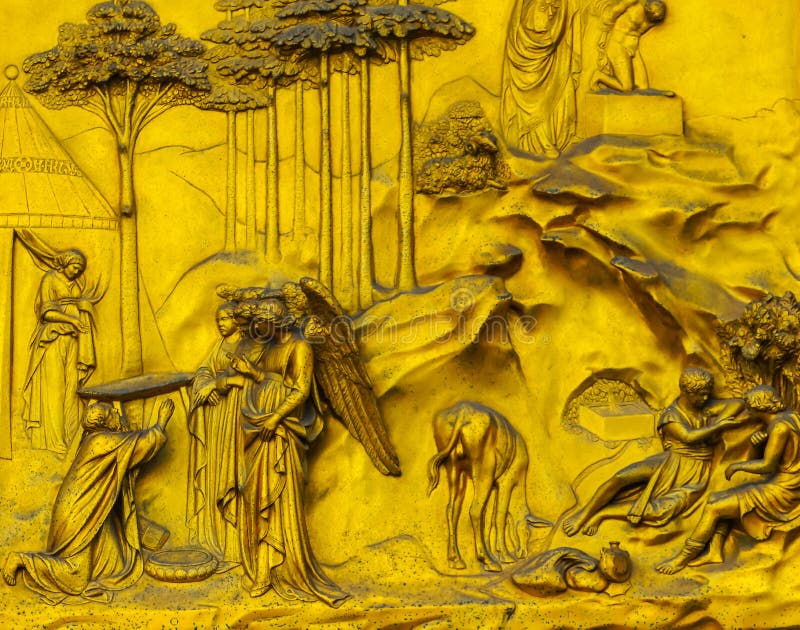
On Trinity Sunday on my way to church I heard on the radio that Russia’s most famous icon, by Andrei Rublev, was on its way from a museum in Moscow to a nearby church. This icon is frequently cited as an image of the Trinity, a showing in the persons of three mysterious angelic visitors to the tent of Abraham and Sarah at the Oaks of Mamre. It is a close-up, in effect, of the larger scene, one you can see depicted by Ghiberti on the doors of the baptistry of St John  in Florence, Italy (and replicated on the front doors of Grace Cathedral in San Francisco). 


Looking at the bigger picture you can see Abraham in front of the tent offering hospitality to the strangers, while Sarah peeks from behind the flap of the tent. They are receiving strange news from strange guests. The icon that focuses in on the three visitors shows them in harmonious relation to each other, a dancing image of God, (perichoresis, reciprocal coinherence) since as they are three, or two, or one, they are a “God sighting” as Reverend Billy calls it (theophany), a miraculous appearance or vision of the presence of God.  


The image is from the story in the book of Genesis (18:1-15, 21:1-7) of three strangers that come to the tent of Abraham and Sarah at the Oaks of Mamre, where their flocks and herds are pastured by the trees, and they greet the old man and his old wife, and receive hospitality. And then give her a blessing. There was to be a child, and a great promise.  


For God had said to Abraham, ‘As for your wife— I will bless her, and moreover I will give you a son by her. I will bless her, and she shall give rise to nations; kings of peoples shall come from her.’ ‘And by your offspring shall all the nations of the earth gain blessing for themselves.’


There are elements in this story that probably came across with particular power over the many centuries of the Jewish people. Three strangers arrive, receive hospitality, give a blessing, and tell of a child of great promise. Hard to forget, wonderfully told, a story for the ages.


On Trinity Sunday I wondered if Mary heard it, if it came to mind as she sheltered near Bethlehem with her newborn son. (Matthew 2:1-12) Because here again, there were, so many centuries later, a mother and a child of great promise, and three strangers who said, as those earlier visitors had said, “through this child a great blessing will come to his people, and to all the world.” 


The new mother: did she smile at this? Did she laugh? Did she laugh to hear the news or did she gently accept it or did she do both? What child was this? What parents? Now this one was already born, when the strangers, this time astrologers, Wise Men, Magi from the east, said to its mother, that this child would be a blessing to his people, and to all the world. Again three strangers, again a mother and a child. Again, a great promise, and in both cases that one promise has become fulfilled.


​​http://www.lectionarypage.net/YearA_RCL/Pentecost/AProp6_RCL.html#ot1

http://www.lectionarypage.net/YearABC_RCL/Epiphany/Epiph_RCL.html


Genesis 18:1-15, (21:1-7)
Matthew 2:1-12


A version of this meditation was printed in the Arizona Daily Star, Keeping the Faith feature of the Home + Life section, pg. E3, on Sunday, July 16, 2023, under the heading, "3 visitors and a blessing."


Saturday, December 19, 2020

The Great Conjunction


Astronomer friends in our neighborhood told me not long ago where to look in the sunset sky for something phenomenal: two planets converging night after night, coming closer together, forming one brilliant light above the crescent moon in the sunset. It formed and forms an unforgettable sight, one bound to become even more remarkable as the winter solstice approaches. It is called the great conjunction, as the light of two planets, Jupiter and Saturn, is superimposed.

2000 years ago magi (Wise Men) may have looked upon a similar sight: two planets growing closer together, forming a brilliant spot in the sky.


Why for them was this a birth announcement? Why did it tell them to pack up and go to Jerusalem? When before had far away nations paid homage to a son of David?


A child who is born became king of the Jews yet Solomon in all his wisdom never saw stars like this and never was so arrayed — and Jesus was and is so arrayed, but in the glory that came to him on the cross. It is not far from Jerusalem to Bethlehem; it is not far again from the Church of the Nativity to the Church of the Resurrection. 


The wise men Herod sent on their way from Jerusalem to Bethlehem went bearing gifts for a king.


The king they sought later bore a cross through the marketplace streets of Jerusalem— buying and selling shouting in bargaining going on around him, soldiers driving him from the pavement below Herod’s Palace to the rocky prominence of Golgotha, to place him on the cross. 


And yet this was the fulfillment; the fulfillment of the sign in the sky that drew the wise to Jerusalem to pay homage to the child who would become king.


And what was an earthly pilgrimage had as pilgrimages do portents beyond our planet. For the child born to reign was not to have a kingdom of this world as Herod held but one whose realm was cosmic. This child would set the world free; invite all people to come into the right relationship with each other, with creation, with all things. As the psalmist sings, 


He shall deliver the poor who cries out in distress, and the oppressed who has no helper. He shall have pity on the lonely and poor; he shall preserve the lives of the needy. He shall redeem their lives from oppression and violence, and dear shall their blood be in his sight. (Psalm 72:10-14)


What makes this king worth celebrating, warming hearts of children and all who look to the stars in the sky is not his majesty but his service, and the liberation from sorrow, the release into joy, that his coming calls forth from us, cause for wonder, love and praise.


“They shall bring gold and frankincense, and shall proclaim the praise of the Lord.” (Isaiah 60:6) 


Written for the Arizona Daily Star, in anticipation of the Epiphany. 

(https://tucson.com/the-great-conjunction/article_2beb7163-51cf-53a4-83ec-6ea71021f44a.html)


https://lowell.edu/the-great-conjunction/


Henry van Dyke, The Story of the Other Wise Man (Harper & Row, 1895)

Friday, December 20, 2013

desert travelers

A walk in the desert. A glimmer. Something new, something good, something hopeful. Across the desert a mixed reception. An authority figure, not meeting the eye, but spreading suspicion in the corners of the room. All he says: When you find what you are looking for, let me know. Journey on. And there – did I mention you bear gifts of value beyond measure of money? – you find the beginning of a new order of the ages, in nascent glory.


Who are you? Wise ones from the East? Naomi and Ruth? Joshua? A family from the land across the desert?

Sunday, January 6, 2013

Epiphany 2013


When I lived in New York my friend and co-religionist Bill Talen was developing a one-man show, Reverend Billy. A cracked-pot street preacher, Reverend Billy would occasionally gather a congregation (audience) together and in the middle of his sermon ask us if we could testify to any god-sightings we’d been blessed with in the past week. It was wise to make one up – if you dared to volunteer: he’d turn and discount your story with explosive sarcasm.

The wise men from the East in our gospel reading today have had a god-sighting:
one they could have predicted, but didn’t;
one so extraordinary that they had to verify it – which involved considerable travel;
one that called for celebration – which involved significant gifts;
one that to us seems so absurd – astrologers from Babylon predicting the birth of the Messiah! – that we might tend to respond with sarcasm, but not Herod’s cold plotting.

Nevertheless they followed that star, and … that god-sighting changed things.

“They returned home by another road”

only to find that they had changed. They could no longer be satisfied with the old ways. Indeed that is why they left in the first place. They saw the portents of inevitable change, and went forward to embrace it.

It was good news they heard. The praise they proclaimed was sincere. Those gifts they offered were honest, generous, and fitting.

“Where is the one born king of the Jews? For we saw his star at its rising…”

We perceived in our wisdom that something new and great was coming into being, that this ordinary-looking child, breathing softly there sleeping in his mother’s arms, that this child’s birth changes the world – and changes us; we too will never be the same, and that is joyous and disorienting news.

For we are – or were – kings in the Orient, wise men from the East. We had our places. 

But we saw the signs. And now we know – we have seen that which makes all our philosophy, all our observations and calculations, seem so much packing material.

Like the straw strewn under the manger, it has its purpose – not so exalted now.

And we began to absorb our losses – to feel our grief for what is gone. No longer will we look to the stars to give life meaning.

We must look on earth. For heaven has come down to meet us.

And meeting us has changed us – changed everything.

Redemption begins with a child. Revelation begins with a baby. It ends in a scene of triumphant glory. But first, in between, in between…

In our minds’ eye we will be walking in the dust beside a young man: far away we will be his companions, as he goes about spreading the news that fell from the sky.

Now earthbound and easy to the touch, the great good news has come to earth, to human form. This boy, this man, this Son of God, has brought the message down to earth.

And he asks us to do earthbound things, things that are ready to the touch.

Love God? Love your neighbor.
Love your neighbor? Love yourself.

Be kind. Be patient, slow to take offense. Be a good neighbor. Give honest weight.

Ordinary things – so hard to do.

And build on them – in them – build the kingdom right there out of earthbound ordinary things.

Find the praise, find the proclamation, find the pardon.

Find the procession of offerings.

Follow it to the altar: as Isaiah the prophet envisioned, a gathering of all nations, to pay homage to one God.

We were just the first to arrive. You come too.

It is a great procession of all people. All are welcome. Where do you find your place?

Are you trying to go back – to retrace your former journey to a time and place when you were comfortable and everything made sense - or are you going forward, entering into joy?

It’s a different road, a hard road. 

So here’s what we do – we the wise of the East:

Hear the good news. Sing his praise. Seek him out. Worship him. And go forth into the world, rejoicing in the power of God.


"Journey of the Magi", T. S. Eliot 

http://revbilly.com/

Sunday, January 8, 2012

Epiphany 2012

I am so glad that we can celebrate this feast today - the glory of God revealed. Arise! Shine! For your light has come... and the Magi show us that the light is for us - we outsiders - outside Israel, outside the campfire, strangers, marginal people, Gentiles, foreigners.... No one is "Stranger" to God. We are all included, all invited, all welcome, into the glory that is the Light of God. Jesus was the epiphany, the manifestation, the showing-forth, the revelation of God's glory, light, and love. You and I are the epiphany - the ones who show God's love - today. What kind of epiphany are we? What kind of God do we make manifest? How do we show the love of God - and share the love of God - and celebrate?

In this place, in this time, here and now, how is God leading us? How is God calling us, forth from our familiar places, to the brave new world that shines with God's glory?

The Magi were strangers, traveling from far away, seeking the One born King of the Jews - seeking the Good News, the good news for all people: Christ our Savior is born, the Messiah is come, the redeeming of the nations and revealing of glory to his people.

How shall we make manifest God's glory in our lives? How shall we seek and follow God's leading as individuals, as a church, as a nation, as people of prayer who are first and last God's beloved children?

As we go forth from this place, sent by God's grace into the world, to love and serve him, in the Christ we meet on the road, let us seek to see God at work in the world, to see Jesus our Lord in the light of sunset, in the face of the unknown who is not a stranger but truly our brother.

Let the Light shine in us, through us, for the glory of God. Amen.

+

JRL+

Sources include: Robert D. Fuller, Homilies from the Heart, Year B (KAN, 2010) http://www.cabrinitucson.org/Homily_Books-Sale.html

+

Thursday, January 5, 2012

A question for Twelfth Night

A question for Twelfth Night: What is God bringing into being tonight? What is God bringing into being where you and I live? What is striving toward Edmonds, waiting to be born? How is the holy Spirit at work, blowing where it will, filling and inspiriting - and blowing over - so that the new can be born in the midst of old trials, temptations, fears, desires, hurts, failings, diseases, triumphs, joy?

What can we do to help?

What were they seeking, those Wise Men, those Magi, from the East?

In the East we saw his star and we have come to pay him homage.
Where is the one born king of the Jews?

Soon we will sing our Nunc Dimitis - shall we go gladly into that good night, saying that now we can depart in peace, having seen the coming of our savior, the one born to bring to the people of God a sense of his glory - and to all the nations, showing forth the glory and the revelation of God's loving presence among us?

"Master, now you are dismissing your servant in peace,
according to your word;
for my eyes have seen your salvation,
which you have prepared in the presence of all peoples,
a light for revelation to the Gentiles
and for glory to your people Israel."
 
(Luke 22:29-32)


Saturday, January 1, 2011

Jesus shows up

Epiphanies are showings, revelations, appearances, times God showed up - notably, in the person of Jesus. These are times the Holy Spirit revealed that God is present in Christ. These are the ‘God sightings’, the times God shows up and transforms lives among us.

The season of Epiphany, or Epiphanies if you will, begins with a visit from magi - wise people from the East. Three wise men, generally, are what we see in pictures: and they are visiting three ordinary-looking people, a father, a mother, and a tiny infant.

Around them may be shepherds and angels - at least in the manger scenes. The essence is three beholding three, and finding in that beholding a revelation of the mystery of Christ: that God has come down to us and become one of us, in order to bring us salvation.

The season of Epiphany ends with three beholding three again. On a mountaintop Peter, John, and James witness the meeting of Moses, Elijah, and Jesus. The disciples see Jesus’ face shine: he is clothed in white, radiant, transfigured; bathed in the light of the glory of God. A voice proclaims: “This is my beloved Son, in whom I take delight: listen to him.” (Matthew 17:5) These words hearken back to the beginning of life – and call us forward to the fulfillment of time.

The next Sunday we remember and celebrate the Baptism of our Lord. When Jesus came up out of the water a voice from heaven was saying, “This is my beloved Son, in whom I take delight.” (Matthew 3:17) Soon Jesus himself proclaims the words of the prophet, come true: “The people that lived in darkness have seen a great light.” (Cf. Isaiah 9:1-2) It is then that he begins to call disciples to follow him. (Matthew 4:19)

In the middle of the Epiphany season there is a special celebration, which recalls our Christmas festivities. It is the feast of the Presentation of our Lord in the Temple (Candlemas or Candelaria). As the Christ Child is dedicated, Anna and Simeon look on and praise God for sending salvation to his people.

In the first few weeks of Epiphany the focus of the gospel is on Jesus, and discoveries of who he is. In his sermon on the mount, Jesus himself begins to turn the camera around. He shows the people God is at work in the world around them – and, as they begin to live as citizens of the kingdom of heaven, they begin to see Jesus at work in their own lives.

Somehow in the very struggle, the pain, even the persecution, that believers endure in this life, God is present - he is there, he is here, God is with us. In the middle of darkness there is a light shining that it cannot smother; in the middle of despair there is hope; in the middle of doubt, faith; in the middle of sorrow, joy. How can this be - unless God reigns?

At the last, the season of the Epiphanies comes to another mountaintop and the experience we have related above: the Transfiguration. It’s a strange, strange moment. It’s a moment when a man they thought they knew becomes, before his friend’s eyes, a living, visible revelation of God’s glory. Moses saw it; Elijah proclaimed it; Jesus - is it!

He is changed – but still their friend, he is awesome and intimate in one. No wonder they are astonished, no wonder they are afraid, no wonder they are for a moment demobilized: but Jesus comes to them, gently calling: “Stand up; do not be afraid.” (Matthew 17:7) And together they descend the mountain, to the world’s ordinary time.

Jesus exhorts us: Be that light; be the presence of God. Be the Good News of Jesus Christ - in your neighborhood, your city, and your school; in the desert or on the mountain; in your solitude and in the community. You cannot hide a city set upon a hill; let your light shine before people. Rejoice and be glad! “You are light for all the world.” (Matthew 5:14)

Let that light shine in all you do – as Jesus shone on the mountain. Don’t be afraid: God will turn fear into courage. All you can do is this: “Put first in your mind God’s kingdom and his justice; the rest will come.” (Matthew 6:33)

So we, showing Jesus in our lives, are sharing in these moments of Epiphany, these God-sightings in troubled times when God is mostly likely to show up, and come to us, gently calling, “do not be afraid”, and helping us get onto our feet again and walk with him.

Christ extends his hands to us as he did to those frightened men - and bids us rise. Let us, then, come to know and share God’s love with all people.

JRL+

For the Gospel Grapevine (January 2011), parish newsletter of Saint Alban’s Episcopal Church, Edmonds, Wash.

+

Sunday, January 3, 2010

Celebrating the Feast of the Epiphany 2010

On the eve of the New Year at sunset I looked up toward the mountains and saw a bright light far up the hill. At first I wondered if it were bright Christmas lights on a nearby building. Then it grew and grew and grew, and I realized it was the full moon coming up on the eve of the new year, just as the sun set on the last day of the old decade. Which is now behind us.

It was a wonderful moment, beautiful and calm, and somewhat otherworldly. This bright big ball in the sky so round and clear was another world.

It was like a sign - a sign of something new about to begin.

Somewhere far away and long ago, some of the wise of the earth, perhaps astronomers, certainly sky-watchers, caught sight of a new light in the heavens. They saw at its rising a star. Its significance to them was more than ordinary.

They felt the world had order and purpose - that was reflected in the sky. And so they attributed to this star the role of herald, announcing the birth of one born to be king of Israel.

And so they set out from home, having prepared to meet a king. They brought along royal gifts - of gold, frankincense, and myrrh - and traveled to the city at the center of the Jewish world, Jerusalem.

There they were greeted by the great Herod, builder of the Second Temple, Hasmonean king, ruler and, truth be told, tyrant of Israel and client of Rome.

"Where is the child who has been born king of the Jews?" they asked, "For we have observed his star at its rising, and have come to pay him homage."

Oh, ah. How interesting. How wonderful. How nice of you to come. Glad you dropped by.

The Messiah? Born? Real? Now? What a threat! What would Herod do? What could Herod do? This could unmake all his achievements - for he was king in Israel, by Caesar's hand. The legitimacy of his rule was quite worldly indeed. The restless people of the Hebrews could easily be upset. If they knew the one prophesied had actually been born - the redeemer, the liberator, the hero who would lead them to freedom - then his rule could be doomed.

So he found out from his wisest advisors - where was the Messiah, the anointed one, the Christ - to be born? And they told him, Bethlehem.

On the quiet he got together with the wise men, the travelers from far away, and told them, Bethlehem: go there, find the child, and then let me know so that I too can go and pay him ... homage.

Something about this conversation must have bothered the visitors, who were after all wise men, for a restless night intervened and they went another way home.

They had come a long way already, and who knows what obstacles they had encountered. The twentieth-century poet T. S. Eliot has us imagine the journey of the magi (the wise people) as one over hill and dale through the cold of winter, encountering all the people and situations of the caravansary and the inn, the roadside wreck and the (at last) arrival. They found the child - and knelt and worshipped him. And their lives were changed.

Their lives – and ours - were changed, far beyond the change feared by Herod the Great.

The wise people found they could not go back home, not the way they had come. They could not go back that way because they were changed people. The old 'gods' - the old ways of worship, of living, the old ways of making sense of the world - no longer fit.

Something had died - some old way of being - because behold! Something new had come into the world and everything changed.

It had to.

The one they had found was light to the nations as well as glory to God's people Israel. News, not only for those faithful servants who had sought God's favor over the years and centuries, but for all people, from all places and nations and walks of life, now came of a redeemer, a sanctifier, a liberator.

So they went home, when they went, by another road - and as other men.


Journey of the Magi

‘A cold coming we had of it,
Just the worst time of the year
For a journey, and such a long journey:
The was deep and the weather sharp,
The very dead of winter.’
And the camels galled, sore-footed, refractory,
Lying down in the melting snow.
There were times we regretted
The summer palaces on slopes, the terraces,
And the silken girls bringing sherbet.
Then the camel men cursing and grumbling
And running away, and wanting their liquor and women,
And the night-fires gong out, and the lack of shelters,
And the cities hostile and the towns unfriendly
And the villages dirty, and charging high prices.:
A hard time we had of it.
At the end we preferred to travel all night,
Sleeping in snatches,
With the voices singing in our ears, saying
That this was all folly.

Then at dawn we came down to a temperate valley,
Wet, below the snow line, smelling of vegetation;
With a running stream and a water-mill beating the darkness,
And three trees on the low sky,
And an old white horse galloped away in the meadow.
Then we came to a tavern with vine-leaves over the lintel,
Six hands at an open door dicing for pieces of silver,
And feet kicking the empty wine-skins.
But there was no information, and so we continued
And arrived at evening, not a moment too soon
Finding the place; it was (you may say) satisfactory.

All this was a long time ago, I remember,
And I would do it again, but set down
This set down
This: were we lead all that way for
Birth or Death? There was a Birth, certainly,
We had evidence and no doubt. I have seen birth and death,
But had thought they were different; this Birth was
Hard and bitter agony for us, like Death, our death.
We returned to our places, these Kingdoms,
But no longer at ease here, in the old dispensation,
With an alien people clutching their gods.
I should be glad of another death.


—T.S. Eliot


We set out long ago and are changed by the journey. Encountering watering holes, an oasis; a caravansary, an inn; encountering strangers, finding companions on the way. Resisting the temptation to stop at the oasis - to ration the water, and to take note - there are only so many dates to go around. But eventually the water fouls and the dates rot. So on we go - and are changed, despite ourselves. We wish only to develop, to grow - but we will change, move on, and seek, seek Christ the Lord. And finding him, be satisfied - with what we have found - and yet not be satisfied in ourselves any longer.

For this Birth also means a Death - a death of the old ways of being. This first coming of the Christ presages a second. And so we experience a death, to our old selves - and feel in ourselves a second birth, into life in Christ, the resurrection life - the life that we know, that we knew, would come after death, begins now.

We are born anew because he is born - because he dies, we die to our sins - and we are born into eternity.

Three kings, wise men, journey west, into the sunset, bearing gifts, seeking Christ, following a star, finding - that Birth, that Death. The old ways no longer satisfy.

And so while the full moon rising on New Years Eve, and the sunset that came before it, show us the beginning of something new - a year, and the death of something old - the old year - there is a real rising and a real new thing happening every day all around us and once for all in Christ.

It is the birth of the life of the spirit - in us; in our world; and it happens, it begins anew, when Christ is born in our hearts.

Like the wise people who followed the star they saw on its rising, seeking the child born to be king, seeking salvation and good news for all peoples, we have a journey before us. It is the journey into Christ.

We are followers of Christ, his life our leading star as we follow on his way, as the wise people sought the one born king, he guides us on our way, calls us forward into new relationship with God, others, and our selves. His is the sign we follow - the sign that points to and beyond himself, to new life.

How do we take this journey? What should we do?

We begin to make our way down the road by taking responsibility for our own growth and development, as individual persons and as a community of believers. In the areas of emotional, intellectual, ethical, moral, communal, and spiritual activity, we begin to let Christ take over as the Lord, the king, in our own lives.

As a community we build respect, courtesy, truth-telling in love, honest seeking of the truth. How we deal with each other and how we reach out to the world begin to reflect the light of Christ. Our dealings with others, our ministries and mission outreach, begin to show the lordship of Christ in our lives as a Christian people.

The call to conversion, to follow Christ, the morning-star of the new creation, comes to full reality as we take our place in the larger community, the church and the world around us, and as we become responsible citizens and moral agents in the life of our town and nation.

How we follow that star - and how we reflect its light however dimly and obscurely, with whatever flickers of inattention or neglect, - how we follow Christ, begins to make manifest to those around us the reality of the good news: a king has been born, a light given to the nations and hope to the world.

We are carried forward in our death to the old and the birth into the new larger life, which comes to its completion in the one who began at Bethlehem.

Our identity as a people of God, of this particular congregation, is part of this new birth. What will we look like as we continue to become God's people?

We cannot return to the past, to be what we once were or wish we were, but we can become what we are called to be, to become God's people here on earth at this time in this place, with these gifts we have, and the gifts to come – the surprising gifts borne by unexpected visitors, like the magi of old – who bear their gifts to bring to kneel and pay homage to the one born at Bethlehem and born anew in each of us as we pray: come Lord Jesus.

Come and be our guiding star. Come be the light of the world made manifest in us. Make your home in our lives. And may we live at home in you.


Edmonds, Wash., January 3, 2010.


T. S. Eliot, "Journey of the Magi" (1927), Collected Poems 1909-1962 (New York: Harcourt, Brace & World, 1963) 99-100.

+

Friday, January 1, 2010

What they sought, what they found, and what they gave

On a cold clear night illumined by the moon the stars are few - a week or two later they are all over the place, our primordial guides to navigation.

During the daytime Old Israel wandering in the desert followed a pillar of cloud, by night a pillar of fire; in a later age the wise people of the East following a star sought what its portent promised: the birth of a new King in Israel.

They crossed the wild desert, following the clear stars shining; they journeyed on by plain and mountain...

They knew, though they were from far away - perhaps from the ancient universities of north India, the mountain observatories of Persia, or the plains of Mesopotamia, that there was something coming into being in the world - in the land of Palestine - that was altogether new - and yet of a promise very old.

These learned people, traveling far, followed - a star; a star - and much more: they followed the hope of the future.

And they found it in Judea, not in a king's palace, not even in the Temple, but in a manger, where a baby lay; they found it in that child, in the arms of his mother, watched over by the patient and faithful Joseph.

Shepherds beat them to it. Rude rustics, ‘mechanics’ as they would be in Shakespeare's play, got there first. Shepherds who had been abiding in the fields, keeping watch by night over their flocks, like that last unlikely son of Jesse, the boy David who would become king - and distant ancestor of this other little boy, this son of Mary - greeted the future, wrapped in swaddling clothes.

The wise perhaps knew better what this would mean; but all, wise and rustic alike, knelt before this tiny fellow, and opened the greatest gift they had to give, each one of them: their hearts.

Open your hearts, O faithful people, Open your hearts, and join in song.

Christ our Savior is born - and the glory of the Lord shone round about them.

Christ our Savior is born - and the praise of the Lord was on their lips.

Christ our Redeemer has come to us - and the message of his kingdom is abroad.

Christ our Lord is come - and we join in proclaiming his glory.

Christ Alpha and Omega is come into the world - and gives us a future with hope.

Open your hearts, O faithful people, and join in the song of celebration.

***

When I was growing up we hung stockings by the mantelpiece on Christmas Eve and lit the old candles (melted red crayons poured into waxed milk cartons). We waited until Christmas morning (each year a little earlier, a little more wise to the wrappings and assemblies of the night past) for bathrobes and pajamas and Christmas tree - all lit up - and presents discovered beneath its boughs. “Merry Christmas!” we greeted each other.

Our cousins by contrast followed the Latin American custom - if we were visiting them there was a second celebration for us - the custom of exchanging gifts on Three Kings Day, the feast of the Wise who followed the star from the east - Epiphany, Little Christmas.

As it was for the baby Jesus and the holy family, so for my cousins it was the day the Christ was revealed as king, his glory first made manifest, that became the day of gifts.

The gifts given on Christmas (Eve or Day) or Epiphany (at the end of the Christmas season) are just the least of it really - they are outward and visible signs of an inward and spiritual gift, the gift of our lives, our devotions, our hearts. We are not kings but what we have to give is what means most - and what, God bless us, everyone can give...

What shall I give him? Give him my heart.


+


Gospel Grapevine,
St Alban's Episcopal Church, Edmonds, Wash., 2010 January


+

Sunday, January 4, 2009

Epiphany Pageant 2009

We watched the skies! We looked for signs, for wonders; we looked for something in the heavens that was telling us, here on earth, that things were going to change. (We knew they had to.) At the Center for Portentous Phenomena, somewhere east of Jerusalem, we all saw something in the sky - and we came to an agreement: it must mean something!

The royal planet Jupiter and the planet we associated with the Hebrew People, Saturn, were in alignment three times in the year now known as 7 B.C. Three times: Hello! Hello! Hello! We get the message, we said, and we set out: for the royal city of the Jews.

We had been following that star for a very long way and we thought we knew what it meant. Across mountain passes filled with untimely snow, across grasslands and along river valleys and into the high desert, across and along the river Jordan and finally up the hill to the summit of the holy mountain - to the city of Zion, the city of (we thought) the kings of the Jews.

That was as far we as got but now we were in the dark.

Politely we inquired of the man in charge: where shall we find him? Where shall we find the one born king of the Jews? For we have been following - his star. (Not yours, pal.)

Oh, he said so politely, is it now? Well tell you what, when you find it, you let me know. I'll be right there - with bells on.

That smelled like dead fish.

But they had clued us in: this may be the royal city, now, but it is not always so: for as the prophet Micah has told us, Bethlehem is not least among the cities of Judah, for from her shall come the greatest of kings: Bethlehem - the city of the shepherd who was king, the city of David.

And so we went.

And then there it was again: that star. We had seen its rising; we are seeing it still. The sign, at last! There was a showing forth of the glorious grace of God: he has sent his king.

And we went into the town of Bethlehem, and inquired at all the right places. And then we were tired, and our camels needed rest.

So we turned their heads toward the caravansary, the place where all the long-distance travelers kept their animals and themselves, to find a place for ourselves in a wayfarers' inn, and, in the stables, a trough at which our animals could feed.

We had looked in all the right places, hadn't we? Among the great we had been courteous, and we had been inquiring minds following the clue of the prophets. And yet - here we were, at the end of our journey, and nothing in the world to show for it.

But there.

There, where we led the camels and the horses to water and food, there we found him. It was a baby, lying in the manger.

An ordinary baby. Of course! We had been looking for the love of God in extraordinary places - well, in this place here it was, in an ordinary looking family in an extraordinary situation. The love was there.

We must have been quite a sight! An eyeful for the caravan men, the stable hands, and the drovers: for you see, we had brought the gifts with us. And we, when we realized what we beheld, had run back and put on our best robes, to present the gifts and ourselves, to give him the honor that was his due - for this baby was the king we sought.

If we had been shepherds we might have brought him lambs' wool or goats' milk, or cheese; as we were wise in the ways of the skies we brought what they had told us, what they had led us to expect...

We carried with us the best gifts of our homelands: frankincense and gold, royal gifts - just as Micah had prophesied! - And one more, one we presented with some trepidation to the young family, myrrh. But the mother nodded: she knew.

And we knew.

And yet we all know something more: he is with us. He is still with us.

And still he calls us, draws us onward, to follow his star, to see the light shining in the darkest night, the light that the darkness has not, will not, cannot, overcome: the light of the love of God.

Come on! He leads us. And we follow. Amen.

+

Sunday, January 6, 2008

still they seek him

The wise still seek him – and they still come bearing gifts. They bring to the Christ Child the symbols of his transcendence: gifts for royalty, for priesthood, for martyrdom. And what they bring is still less than what they receive, and being wise, they know it. That is why they come: because here at the feet of the Christ Child they are in the presence of a mystery greater than any king, any priest, any martyr, any prophet. They are in the presence of the living God.

In Jesus the fullness of God is pleased to dwell.

In Jesus we are ourselves invited to dwell: to live in his tent as he has come to live among us, as one of us.

Gifts, presence, manifestation and invitation: today we are invited to kneel with the wise at the feet of the Christ. We bear our gifts: our selves. We stand like them in the presence of the living One.

Shown to us by the leading of a star, or some less likely light, we too travel from afar to be at this manger side. We too have been chosen to receive the gift of his Light, and to reveal to the World his Word.


And Jesus came and said to them, “All authority in heaven and on earth has been given to me. Go therefore and make disciples of all nations, baptizing them in the name of the Father and of the Son and of the Holy Spirit, and teaching them to obey everything that I have commanded you. And remember, I am with you always, to the end of the age.” (Matthew 28: 18-20)

Each of us is called to service, each of us is called to witness; but first, each of us is called to worship: to adore, at the side of his little bed, in the smallest of miracles, the quietest of triumphs, the living God, present among us in the form of a human being like ourselves.

With no trappings of glory other than those he receives from us – and from us he is more likely to receive, inevitably, a crown of thorns – he yet comes to us, bringing to us Light and Life and Hope.

The star in the east, the wise ones sought: and they followed. And they found him. We can do no less. And no less will we receive, in the cover of word and sacrament and Spirit, him whom they sought.

Saturday, January 5, 2008

by the leading of a star


The season of Epiphany lasts from the Twelfth Day of Christmas until just before Lent. At the beginning of the season is the feast of Epiphany, or Little Christmas, also known as Three Kings Day; the feast of the Presentation, or Candlemas (Candelaria), February 2nd, marks its end.

On the feast of Epiphany, in some places, a lucky person will find a little clay (or plastic) baby Jesus – or a bean or a coin – in their piece of festival cake; that means they’re king or queen for the day, and it’s their turn to provide the refreshments at the next feast, on Candelaria DayCandlemas.

In between is the season of Epiphany, of ‘appearance’ or ‘manifestation’, celebrating the ‘shining forth’—or revelation—of God becoming present to humankind in the person of Jesus.

And the Word became flesh and lived among us, and we have seen his glory, the glory as of a father’s only son, full of grace and truth. (John 1:14)

The whole event of the Incarnation, including the Birth of the Messiah, the visit of the ‘Magi’ – the Wise Men or ‘astrologers’ – to the Holy Family at Bethlehem, all of Jesus’ growing up, his Baptism in the Jordan River, the Presentation in the Temple, the Wedding-feast at Cana, can becelebrated illuminates at this season; we pay particular attention to his Baptism on January 13th.

This continuing celebration of the mystery of the Incarnation, of ‘God in Man made manifest’,—in Christ— shows forth to the whole of creation the love of God.

The star in the east, the pilgrim kings bearing royal and mysterious gifts, the night flight of the holy family, the descent of the dove as Jesus emerges from the river water, Cana — all these portents point to the question, “Who is Jesus?” Who is he now, here, in our lives and our world? Who will he be for us? How will God be present to us in our lives?

And how will we make God present to others? Epiphany is the season to explore that…