Showing posts with label Isaiah 25:6-9. Show all posts

Sunday, October 15, 2023

The ultimate feast

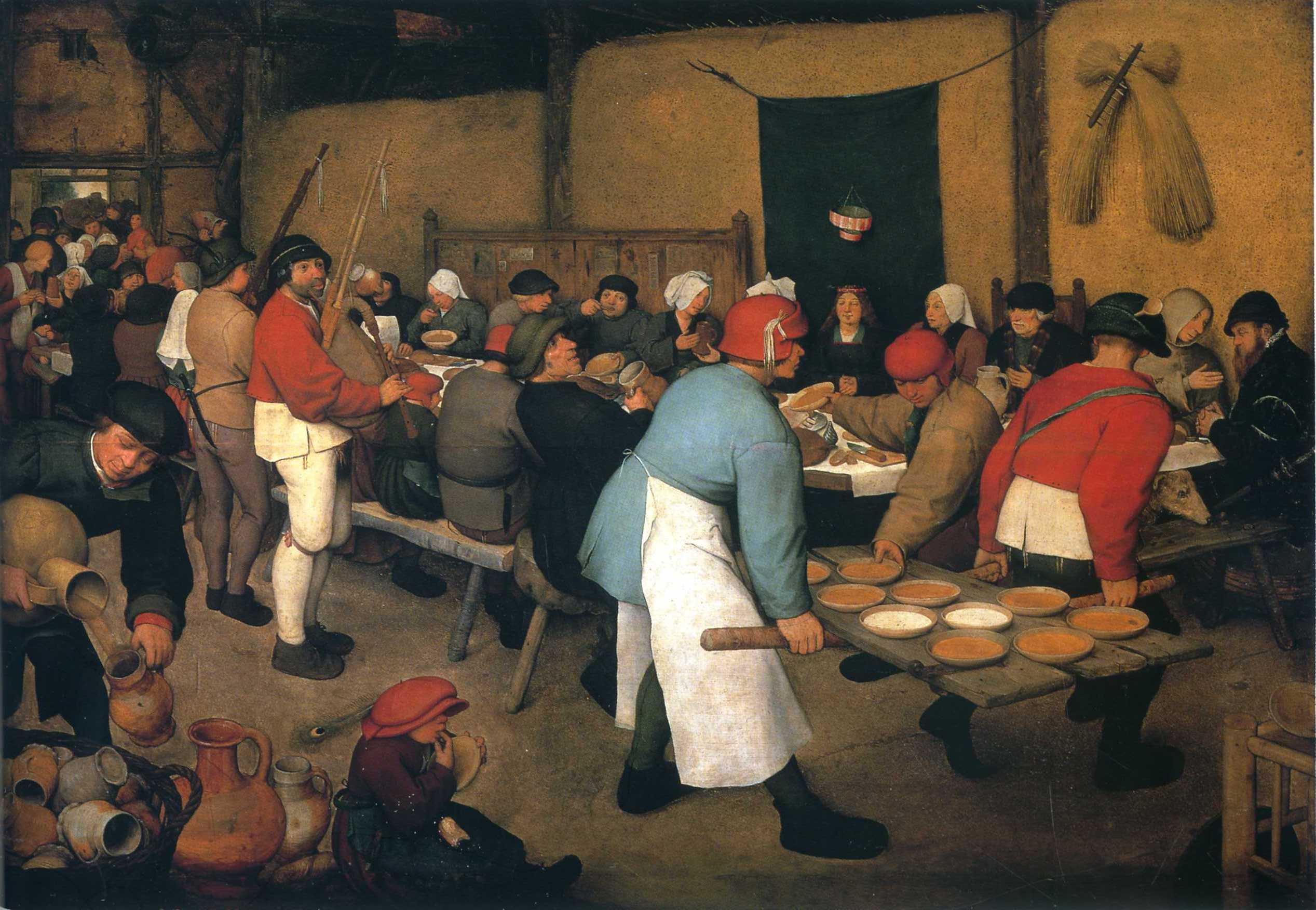
Peasant Wedding, 1568 - Pieter Bruegel the Elder
Peasant Wedding, 1568 - Pieter Bruegel the Elder 


What wonderful images of the kingdom of heaven the Scriptures give us.


On this mountain … In the book of the prophet Isaiah (25:6-9) we receive the gift of the vision of the ultimate banquet. There is a table spread before all peoples, as at the end of time. The people gather. God provides a rich abundance of food and drink. The food is rich; the wine is clear and well aged. What is more: the people are free of fear. God has vanquished the ruthless. God destroys death forever. No one need ever again live in fear. And all are welcome at the table of the Lord.


It is a picture of Paradise; it is a picture of the kingdom of heaven; it is a picture of the world in peace.


War will be no more; not simply because hostilities have ceased; this is not a mere truce.


It is a picture of peace that is more than the absence of evident conflict. It is a positive peace, a peace of justice and reconciliation.


There is no war and no fear and no hunger. God reigns and the people rejoice.


We know this prophecy from many funerals; we may also know it from weddings or baptisms or any kind of celebration of the resurrection. It is a vision of life in God, rightly lived, and brought to fulfillment.


The visions of peace and paradise, of God protecting, providing, and guiding, continue in the responsorial psalm. It is psalm 23: The Lord is my shepherd. The Lord is my king, my provider, my protector, my leader and my guide. The Lord is the host at the banquet table. He provides my needs.


God loves me. God gives me peace. The abundant mercy and grace of God overflow like wine from a cup, like cool water over the brim of a spring. His generosity and his goodness will pursue me forever.


That is the feast we are welcomed to. That is the feast we celebrate.


At the Lord’s Table we celebrate together the feast of Thanks Giving – the Eucharist.


It is the feast that everybody is called to. Not just us; everybody. All the people around us, on the highways of our county and the back streets of our towns, are welcome – they are invited – to come in and join us at the Table.


We open our doors.


But the gospel of Matthew (22:1-2, 11-12) gives us pause. It is not open season at the mini-bar. It is not you-can-eat-all night at the sushi place. You need to dress appropriately if you are going to attend the feast. Or better not to come. You need to be ready.


Jesus spoke to the people in parables, saying: “The kingdom of heaven may be compared to a king who gave a wedding banquet for his son. . . But when the king came in to see the guests, he noticed a man there who was not wearing a wedding robe, and he said to him, ‘Friend, how did you get in here without a wedding robe?’ And he was speechless.


So – how do we prepare for this feast? How do we dress for this banquet?


Put on Christ. Allow ourselves to be made over into the image of the living God, the loving God. As the Apostle Paul advised the Colossians (3:12-25):


Put on the garments that suit God’s chosen and beloved people. Clothe ourselves in:

• compassion,

• kindness,

• humility,

• gentleness,

• patience.


Above all, clothe ourselves with love, which binds everything together in perfect harmony.


JRL+

Saturday, January 28, 2023

On this mountain


Some years ago a group of New Testament scholars began to meet, to inventory, sift through, and assess all the words and deeds attributed to Jesus in the Scriptures, as well as the narrative material that tied it all together. 

They would gather twice a year around a conference table, confer, and at the end of a couple of days, reach some conclusions, and, incidentally, have a banquet.


First, they did a book reporting out the results of their findings of what Jesus really said, what sounded very much like he would’ve said it, what could be giving a sense of what he might’ve meant, and some stuff he probably just didn’t say at all. 


And then they published a second book similarly asking did he really do this? – and they came to some astonishing conclusions: 


“There are certain pieces of narrative information that probably reflect historical actuality and among them are the following: 


“Jesus was an itinerant teacher in Galilee. Jesus proclaimed the kingdom of God. Jesus cured some sick people. Jesus drove out what were thought to be demons. Jesus enjoyed a certain amount of popularity in Galilee and surrounding regions. 


These observations are almost certainly historical.”


“Historical? Outrageous! – that this is an actual person instead of a comforting myth, or more to the point, it was comforting if it were a myth, but if it’s true, historically true, then you have to take this person seriously.


What he did and what he said matters deeply, and Jesus can change your life. Jesus can change your life, personally, and as a church, and as a society and as a world. And you know what? He already has. And he is doing it now. We get to choose to follow him.


In the workings of that scholars’ group they expressed various levels of confidence in the authenticity of the words of the Bible as they have come down to us. Some words, some language, they were pretty sure came down to us direct, others carried the gist, some the general idea, and some - not so much. Among the words that sound a lot like Jesus, in which they had much confidence as conveying Jesus’ message, were these: 


3. Congratulations to the poor in spirit! 

Heaven’s domain belongs to them.

4. Congratulations to those who grieve!

They will be consoled.


6. Congratulations to those who hunger and thirst for justice!

They will have a feast.


I am reminded of the words of the prophet Isaiah (25:6-9), depicting the gathering at the end of time.


On this mountain the Lord of hosts will make for all peoples

   a feast of rich food, a feast of well-matured wines,

   of rich food filled with marrow, of well-matured wines strained clear.

And he will destroy on this mountain

   the shroud that is cast over all peoples,

   the sheet that is spread over all nations;

he will swallow up death for ever.

Then the Lord God will wipe away the tears from all faces,

   and the disgrace of his people he will take away from all the earth,

   for the Lord has spoken.

It will be said on that day,

   Lo, this is our God; we have waited for him, so that he might save us.

   This is the Lord for whom we have waited;

   let us be glad and rejoice in his salvation.


They will have a feast. Not because of what you might expect. What they experienced, what they felt, including grief and disconsolation, is a common human condition, part of life as we know it, alongside other happier feelings and experiences. These are not things we seek but they are things we know.


And somehow even that has a blessing in it. 


Some of the sayings that pretty much get the point across are these: 


10. Congratulations to those who have suffered persecution for the sake of justice! Heaven’s domain belongs to them.


11. Congratulations to you when they denounce you and persecute you and spread malicious gossip about you because of me. 12. Rejoice and be glad! Your compensation is great in heaven. Recall that this is how they persecuted the prophets who preceded you.


Congratulations?! Is this what it means to follow Jesus? Did we sign up to be prophets? Did we sign up for this burden? Or like grace, does it just come? Having taken on the good news and the joy of Jesus, have we also found in the packages under the Christmas tree something a little more formidable, the joy that is found in the midst of suffering for the sake of the gospel? 


As we follow Jesus, we are under the wings of the Holy. These things will come. But with them will come the kingdom of God. And this is a promise.


Not long ago I saw a play about a small group of people in an isolated community who shared a common, if strictly limited faith, and therefore a common, if strictly limited, attitude toward life.


Into their community comes a free spirit, a refugee from another life, someone who brings a different sense of the joy of life and of the possibilities of life to them despite her own long-standing grief …


The name of the  story is “Babette’s Feast", and as a result of the sumptuous Feast that Babette prepares for the people of the small community, they begin to embrace Joy and Grace a little more warmly than they have before. 


As they gather and share the meal they talk and reconcile; old grudges drop away as love emerges. 


They begin to embrace joy, and grace, a little more warmly than they have before – in fact, a lot more warmly, so that it is as if for an hour, they’ve had a glimpse of heaven. 


   a feast of rich food, a feast of well-matured wines,

   of rich food filled with marrow, of well-matured wines strained clear.


In the midst of this story, which I watched as a play recently, I recalled the reflection “church is church,“ as I was watching the members of the close little community bicker with each other, and then at the end, when they embraced each other, and reached a moment of grace together, I said to myself again “church is church”.  


That is, both the good and the bad, the happiness and the bickering, and the possibility of the release of mercy based on God‘s own infinite mercy— are church.


Actually, that’s the explicit point made by one of the characters: we are surrounded by God’s infinite mercy. Let’s open our hearts to it. The feast helped.


The phrase “church is church“ I heard in a group of ministers in a class in about 2010 where a black church musician and pastor name Royce Shorter was listening to people from very different faith backgrounds to his own talk about what was going on in their congregations and how they were feeling about it and he said somewhat to his surprise “church is church.” 


We all have these experiences, as pastors, as church members, as people of God.


We have a lot of the same ways of being with each other, the ways we behave, in the way we treat each other and feel about each other, in the congregation, regardless of denomination. In fact, I remember “Church is Church” when I have spoken with Sufi leaders and Sikh leaders, as well as Christians of my own and other denominations.


Church is church, and we embrace the grace as well as the grit of life together. 


Living into the kingdom - a phrase you may have heard - means living as if Jesus is real, as if what he said is true, and compelling, and may re-order the whole of life. In fact, that is what we want to happen. And that is why we are here today.


We Arizona clergy just had our annual retreat - mostly about “how are you guys coping with pandemic stress?” - and the congregations I'm involved in, here and in Tucson, are having annual meetings this weekend. Some can say 'steady as she goes' while others need to have real come-to-Jesus conversations. There are substantial issues to discuss. It’s worth sticking around.


And while we are doing that we can keep in mind last week’s closing question: What does it mean to follow Jesus? We got some answers in the Gospel this morning, and in the reading from the prophet Micah. Indeed, one Tucson congregation has adopted as its slogan for today “Do justice, love mercy, and walk humbly with our God.”


What will that mean for us going forward? This congregation, this church, each of us? Let’s pray about it, let’s talk about it, let’s let the Spirit lead us. Keep the faith. In joy.


Robert S. Jones: Exodus, Moses, Law. Requirements.  ||  Mt5  Beatitudes, New Law: Blessings. 


Steve Springer: Hymn 560. The Hymnal 1982. New York: Church Publishing. 


Robert W. Funk and the Jesus Seminar. The Acts of Jesus: The Search for the Authentic Deeds of Jesus. A Polebridge Press Book. New York: HarperCollins.1998.170.


Robert W. Funk, Roy W. Hoover, and the Jesus Seminar. The Five Gospels: The Search for the Authentic Words of Jesus. A Polebridge Press Book. New York: Macmillan. 1993. 138-139.


http://www.lectionarypage.net/YearA_RCL/Epiphany/AEpi4_RCL.html


http://edgeofenclosure.org/epiphany4a.html


“Blessed are” (Joan Baez) https://www.youtube.com/watch?v=etLe3UcptCk


Amy-Jill Levine, a Jewish scholar of the New Testament, names ways Jesus’ life and actions echoed those of prophets familiar to her from her religious upbringing:
Jesus fusses at priests, just like Amos. Jesus tells parables, just like the prophet Nathan and a number of rabbis whose stories appear in postbiblical Jewish sources. Jesus heals and raises the dead; so too Elijah and Elisha. Jesus survives when children around him are slaughtered, just like Moses. I didn’t have to read Matthew 2–7 to know that the rescued baby would take a trip to Egypt, cross water in a life-changing experience, face temptation in the wilderness, ascend a mountain, and deliver comments on the Law—the pattern was already established in Shemot, the book of Exodus.
In spite of many similarities between Jesus and the Jewish prophets, Levine stresses that the Gospel writers view Jesus as more than a prophet:
Although Jesus himself may be perceived as heir to the legacy of Amos and Jeremiah, the Gospels present him as more than a prophet. He is, according to the Evangelists, the Son of God, who adds something new to the prophetic concern for justice. He goes well beyond the role of Isaiah and Micah, who seek what is called in Hebrew t’shuvah, return and repentance. Jesus of the Gospels seeks something new, specifically, following him. He is important not only because of what he says, but also because of who he is.
References:
Amy-Jill Levine, The Misunderstood Jew: The Church and the Scandal of the Jewish Jesus (New York: HarperCollins, 2006), 3, 110. https://cac.org/daily.../jesus-prophetic-lineage-2023-01-27/


Sunday, April 4, 2021

Easter Day

Christ with Us


The Love of Christ

Surround us

The Light of Christ 

Lead us

The Peace of Christ

Fill us

The Power of Christ

Aid us

The Joy of Christ

Thrill us

The Presence of Christ

Be with us evermore.


David Adam, Tides and Seasons, SPCK, 1989, 76.


https://www.lectionarypage.net/YearB_RCL/Easter/BEasterPrin_RCL.html

Saturday, January 19, 2013

wedding/gifts

 
Ever been to a wedding? One where the gifts piled up? Years ago Jackie and Glenn got married; and there was a table in the reception hall just piled with wedding gifts. I wonder if that was what it was like for Jesus and the disciples, as they came into the celebration of the wedding at Cana.

They’d traveled a long road up from the Jordan valley, where John was baptizing, and John had baptized them – all of them, including Jesus. Then John pointed out Jesus to some of his disciples, who were standing around, and said, “Behold the Lamb of God who takes away the sin of the world.” So naturally some of them went over to talk to him. And they stayed with him.

And then he said, “Follow me.” And off they went. When they got back home to Galilee, where some of them, including Jesus, were from, they found themselves invited to a wedding as guests.

What do you bring? Do you have a year if you forgot?

There they were – and the wine ran out.

In a desert town far from here there was a woman who was a legendary hostess. She had, as David Steele puts it, “the gift of throwing parties that combine food, decorations, music, and laughter to create an atmosphere of welcome, well-being, and love.” She had three daughters, and they learned this grace from her.

What is happening at the wedding party is that Jesus and his disciples are learning that grace too: from his mother. For there they were: at the beginning of his public ministry, she points out an immediate need – an opportunity, an invitation.

Jesus doesn’t say, “I don’t know how,” or “that’s not my job.” He does say, “Is that our concern? I’m not ready yet.”

He is not ready to be revealed for who he really is – not fully, not yet. But fullness is what is needed here. Abundance has an opening here. And his mother points it out to him.

She trusts him: “Do whatever he tells you,” she says.

Jesus begins to show he knows what it means to throw a party. Indeed, he shows what it means to bring new life, new laughter, new hope, new joy, when it seems like the party is over. “They have no wine.”

Over? The party is just beginning!

He takes what is there: six empty ritual jars, sitting there unused and ineffectual. “Fill them.”

What is drawn out of those once-empty stone jars is abundance, fullness, richness – a cup of blessing is brought to the chief steward. He knows what he tastes – it’s the good wine, at last.

All Israel has been waiting for this wine – for centuries.

This is where the party really starts to take off.

Each of us may find ourselves at a party with no wine, just some empty old stone jars left over from a ritual of the past that no longer works.

But into our lives if we welcome him comes the life of the party – the new life that fulfills life, beyond our hopes and dreams.

And each of us is called to bring something to the party (something we are given in the first place) – some steps in the dance, some gifts for the table, some action or word or service, that is our unique offering to the whole. Together we form, with what each of us is given to bring, a community of joy, love, life, and laughter.

All from the same source, those gifts come: and we find ourselves giving and appreciating gifts – and seeing them in each other – differently as we grow through life.

This is the community of Christ. This is the place where the fun really begins. Here life, love, and laughter take their place; here sorrows, doubts, shame, and darkness are banished at last.

“I am not yet ready,” Jesus says. He knew at that wedding-feast that the hour had not yet come, the hour when he would be glorified. For the hour of his glory would be the hour of the cross. There he would be fully revealed – for who he is. The splendor of his radiance, the glory of God, would shine through him. At that darkest of hours, God’s grace would be poured out for all.

Like the cup of salvation in the Psalms, the cup of wine at the Lord’s Supper, the cup of blessing that the Lord our Shepherd fills to overflowing. This wedding feast is the first celebration of the kingdom coming into our world.  A meal with Jesus at the head of the table is a foretaste of the heavenly banquet Isaiah prophesied, where everyone drinks their fill of aged wines strained clear.


(Isaiah 25:6–9)
On this mountain the Lord of hosts will make for all peoples
   a feast of rich food, a feast of well-matured wines,
   of rich food filled with marrow, of well-matured wines strained clear.

And he will destroy on this mountain
   the shroud that is cast over all peoples,
   the sheet that is spread over all nations;
he will swallow up death for ever.
Then the Lord God will wipe away the tears from all faces,
   and the disgrace of his people he will take away from all the earth,
   for the Lord has spoken.
It will be said on that day,
   Lo, this is our God; we have waited for him, so that he might save us.
   This is the Lord for whom we have waited;
   let us be glad and rejoice in his salvation.

The hour? Not yet: the best is yet to come.

In the meantime we raise a cup, a common cup of blessing, knowing his life, poured out for us, is the source of our life and our joy.

Sunday, April 8, 2012

He has been raised - and we with him

He was crucified under Pontius Pilate. The most scrupulous of scholars will affirm that as historical fact. But --

We would know nothing of Jesus if he had not been raised from the dead. As it is nothing can stay the same; for we do know of him – and we know him. Because he has been raised from the dead, our faith is alive.

Our faith is in a living Lord – and that makes all the difference. He is alive – and so he is not just a historical figure – to be studied as just another man. He is alive and is alive in us. He is not a mere memory – someone to talk about from the days of a distant past. He is a presence. His influence is all around us and on us and in us.

Jesus is not so much someone to talk about – as someone to meet, not so much someone to know about – as someone to know, and not so much to know – as to be known by.

We may begin by learning about him, studying him, discussing his impact on us, but we wake up to his living presence at last; we know him and trust him. 

(The above draws on William Barclay, The Gospel of Mark. Revised Edition. The Daily Study Bible Series. Edinburgh: The Saint Andrew Press, 1956. 368-369.)

From this point on our lives do not stand still – they move. For our faith is in a living Lord – always moving, changing, revealing new wonders for us to discover, new delights for us to enjoy and share with him. We take joy in his presence in others; we delight in the creation he unfolds; we pause in wonder at the depths of his love.

Truth deepens within us – and so we too are ever changing, growing, developing, and maturing in faith, as we walk with him on the path to Jerusalem and beyond.

Where will we go from here? What happens to us – but to grow in faith? Even as we age physically, we can be growing spiritually. We find ourselves on an upward path, toward his glory, toward knowing him at last in fullness— being known ourselves.

What little we know of the resurrected life of the individual we shall learn in the gospel lessons of the next few weeks – the season of Easter. What we know of the resurrected life of the community – of the Body of Christ that is the Church – we shall study from the Day of Pentecost all the way through to the feast of All Saints. It is a long green growing season in which we see the resurrection of our Lord and its implications for life played out in the life of the believers, our lives.

From our baptism we begin on the journey of faith, the journey into freedom. It is a long journey, a pilgrimage: to become perfected in our faith, to be sustained in the Spirit, and to grow into the fullness of the stature of Christ.

Today we welcome a new person into the journey, together with us – a new pilgrim into our company of travelers – as we together walk the way of Jesus – and as we welcome the newly baptized so we deepen and reinforce our own commitment as followers of the cross, as heirs of hope, as witnesses of the resurrection.

Today we baptize a new member of the household of faith. We take a vow on her behalf. Her parents and godparents undertake to raise her in the faith; the congregation undertakes to support them in this effort – and to see her grow in Christ. This is our job. This is part of the work of a Christian community: to see its new members grow in faith and grow into the fullness of the stature of Christ.

During the sacrament of Holy Baptism,
The Celebrant asks the parents and godparents:
Will you be responsible for seeing that the child you present
is brought up in the Christian faith and life?
And each of the Parents and Godparents responds:
I will, with God's help.
And the Celebrant asks:
Will you by your prayers and witness help this child to grow
into the full stature of Christ?
And the Parents and Godparents each respond:
I will, with God's help.
But then the Celebrant addresses the congregation, saying:

Will you who witness these vows do all in your
power to support these persons in their life in Christ?

And the People say      We will.

It is that third vow I want to talk to you about today. What it means for the newly baptized, for her parents and godparents, for you – and for the community around you. We are each of us - and all of us - called into a ministry of support for baptized persons in their life in Christ.

As a people of God, as a welcoming, Christ-centered community of faithful believers, we are called to embody and fulfill our own baptismal promises. These are the promises of the Baptismal Covenant, which we will reaffirm in just a few minutes. We are called – as God’s people – to become the good news for the people in our community.

We are the ones who will act as super-godparents of the faithful – not just this child and her sisters but all persons who come to us seeking the life of faith, the good news of Christ.

“We will!” the people say. We say it with all the good will in the world, but what will it mean? In coming days after the liturgy what difference will it have made to say this?

“We will” comes as the ‘third vow’ in the rite of baptism, as it does in the rites of marriage and ordination. It comes after the candidates, or the parents and godparents speaking on their behalf, have said, “I will.”

It is the undertaking of the congregation – to uphold and support these people in their pledge.

What will it mean after the service –?

There is no indication in the Book of Common Prayer that this third vow is to be taken any less seriously, or carried out with less of a will, than the vows that precede it in the rite.

At baptisms we are used to parents, godparents, sponsors, witnesses and/or presenters to take a role. This is not a private, family ceremony, but a service of the church and public. It is not simply giving something special away – it requires responsible incorporation of new members into the community of faith.

Grace is what we want to impart – not cheaply nor wantonly entered into but advisedly and soberly, with a reasonable intention to guide us. The minister, the priest, must have, indeed, a ‘founded hope’ (in the felicitous Roman phrase) that the child shall be raised in the faith. This hope must be founded on vows not only individual but congregational.

Will you who witness these vows do all in your power to support these persons in their new life in Christ?

We ask those who are to be baptized to come forward. We call them out of the congregation, saying, Come forward. You sponsors come along too; and we will pray for you, and we will work with you, and walk with you, in the newness of life you now seek.

The congregation, represented by the sponsors, continues to monitor the progress in faith and newness of life, offering material and moral support and guidance as needed.

This rite of baptism has a meaning for the whole congregation, as the people of God in whose context and presence these sacramental rites take on living form, incarnating the grace of God in the middle of them, and bringing home to the congregation as well their role in the ongoing support of the newly baptized, as they continue to pursue and enact the vocation these vows represent.

This ritual provides an opportunity for the church to take responsibility for its growth and development as a welcoming, Christ-centered community, and to take pride in faith and fellowship, moving forward into a hopeful future, a future where the members of the church embody and enact the reign of a just and loving God in their relationships with each other and in their service to the community and the world, individually and together.

How then can these ‘third vows’ be made sufficiently explicit (and lavish) to engender a sense of meaning and responsibility in we who take them?

Conversion – the continuing turning, turning home which is the Christian life – means taking responsibility for an area of one’s own growth and development. This day’s work, this baptism, can yield new insight into the meaning of the baptismal covenant, not only for the person being baptized today but also indeed for the whole people here assembled.

This is the hidden opportunity of the ‘third vow’. There are plenty of charming examples of a celebrant chiding the people, ‘say it again, this time with feeling’, but beyond emotion and stage theatrics, what lasting change can be effected by taking this vow?

And what help and support and affirmation might the newly baptized expect to receive after the service is over?

The idea of sponsors or witnesses to baptism allows for some willing individuals to represent and model for the congregation the affirmation that all make together and the support that all undertake before God in solemn assembly to carry out.

The people of God have work to do, in praise and prayer and service, which we affirm and renew in this sacramental liturgy? Let’s put some ‘oomph’ into ‘we will’ – and vim into our vows, and power into our prayers. 

Will you pray for this child and her parents?

Will you make her - and all children - welcome in church?

Will you get to know the family and walk with them through good times and challenging times?

Will you participate in the education of this child - and all children - as Christians?


Will you who witness these vows do all in your
power to support these persons in their life in Christ?

And the People say      We will.

Amen.


Easter Day * April 8, 2012


JRL+

This sermon owes a lot to the Rev. Dr. Susan Marie Smith, who taught a course on worship at the San Francisco Theological Seminary in 2011. Some of the ideas come from a paper that I wrote for her class.