This summer the church of St Raphael in the Valley, Benson, Arizona, using the Revised Common Lectionary, is following the semi-continuous track 1 for the first reading, beginning in Genesis...
In the story last week, we heard of Abraham and Sarah leaving their family to follow the promise of God into a new land. There God would make them a blessing to many nations.
Now we are getting deeper into the cycle of readings about Abraham and his family, which begins in the 12th chapter of Genesis and continues through until the 36th chapter. Last week began that cycle as soon-to-be long-suffering Abram and Sarai left the place their family had begun to settle and ventured south into the promised land. Only to find that it was a temporary respite.
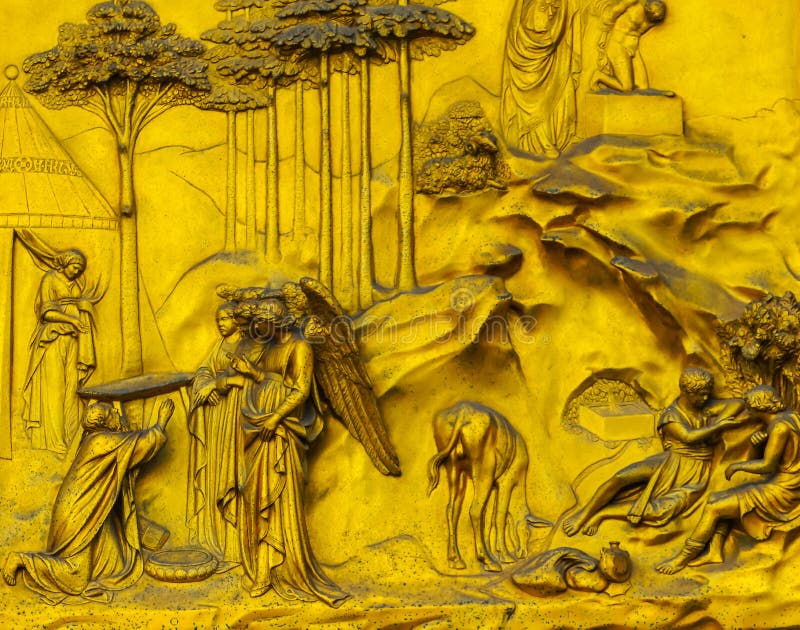
In today’s first lesson, they share that respite with others. They extend classic Middle-Eastern hospitality to strangers, offering water and rest and food to three travelers. Sarah and Abraham are tent-dwellers, with their herds and flocks and servants around them, and they are resting under the trees and the tent-flap on a hot day.
[This reminded me of the journey of the Odyssey, where a long-suffering hero travels through many countries before he could reach his own. Like Abraham and Sarah, on the way he encountered divine messengers.]
We can imagine who these three travelers are, who turn up at the Oaks of Mare. What comes of it, along with the hospitality, is a promise. “I’ll come back this way next year and Sarah will have a son.” A pleasant prophecy but unlikely to be fulfilled - unless God is speaking.
And so there is a promise given. It will be renewed and repeated, to Abraham and then his son and then his grandson. Abraham and Sarah are already traveling, venturing, on the basis of earlier promises. Go to the land that I will show you. I will make you a great nation. But how are you to become - here it is! the Fathers’ Day reference - father of many nations? Abraham and Sarah are old, they have journeyed far already; they are in the midst of – what proves to be – a very long wandering navigation of the Fertile Crescent, from Iraq to Syria through Palestine, down to Egypt and then back north again to Palestine where they settle down at last.
And yet they are following a promise that will be fulfilled: for a child will be born to them, as subsequent events bear out.
There is a promise - and there is more: for faith, hope, and love abide, these three, but the greatest of these is love.
We see faith at work in the relentless courageous obedience and trust of Sarah and Abraham as they venture forth from home ground, seeking beyond the familiar what is only familiar to them as they are God’s people.
We see hope at work. Hope that persists beyond toil and travel and despair, injury, bad weather, woeful barrenness and impossible pregnancy, there will be a child, and children. There will be a place for them at last, in the promised land. War will not prevent them, nor drought, nor incapacity. They will make it there. They will find it home.
We see love at work. Love between husband and wife. Love, compassion, caring for the strangers. Love, in the expectation of a child. Love, in seeing a future with hope. Love, in the strangers’ promise. And love, in its fulfillment.
This is part of the ongoing story of Abraham and Sarah, and their family. Of love, hope, and faith. And through faith, hope, and love, it is our story too.
We seek a future with hope. We come to expect the fulfillment of the promise. The promise that is behind and beyond all these other promises.
Beyond despair or deprivation or strife, animosity or the cessation of good will, there will be and is, a greater good, a greater peace. And we are called to proclaim it, and to live into it. The peace of God, the love of God, hope in God, faith in God.
You will see from the day’s prayers, and from the gospel, that we can have that expectation, that is more than a dream, a hope and faith and love that will bring God’s love into the world, in the children of Abraham that are all those who share his faith. And that promised land will begin right here, as we, children of the promise, of faith and hope and love, seek and make a new community and a new home with all those who respond to the call.
###
As he sent them out for the first time, Jesus commanded his disciples: “As you go, proclaim the good news, ‘The kingdom of heaven has come near.’”
That is the message. The one who sent Abraham and Sarah on their journey is the one who is sending the disciples on theirs – a mission that belongs to all his followers, from then on. It is ours as well as theirs.
Abraham and Sarah were told that they would be a blessing to many nations. Those nations are us. And the message that in those nations would be established the kingdom of peace. The reign of God is what encompasses and embraces all who seek the peace of God.
Jesus sends out those first disciples on an early mission. They go before him into the villages of Israel, with a message and a ministry. We too proclaim the kingdom in both deed and word. This congregation, I am told, has many ministries to those around us, strangers and residents, as they are in need.
This congregation has a ministry to those around us as we welcome them into our celebrations. In these ministries we proclaim the good news, we live the good news, we celebrate the good news. The ministries make manifest the reign of God. We show that the kingdom of heaven has come near.
Those early disciples, messengers of the reign of God, were so urgent on their mission that they traveled light. Lucky for them that ancient Mideastern tradition of hospitality had not worn off.
As they entered villages where they might find a welcome, and be able to rest and even, we can imagine, receive water and food. They might find a welcome for their message. Not everywhere, nor with everyone. Where they did not, they could move on.
Where they did receive a welcome, there was much to talk about with those who received the message: How do we live out the good news? How do we live as citizens of the kingdom of heaven? What does the reign of God look like? How does it begin to show? How do we live into it?
We receive, and we give. May God’s love go with you today and always. May you carry with you Jesus’ message of peace, and the promise of Abraham and Sarah. May faith, hope, and love abide with you, and go with you.
For the kingdom of heaven is near. Right on top of you. Proclaim it with joy.
JRL+
June 14th 2026 : 3rd Sunday after Pentecost. San Rafael, Benson.
The Lessons Appointed for Use on the Sunday Closest to June 15
Proper 6, Year A, RCL, Track 1
Genesis 18:1-15, (21:1-7)
Psalm 116:1, 10-17
Romans 5:1-8
Matthew 9:35-10:8(9-23)
The Collect (Episcopal)
Keep, O Lord, your household the Church in your steadfast faith and love, that through your grace we may proclaim your truth with boldness, and minister your justice with compassion; for the sake of our Savior Jesus Christ, who lives and reigns with you and the Holy Spirit, one God, now and for ever. Amen.
Prayer of the Day (Lutheran)
God of compassion, you have opened the way for us and brought us to yourself. Pour your love into our hearts, that, overflowing with joy, we may freely share the blessings of your realm and faithfully proclaim the good news of your Son, Jesus Christ, our Savior and Lord.
Amen.
***
From the Lectionary Page (https://www.lectionarypage.net/):
"What are “Track 1” and “Track 2”?
During the long green season after Pentecost, there are two tracks (or strands) each week for Old Testament readings. Within each track, there is a Psalm chosen to accompany the particular lesson. The Revised Common Lectionary allows us to make use of either of these tracks, but once a track has been selected, it should be followed through to the end of the Pentecost season, rather than jumping back and forth between the two strands. The first track of Old Testament readings (“Track 1”) follows major stories and themes, read mostly continuously from week to week. In Year A we begin with Genesis, in Year B we hear some of the great monarchy narratives, and in Year C we read from the later prophets.