Showing posts with label AProper23. Show all posts

Sunday, October 15, 2023

The ultimate feast

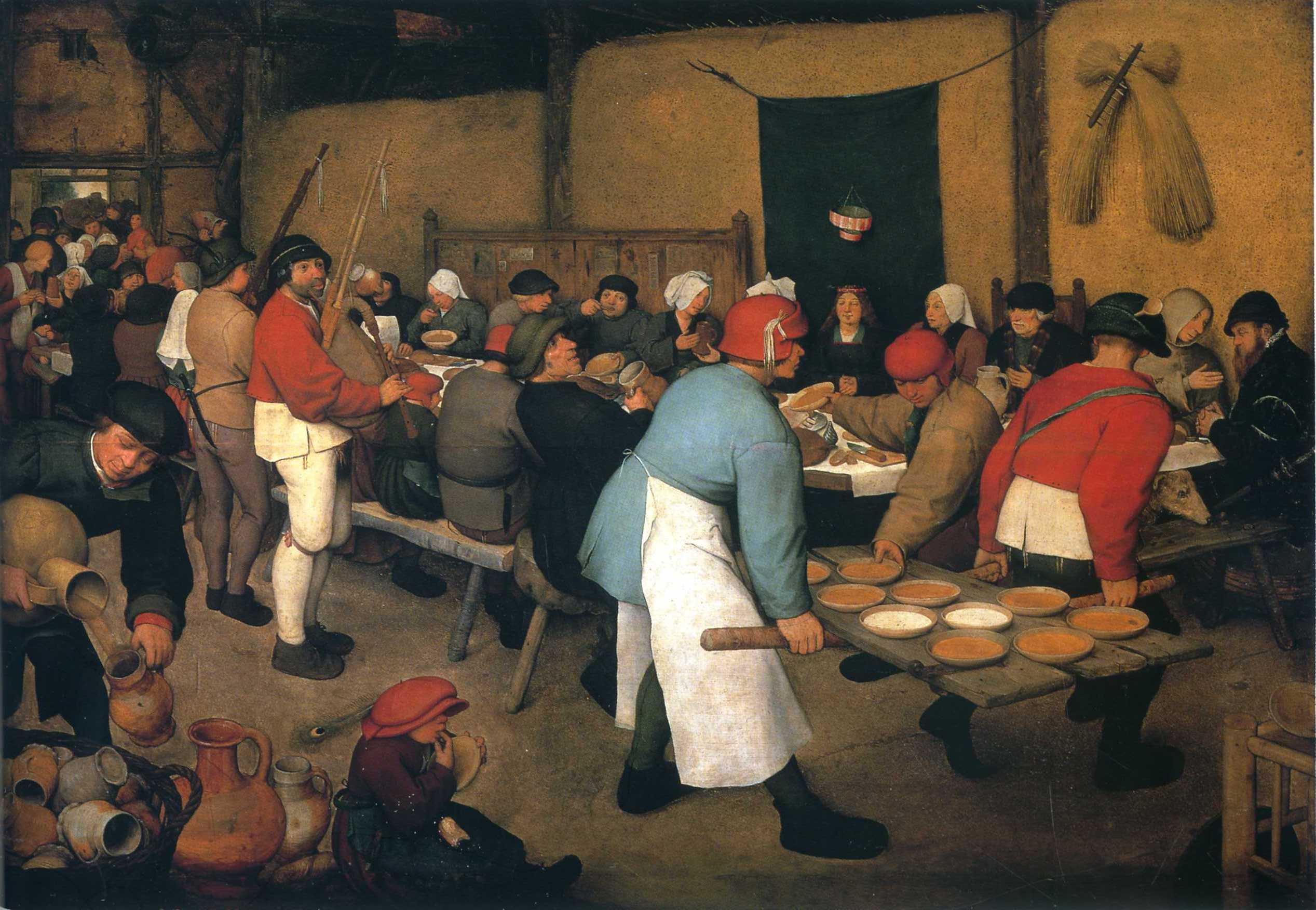
Peasant Wedding, 1568 - Pieter Bruegel the Elder
Peasant Wedding, 1568 - Pieter Bruegel the Elder 


What wonderful images of the kingdom of heaven the Scriptures give us.


On this mountain … In the book of the prophet Isaiah (25:6-9) we receive the gift of the vision of the ultimate banquet. There is a table spread before all peoples, as at the end of time. The people gather. God provides a rich abundance of food and drink. The food is rich; the wine is clear and well aged. What is more: the people are free of fear. God has vanquished the ruthless. God destroys death forever. No one need ever again live in fear. And all are welcome at the table of the Lord.


It is a picture of Paradise; it is a picture of the kingdom of heaven; it is a picture of the world in peace.


War will be no more; not simply because hostilities have ceased; this is not a mere truce.


It is a picture of peace that is more than the absence of evident conflict. It is a positive peace, a peace of justice and reconciliation.


There is no war and no fear and no hunger. God reigns and the people rejoice.


We know this prophecy from many funerals; we may also know it from weddings or baptisms or any kind of celebration of the resurrection. It is a vision of life in God, rightly lived, and brought to fulfillment.


The visions of peace and paradise, of God protecting, providing, and guiding, continue in the responsorial psalm. It is psalm 23: The Lord is my shepherd. The Lord is my king, my provider, my protector, my leader and my guide. The Lord is the host at the banquet table. He provides my needs.


God loves me. God gives me peace. The abundant mercy and grace of God overflow like wine from a cup, like cool water over the brim of a spring. His generosity and his goodness will pursue me forever.


That is the feast we are welcomed to. That is the feast we celebrate.


At the Lord’s Table we celebrate together the feast of Thanks Giving – the Eucharist.


It is the feast that everybody is called to. Not just us; everybody. All the people around us, on the highways of our county and the back streets of our towns, are welcome – they are invited – to come in and join us at the Table.


We open our doors.


But the gospel of Matthew (22:1-2, 11-12) gives us pause. It is not open season at the mini-bar. It is not you-can-eat-all night at the sushi place. You need to dress appropriately if you are going to attend the feast. Or better not to come. You need to be ready.


Jesus spoke to the people in parables, saying: “The kingdom of heaven may be compared to a king who gave a wedding banquet for his son. . . But when the king came in to see the guests, he noticed a man there who was not wearing a wedding robe, and he said to him, ‘Friend, how did you get in here without a wedding robe?’ And he was speechless.


So – how do we prepare for this feast? How do we dress for this banquet?


Put on Christ. Allow ourselves to be made over into the image of the living God, the loving God. As the Apostle Paul advised the Colossians (3:12-25):


Put on the garments that suit God’s chosen and beloved people. Clothe ourselves in:

• compassion,

• kindness,

• humility,

• gentleness,

• patience.


Above all, clothe ourselves with love, which binds everything together in perfect harmony.


JRL+

Friday, October 13, 2017

The Shepherd


(Sheep on Iona)

In his commentary on the Book of Common Prayer (USA, 1928) Dr. Shepherd includes his remarks on the 23rd Psalm, possibly the most beloved and best-known in the Psalter:


Psalm xxiii. This Psalm is appointed in all the recent Prayer Books, and its selection needs no explanation. It is one of the first devotions every child of a Christian family learns by heart. It teaches us, by way of two simple but unforgettable pictures of the Shepherd (vs. 1-4) and of the Host (vs. 5-6), God's loving care and providence for each of His own creatures.

The figure of God as a Shepherd is very common in the Psalms and the Prophets (cf. Isaiah xl.11, xlix.9-11, Micah vii.14), and our Lord applied it to Himself (John x.1.ff.; cf. Heb. xiii.20, 1 Pet. ii.25, v.4).

The shepherd's devoted nurture and protection of his flock is a parable of God's guidance of us into 'green pastures' of spiritual nourishment and refreshment and of His safe deliverance of us from 'dark valleys' of danger and temptation. Each single lamb or sheep is as much beloved by the shepherd as his whole flock, and no exertion of the shepherd is spared in order to save and rescue one that is lost (cf. Matt. xviii.12-14; Luke xv.3-7).

Similarly in the figure of the Host, God's provident and protective care is pictured both materially, in His supply of more than we need, and spiritually, in the continual joy of His worship and service.

Massey Hamilton Shepherd, Jr., The Oxford American Prayer Book Commentary, Oxford, 1950, section on the rite "Burial of a Child" p. 338-339 of the Book of Common Prayer.

Psalm 23 Dominus regit me (Coverdale/1662 version)

The LORD is my shepherd; *
therefore can I lack nothing.
He shall feed me in a green pasture, *
and lead me forth beside the waters of comfort.
He shall convert my soul, *
and bring me forth in the paths of righteousness for his
Name's sake.
Yea, though I walk through the valley of the shadow of death,
I will fear no evil; *
for thou art with me;
thy rod and thy staff comfort me.
Thou shalt prepare a table before me in the presence of them
that trouble me; *
thou hast anointed my head with oil,
and my cup shall be full.
Surely thy loving-kindness and mercy shall follow me all the
days of my life; *
and I will dwell in the house of the LORD for ever.

Psalm 23 King James Version

The LORD is my shepherd; *
I shall not want.
He maketh me to lie down in green pastures; *
he leadeth me beside the still waters.
He restoreth my soul; *
he leadeth me in the paths of righteousness for his
Name's sake.
Yea, though I walk through the valley of the shadow of death,
I will fear no evil; *
for thou art with me;
thy rod and thy staff, they comfort me.
Thou preparest a table before me in the presence of
mine enemies; *
thou anointest my head with oil;
my cup runneth over.
Surely goodness and mercy shall follow me all the days
of my life, *
and I will dwell in the house of the LORD for ever.

In the Church's worship these last two verses have been mystically interpreted as referring to the heavenly banquet of the Messiah in His eternal Kingdom, of which the Eucharist is the earnest (cf. Luke xxii.24-30).

Op. cit., 339.


It seems especially poignant to me that this Psalm should have been specified, and commented upon, in the context of the Burial of a Child. It is also in the ordination rite of a bishop...


In the context of the Burial of a Child we are reminded that we are child, too, each of us, and ultimately in the care of the Good Shepherd who will see us safely home. That is reassurance.
In the meantime we are guided, and sometimes chastised, (thy rod comforteth me?) by that Good Shepherd. 


In times of trouble or danger, this, and the Lord's Prayer, and possibly the prayers of the rosary, if you are catholic, and possibly one or two passages of Saint Paul, come to mind - and breath. If you were going to memorize anything you would, and possibly did, begin with this psalm and Our Father...


Our Father, who art in heaven,
    hallowed be thy Name,
    thy kingdom come,
    thy will be done,
        on earth as it is in heaven.
Give us this day our daily bread.

And forgive us our trespasses,
    as we forgive those who trespass against us.
And lead us not into temptation,
    but deliver us from evil.
For thine is the kingdom, and the power, and the glory,
    for ever and ever. Amen
.


When a visitor came to the church a couple of hours early, just to have a look around inside a building he had often passed by, he came to the lectern and saw the psalm appointed for that morning was the 23rd. He said, he had learned it at the age of four and could recite it from the heart - and did.

If we were to carry around 'mass cards' with the picture of the church or of its patron saint Paul with us, we would probably want this prayer - and this psalm, until and whenever we needed their comfort and their sturdy encouragement.

The two passages from the letters of the Apostle Paul that come to mind are these:

Philippians 2:4-11

Let the same mind be in you that was in Christ Jesus,
who, though he was in the form of God,
   did not regard equality with God
   as something to be exploited,
but emptied himself,
   taking the form of a slave,
   being born in human likeness.
And being found in human form,
   he humbled himself
   and became obedient to the point of death—
   even death on a cross.

Therefore God also highly exalted him
   and gave him the name
   that is above every name,
so that at the name of Jesus
   every knee should bend,
   in heaven and on earth and under the earth,
and every tongue should confess
   that Jesus Christ is Lord,
   to the glory of God the Father.


Romans 8:31-39

What then are we to say about these things? If God is for us, who is against us? He who did not withhold his own Son, but gave him up for all of us, will he not with him also give us everything else? Who will bring any charge against God’s elect? It is God who justifies. Who is to condemn? It is Christ Jesus, who died, yes, who was raised, who is at the right hand of God, who indeed intercedes for us. Who will separate us from the love of Christ? Will hardship, or distress, or persecution, or famine, or nakedness, or peril, or sword? As it is written,
     ‘For your sake we are being killed all day long;
        we are accounted as sheep to be slaughtered.’
No, in all these things we are more than conquerors through him who loved us. For I am convinced that neither death, nor life, nor angels, nor rulers, nor things present, nor things to come, nor powers, nor height, nor depth, nor anything else in all creation, will be able to separate us from the love of God in Christ Jesus our Lord.
 

AProper23 
Pentecost XIX 2017 October 15th. St. Paul's, Tombstone. JRL+  

(Sheepfold on Iona)

Sheepfold on Iona, photograph by Allen Morris, 2014. 
https://stjohnswoodblog.files.wordpress.com/2014/05/sheepfold-iona.jpg?w=416&h=619 
accessed October 13, 2017.

Sheep on Iona. http://www.fotothing.com/photos/839/839b4d83e529f715196a969c1a8eb320_ee2.jpg accessed October 13, 2017.

Sunday, October 9, 2011

To the Table Everyone!

What wonderful images of the kingdom of heaven the Scriptures give us today.

In the book of the prophet Isaiah we receive the gift of the vision of the ultimate banquet. There is a table spread before all peoples, as at the end of time. The people gather. God provides a rich abundance of food and drink.

The food is rich; the wine is clear and well aged.

What is more: the people are free of fear. God has vanquished the ruthless. God destroys death forever. No one need ever again live in fear.

And all are welcome at the table of the Lord.

It is a picture of Paradise; it is a picture of the kingdom of heaven; it is a picture of the world in peace.

War will be no more; not simply because hostilities have ceased; this is not a mere truce.

It is a picture of peace that is more than the absence of evident conflict. It is a positive peace, a peace of justice and reconciliation.

There is no war and no fear and no hunger. God reigns and the people rejoice.

We know this prophecy from many funerals; we may also know it from weddings or baptisms or any kind of celebration of the resurrection. It is a vision of life in God, rightly lived, and brought to fulfillment.

The visions of peace and paradise, of God protecting, providing, and guiding, continue in the responsorial psalm. It is psalm 23: The Lord is my shepherd. The Lord is my king, my provider, my protector, my leader and my guide. The Lord is the host at the banquet table. He provides my needs.

God loves me. God gives me peace. The abundant mercy and grace of God overflow like wine from a cup, like cool water over the brim of a spring. His generosity and his goodness will pursue me forever.

That is the feast we are welcomed to – today. That is the feast we celebrate.

At the Lord’s Table we will celebrate together the feast of Thanks Giving – the Eucharist.

It is the feast that everybody is called to. Not just us; everybody. All the people around us, on the highways of our county and the back streets of our towns, are welcome – they are invited – to come in and join us at the Table.

We open our doors.

But the gospel of Matthew gives us pause. It is not open season on the bar.

It is not all-you-can-eat night at the sushi place.

God is Judge as well as provider. Many are called but few are chosen.

You need to dress appropriately if you are going to attend the feast.

Or better not to come.

You need to be ready.

So – how do we dress for this banquet? How do we prepare for this feast?

Paul gives us the answer, in his letters to young churches, to the saints at Philippi – as we heard today – and in his letter to God’s people at Colossae.

Put on Christ. Put on the mind of Christ.

Put on, then, garments that suit God’s chosen and beloved people:

• compassion,
• kindness,
• humility,
• gentleness,
• patience.

How should we act, as guest at this banquet? How should we act, now, to get into the swing of things?

• Be tolerant with one another and forgiving, if any of you have cause for complaint: you must forgive as the Lord forgave you.

• Finally, to bind everything together and complete the whole, there must be love.

• Let Christ’s peace be arbiter in your decisions, the peace to which you were called as members of a single body – the body of Christ.

• Always be thankful.

• Let the gospel of Christ dwell among you in all its richness; teach and instruct one another with all the wisdom that good news gives to you.

• With psalms and hymns and spiritual songs, sing from the heart in gratitude to God.

• Let every word and action, every thing you do, be in the name of the Lord Jesus, and give thanks through him to God the Father.


Put on Christ.

Allow your selves to be made over into the image of the living God, the loving God.

Love reveals its face – in the face of Christ.

Let us become that face to our people and to our community.

How do we do that?

We begin by – positive things. We begin by focusing our minds on the good news of God, that we might become that good news to the people around us.

We allow our minds to dwell on these things:

• whatever is true,
• whatever is honorable,
• whatever is just,
• whatever is pure,
• whatever is pleasing,
• whatever is commendable,
• any excellence and
• anything worthy of praise,

These are the pastures we rest in – this is where we begin to celebrate life.

We can do this – we can do this – only if we let the Spirit in; only if we put on the mind of Christ.

If we call on the Lord, he will answer.

• Do not worry about anything.

• In everything, by prayer and supplication, and with thanksgiving, make your requests known to God.

And when he comes, he comes with life abundant in his hand.

Let your gentleness be known to everyone.

Let the gift of God’s loving-kindness be known to all through your love for one another and for the world Christ gave life.

The Lord is near. Rejoice in the Lord always; again I say, Rejoice.

And the peace of God, which surpasses all understanding, will guard your hearts and your minds in Christ Jesus. AMEN.

+

Sunday, October 12, 2008

How is your heart set?

In the name of God, merciful Father, compassionate Son, spirit of Wisdom. Amen.

This is a story about persistence – persistence in prayer, and the persistence of mercy.

Before the prayer even began, the mercy was there – at work, doing more than I could ask for or even imagine.

Once in a while in Mr. McCormick’s 10th grade Spanish class, students would pass around little slips of paper and ask each other, “Are you going to club?” Club? What were they talking about? I asked – they meant Young Life!

There was a meeting every week at someone’s house. Lots of people went, and so I was curious. The slips of paper were little hand-drawn maps – how to get to ‘club’ this week. I didn’t drive – but one month my neighbor and childhood friend Adrienne hosted the meetings.

And so one blustery fall evening I walked down the block, and rang the doorbell of her house. It opened onto a warm roomful of bustling people – and before I knew it I was greeted, asked what my name was and greeted again, and welcomed in to the warmth of that room. It was full and an older guy named Lee made room for me at the back. There was singing and another guy, a college student named Steve, gave a ‘talk’ built on a song – “You’ve Got a Friend”. That was my first experience. I came back.

Somehow all that noise and laughter helped me to take in the message of hospitality that lay behind it all – that in the home of Jesus there was room made for me, that I could find my place in him, and eventually I could invite him to come into my life, and we would together journey to the true home of all people, the dwelling place of the peace of God.

And the peace of God, which passes all understanding, will guard your hearts and your minds in Christ Jesus.

II

Long ago in a land far, far away called San Francisco, there was a newspaper columnist named Art Hoppe. His column was light-hearted and spoofed many of the foibles of the day. However… frequently two characters appeared, standing on clouds, regarding Earth from the prospect of Heaven. There stood the Heavenly Landlord, and by his side stood the faithful messenger Gabriel. “Look! Look at what they are doing now!” the heavenly landlord would exclaim in exasperation. For it looked like this time they had really torn it – and Gabriel would eagerly inquire, brandishing his trumpet, “Shall I sound the heavenly Eviction Notice, Lord?” And the landlord would look down once again on his favorite planet and say, “No, no, — ” His mercy always overcame his wrath.

In the story of the Golden Calf, the people of Israel have vexed their God just about beyond belief – he has rescued them from slavery in Egypt, parted the Sea that they might escape to dry ground, led them through the desert faithfully, when they were hungry he fed them, when they were thirsty he gave them drink – and now, they have a few moments to themselves while Moses is facing God on the mountain.

So what do they do? They melt down their gold earrings and make themselves an idol of gold.

And so they exchanged their Glory for the image of an ox that feeds on grass.

To the gold they bow, saying, this is what preserved us. This is what brought us through the hard times, through the desert of want and the forest of need, through all our wandering, this is what got us fed and led us to safety.

Oh boy. Is he angry now!

Moses intervenes: do you want the whispering campaign to be proved true? that you brought them out into the wilderness just to see them suffer and die? Remember your promise, Lord; remember your mercy.

And God changes his mind.

God renews the intention of his heart – his resolve, his intent.

In heart and mind he recovers his purpose.

And he stays his hand.

It is written above his throne: his mercy always overcomes his anger.

Moses interceded for the people: does this mean that magic words make God change his mind?

Or does it mean that the will of God is fulfilled, that the true nature of God is revealed, that his purpose is completed in the compliance and the supplication of a willing heart? Moses asked for what he needed – for the mercy of God to prevail.

Indeed, God gives to us in abundance what we need before we ask – we have all we are and have and will be, owing to God. It is almost an act of courtesy, but a necessary act of completion, of coming into harmony with divine purpose, that we ask for what we need: our daily bread, our sins forgiven, our temptations deflected, our deliverance made real.

Israel in the desert, the people of God wandering through the world of want and need and dependency on divine favor – he has only to remove his hand and it all goes away – have rebelled once again like Adam in the garden at their place in the world. But it is only the truth of the human condition. We are dependent on God for all that is.

And yet – the truth is, his gift of love precedes our need; God is there before us, before we conceive of it, providing with abundance. And not for ourselves only: as Paul has said to us (through the letter to the people of Philippi) our abundance is to overflow in generosity to others. That is its purpose: not to give us something to hold onto, but something to share.

And so Paul says, rejoice. Always in the Lord rejoice – be glad of God’s faithfulness and his provision. By prayer and with thanksgiving let God know what you need.

And the peace of God, which passes all understanding, will guard your hearts and your minds in Christ Jesus.

His mercy endures forever.

III

The letter of Paul to the Christians at Philippi has a lesson for us. Put in sharp contrast the way of the world’s doing. Here is a nugget of wisdom I learned this summer from a Lutheran pastor and theologian named Paul Lee:

Badmouthing is negative prayer.

Badmouthing is negative prayer.

Badmouthing – I think you know what I mean – is like Badwater – the low ground in Death Valley: a place and a way of being full of bitterness and stagnation and defeat.

It is not the life-giving water, the sweet water; the gift of abundance of God.

It is scarcity thinking, at its worst—there isn’t enough for me, there certainly isn’t enough for me to share with the likes of you.

What is the sweet water? What is positive prayer?

Paul the apostle:

o whatever is true
o whatever is honorable
o whatever is just
o whatever is pure
o whatever is pleasing
o whatever is commendable
o what is excellent
o what is praiseworthy

Let your mind rest on these things
Let these things refresh your mind
Let your heart find its dwelling-place in the gracious things of God

In the renewing of your mind let God’s grace flow like waters in the wilderness
bringing new life

Do not be conformed to this world’s ways any longer, but be transformed by the renewing of your minds, so that you may discern what is the will of God—what is good and acceptable and perfect. (Romans 12:2)

And be not conformed to this world: but be ye transformed by the renewing of your mind, that ye may prove what is that good, and acceptable, and perfect, will of God.

Paul’s message to us here – do not worry, make your dwelling-place in the peace of God – is more than an admonition to avoid bad feelings.

He assures us that the God of peace will be with us, as we set our hearts on the good things of God: true, honorable, just, pure, pleasing, commendable, excellent, praiseworthy things.

Not things as the world acquires them are the things of God: they are lasting, they are blessings, and the more you share them, the more abundant is your own life.

Set your heart on the things of God and receive his blessings.

How is your heart set?


+