Thursday, April 10, 2025


Saturday, April 15, 2023
doubt

"Or perhaps it was a croissant..."
Doubting Thomas
The two Sundays following Easter Sunday, are still part of the resurrection message – as is everything up until the Ascension. In the Gospel of John (20:19-31) we read of disciples gathered the evening of Easter Day, anxious and afraid – at least “concerned,” as I said of myself after a real earthquake. They instinctively drew together for shelter and comfort, not knowing what would happen or what to do next. If it had been a fire in an office building, they would have gathered in the parking lot, in impromptu attire, chatting about what happened, pondering it.
Billy Graham once in a sermon described evacuating a hotel in the middle of the night as a fire alarm woke everybody up, and as people milled around looking for someone familiar, they saw him, the one person they recognized and came over. “And I ministered unto them,” he said.
For the disciples on the first last day it was Jesus who showed up, much less expected than Billy Graham, despite “an idle tale” they had been told but dismissed out of hand, and He ministered unto them. He reassured them. The idle tale was true. The resurrection was real. He was real.
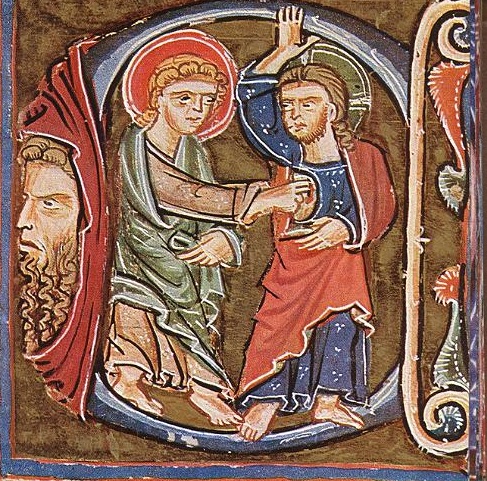
And then one thing happened. “We have seen the Lord,” they said to one who had not been there, one who would turn a sudden 180° from disbelief to total faith: Thomas. He would not put his faith in hearsay; he wanted to see and feel for himself.
And so a week later on the second Sunday of Easter he did. Here, go ahead, test me, touch me, feel me: what you see and hear and hold in your arms is real. Jesus is for real.
Thomas expressed all the doubt and unbelief of the fresh first day of the new, risen Lord, and then made his exclamation of radical faith a Sunday later.
How blessed are we who heard the news from afar and centuries later, who can yet testify, and put our faith in one who we have not seen but yet believe.
What went on from here, what grew from here, was a community not only of those few apostles, witnesses to Jesus’ life and messengers of his resurrection, but an ongoing community that could testify to the reality of the risen Lord. He is alive, he is at work in the world, and he is at work in the world through our hands, and he proclaims the good news of the reign of God that is at hand through our voices, word and deeds.
We continue the work that the first apostolic community began. The third week of Easter season we hear another story of the risen Lord, set in the place that once held the world record for the largest platter of hummus. That's another story. It involves bread and, like this story, discouragement and grief: grief turned to wonder and faith.
For now, though, we join Thomas at the feet of an unexpected Jesus, and there’s one thing to say: “My Lord and my God.” (John 20:28)
The Rev. Dr. John Leech serves as a priest associate at the Episcopal Church of Saint Matthew, Tucson.
- Acts 2:14a,22-32
- 1 Peter 1:3-9
- John 20:19-31
- Psalm 16
- http://www.lectionarypage.net/YearA_RCL/Easter/AEaster2_RCL.html
(Meditation for The Second Sunday of Easter 2023)
https://cdn.britannica.com/93/152993-050-57F2DCCE/Marcel-Proust.jpg
Sunday, April 24, 2022
The Second Sunday of Easter

The Second Sunday after Easter Day
The Doubting Thomas of Climate Change
“Unless I see a mountainside burn from west to east and smolder for a month, unless I put my finger to the ashen ground where wildflowers once bloomed and put my hand into the dry hole where a spring once gushed forth, well, even then, I will not believe!”
I wonder. Do you think Thomas was a bit of an Eeyore? Bush pilot Dave Olesen, reminiscing on a 1977 conversation with climate activist Edward Abbey, wrote, "Big soft-spoken man--he seems almost depressed...." Then a quote from him to underscore this: "I'm an optimist. Things are a lot better now than they will be."
Ed, I don’t think that word means what you think it means.
If Thomas was at all like this, no wonder he was disbelieving of what the other disciples told him.
And if we were the kind of “optimists” Edward Abbey claimed to be, we might decide the story ends right there.
The doubting Thomas is a familiar figure from popular culture and it comes of course from this Sunday’s gospel reading of the appearance of Jesus to his disciples —except Thomas — and his disbelieving reaction to news of the resurrection until he can see and touch for himself the man he once knew as his teacher.
However. We are people of the resurrection. We know that the story continues.
Because what happened was a lot more than what we might associate with the events of the past eight days, if we just shopped at a grocery or pharmacy, and saw lots of yellow and lavender and white decorations - and merchandise!
Colored eggs. Bunnies. Fragrant flowers. We are not celebrating the resuscitation of a corpse. Scholars say it is unlikely Jesus’ body did not decay - and yet, somehow…
Jesus lives.
There are more things in heaven and earth, old friend, than are dreamt of in your philosophy.
What the disciples experienced, from the women at dawn on that first Sunday morning, through the disciples’ disbelief and amazement, to the ongoing miracle of divine presence among us, is ever a mystery - and yet.
He lives.
Nobody was there when he awoke into the resurrected life - as Stewart McDonald points out. Nobody was there at that moment. But soon, in the lightening of the dawn, Mary Magdalene and others who had gone down to the tomb found it empty. And they were not alone. There was someone standing nearby.
Kind of gives you chills doesn’t it? If you had see Jesus die on Friday, and that was not enough to frighten you, seeing him risen from the dead might scare you out of your wits.
Intrepid Mary did not panic. Although it took a while to convince the guys, who were still hunkered down against possible further police action, Peter and another disciple did go and see the tomb empty. And then things started to happen. New things.
None of us has seen the Father. Jesus returned from the grave for only a short while. Granted he packed a lot into those few days, if the Gospels are historical documents, but soon enough he ascended like Elijah and was lost to sight. And that means the way we experience God is through the Holy Spirit, the comforter and guide that Jesus sent us disciples after his final disappearance.
So the new order of the ages begins. The story of Jesus continues, in his disciples and through the holy Spirit. Until it envelops us, and gives us a continuing mission.
We are the disciples now. We are called to follow Jesus.
The challenge, the call, are unmistakable and unshakable. Jesus said and did things no one had ever done before. As well as performing the proper rituals on festivals and fasts of his family calendar, and saying and praying things in accordance with ancient practice, he, well he raised the dead. So they tell us. He healed people. And most outrageously of all, he proclaimed that the reign of God, the kingdom that has no end, the kingdom that makes all other kingdoms and rules and rulers and governments seem small and contingent, has come into being even as he speaks.
Of course we know now that that challenge includes care of creation, this planet we share and inhabit. Its other animals, its plant life and bacteria, its viruses, and its own integrity, all of these are in our area of responsibility. The doubting Thomases of climate change reject the evidence of science.
Today’s Doubting Thomases close their minds to the actionable knowledge that forms the impetus for our response. And if we were the kind of “optimists” Edward Abbey claimed to be, we might decide the story ends right there.
But the story of the Apostle Thomas does not end in desperation. It is a story of restoration. It is a story of renewal and, ultimately, it is a story of resurrection
Jesus came and stood among them and said, "Peace be with you." Then he said to Thomas, “Put your finger here and see the blackened soil. Reach out your hand and touch the ground. Feel the smoldering heat. Smell the ash. Do not doubt but believe.” Thomas answered him, “My Lord and my God!”
We are not Ed’s optimists, we are Christ’s people - and we know, even after he ceased appearing to those first followers of the gospel, his story continues. His challenge, and his promise.
And becomes our own.
And so we can sing, doubters and over-impetuous among us, about something more miraculous, more incredible and more life-giving, than the resuscitation of a corpse could ever be.
Christ is risen from the dead,
trampling down death by death
and on those in the tombs
bestowing life, bestowing life!
AMEN.
Wonder, Love, and Praise #817 (Rick Fabian)
https://www.lectionarypage.net/YearC_RCL/Easter/CEaster2_RCL.html
https://sermonoats.blogspot.com/2022/04/the-doubting-thomas-of-climate-change.html
Dave Olesen, "Trespassing with Edward Abbey", Northland College Magazine, Spring 2022, 20. https://bushedpilotblog.ca/
Katherine Willis Pershey. Living the Word. April 24, Easter 2C (Revelation 1:4-8; John 20:19-31. The Christian Century. https://www.christiancentury.org/article/living-word/april-24-easter-2c-revelation-14-8-john-2019-31
The Second Sunday after Easter Day. The Episcopal Church of Saint Matthew, Tucson. https://www.youtube.com/channel/UCWI48qhKGZc5dZVf5elsRPw
JRL+
An edited, abridged version of this essay appears in the Arizona Daily Star, Sunday May 15, 2o22, page E3, as "Defeating doubt with hope".
Friday, April 22, 2022
The Doubting Thomas of Climate Change

“Unless I see a mountainside burn from west to east and smolder for a month, unless I put my finger to the ashen ground where wildflowers once bloomed and put my hand into the dry hole where a spring once gushed forth, well, even then, I will not believe!”
Jesus came and stood among them and said, "Peace be with you." Then he said to Thomas, “Put your finger here and see the blackened soil. Reach out your hand and touch the ground. Feel the smoldering heat. Smell the ash. Do not doubt but believe.” Thomas answered him, “My Lord and my God!”
Sunday, April 11, 2021
seeing and believing

During a plague year, in the midst of a pandemic, funeral bells rang continually across London. The dean of Saint Paul’s Cathedral wrote this:
No man is an island, entire of itself; every man is a piece of the continent, a part of the main. If a clod be washed away by the sea, Europe is the less, as well as if a promontory were, as well as if a manor of thy friend's or of thine own were: any man's death diminishes me, because I am involved in mankind, and therefore never send to know for whom the bells tolls; it tolls for thee.
[From Meditation XVII, John Donne, (1572-1631), and from the epigraph of Hemingway’s novel.]
I had not really meant to talk about this but the resurrection is really about death and then about resurrection. How to die, how to see a friend die, and then to understand how to live. That is the story of doubting Thomas really. Not about doubt at all but about how to grasp reality. His friend really had died. That is common fact, historical fact. He was crucified under Pontius Pilate (the Apostles’ Creed). “Jesus’ body decayed (.82 red)” - The Jesus Seminar’s consensus.
He had died. What did it mean? What did it mean, then, that he had lived, and how he had lived? That was the question, those were the questions, that occupied the disciples after Jesus’ resurrection.
And so they began to understand. Who he really was, who they really were, what there was to do next, after there had been nothing to do because after all he was dead and we were all going to die. But now, how are we to live?
Jesus’ reality comes stronger, now, knowing that he ‘had’ to die, to fulfill his mission he had to stay true, even though that could and did mean accepting death, execution at the hands of another corrupt administration. The chief priests and the scribes, the leaders so-called of the people, the people they were betraying, with their every breath, handed him over oh so gladly to the Roman authorities, the occupying authorities, who were the means, the instrument, the engine of execution.
But he himself was the engine of understanding. He took, as the gospels give him to us, all of human experience, humanity, life itself, into himself, and made it whole and wonderful and sane even as it hurt beyond belief. Yes, others have suffered more, as many were executed his way, as he was executed, by the Roman authorities, in their thousands. And that may be exactly the point.
He did not have to do it. He did not want to do it. He wanted to live and he wanted to live life in its fullness. And so he did.
And he did not keep it to himself. Miraculously he shared it with us.
And so we live. Knowing what it is at last to die, we begin to know what it is to live.
***
There is a book called "The Five Gospels" and a one-man play called "The 5th Gospel" - unrelated except by name, and perhaps by intention: to get to the human figure behind the stained glass or cultural images.
Craig McNair Wilson in his play imagined Jesus horsing around with the disciples, or doing other human things.
The book, by historians and Bible scholars of the Jesus Seminar, tried to get at what Jesus really said and thereby get closer to what he was really about. And is about, for us now.
Scandalous, really, to think that we can know much about a man who lived 2000 years ago - and that it matters to us today what he said and did and how he was truly human.
Seems to me that both play and book were trying to get at something that the first letter of John captures in a phrase: we speak to you of what we have seen and heard and held in our arms.
That was then. But you know what? That is also now. We experience Jesus as real, in our prayers, in our fellowship, in the eyes of total strangers, in our inner selves.
And we can bear witness to him as first-century John did; we have not touched him with our hands but we can encounter him nevertheless.
[On the road to Emmaus he appeared to two disciples in the person of a mysterious stranger, as he accompanied them on the way and in the breaking of bread.]
There are so many ways to say we have seen the Lord.
Many years ago at a youth retreat weekend in the Santa Cruz mountains I heard a new song - new to me and new then: "Have you seen Jesus my Lord?"
Mary asked such a question at the tomb, on the morning three days after Good Friday. "If you have taken him away, tell me where I can find him."
She is expecting nothing more than the pious duties of grief, to prepare the body for its long rest in the tomb. And perhaps as Michael Curry pointed out on Easter not even that: for who would roll away the stone? And yet - she went.
She is not seeking and does not expect to find the man she knew. Not as he was.
And she does not. For God is doing a new thing.
Resurrection, as Marian Budde reminded us on Easter morning, is - for us - a process, not a moment. Even if our life with Jesus begins with a moment of decision it continues as a process. A whole new way of living.
Mary is the first to experience this, to have it dawn on her that the resurrected Lord is more than the man she knew. He is not revived but remade. Born anew, as it were, into the fullness of life in God's house.
How are we to begin to live as if this is real? Some clues follow. Mary goes and bears witness to the men, the skeptical apostles, but they too come to believe, as they experience Jesus as real.
I first experienced Jesus as real not long after that weekend in the mountains. I had listened to the message, received from preachers, in songs, and in the gentle witness of an older friend. And even in the quiet hospitality of a neighbor. But it was when I woke up on Holy Saturday morning that he became real to me. And that is when I began to pray.
How are we to begin living as if Jesus is real?
Witness, yes, Mary did that first. He is alive! He is risen! He really is the Lord.
Then action. And that is when we collect together to - commiserate? - no, to celebrate, and to figure out what this means and what to do and to begin to encourage one another to live it out.
In the stories of acts of apostles we find them gathering all together, like a big family, every night, and still going to the Temple every day as they had when he was alive among them as a fellow human being, teacher, and healer. Now however a new era now begins, with these few, these befuddled, scared, and hopeful few, reborn themselves and calling others into new life.
It is as if they had to begin again. As if everything they knew now had a new significance, new meaning.
When at last Thomas showed up, he expressed doubts - the pragmatical dog! How can you know what he really said and did unless you were there? And he was not: so he says, I need to see him and hear him and touch him with my hands again. The Jesus I knew. But he does not meet the same man, not as he was, and for all we know, all his prerequisites for believing were thrown aside, as he met not the resuscitated man but the living Lord.
My Lord and my God.
Now he is here among us. What shall we do?
***
Christ with Us
The Love of Christ
Surround us
The Light of Christ
Lead us
The Peace of Christ
Fill us
The Power of Christ
Aid us
The Joy of Christ
Thrill us
The Presence of Christ
Be with us evermore.
David Adam, Tides and Seasons, SPCK, 1989, 76.
Resources: Commentaries by Herbert O'Driscoll, Fred Craddock, Stevan L. Davies, Arthur Dewey, and Raymond E. Brown, S.S. Prayers by David Adam. Self-guided retreat by Suzanne Guthrie, At the Edge of the Enclosure (http://edgeofenclosure.org/).
(All this came to me in part as I was listening to the comments halfway through the second episode of “Hemingway” the PBS series. One of the writers got it right, one got it wrong, about what “for whom the bell tolls” means: I think the latter had not understood where it came from. Albert Camus did, or would have. The plague. That is where it came from. John Donne, Meditation XVII, the epigraph to “For Whom the Bell Tolls”, as I memorized it in eighth grade (but had yet to understand). John Donne was writing about people dying in an epidemic, a pandemic, the plague, as it hit London in the 1660s, - as Pepys memorialized it in his diary - and so “the bell was tolling for all of us, in Europe and the United States” is wrong: it is about death, it is the mark, the memorial, the moment, the announcement, of some one particular dying. And Hemingway got it right, and his character Robert Jordan got it right, and John McCain reading it got it right, it is about that particular death and therefore, therefore, about our own, our own humanity, and therefore our own life.)
Ken Burns and Lynn Novick, Hemingway. NPR, aired April 2021. https://www.pbs.org/kenburns/hemingway/
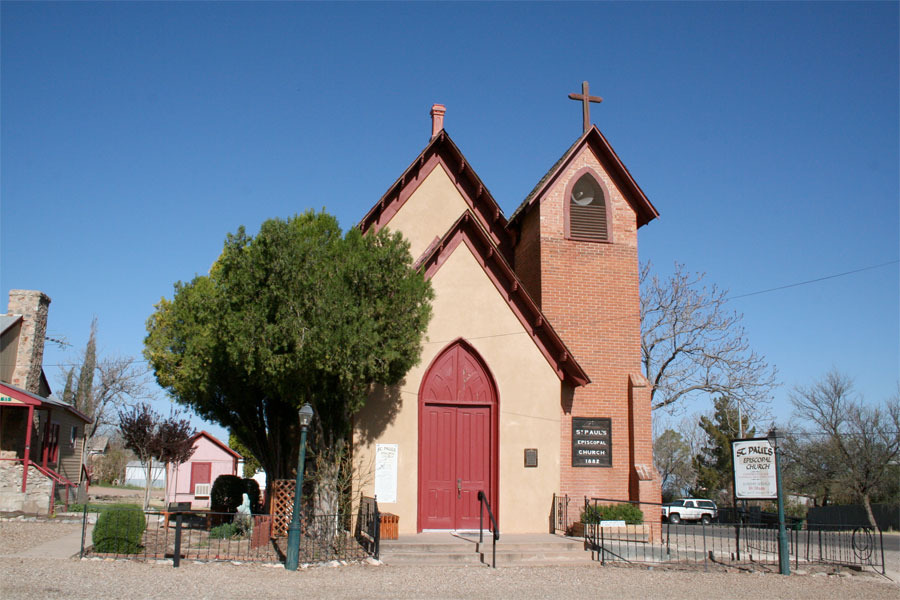
Psalm 133,Acts 4:32-35,1 John 1:1-2:2,St Paul's Tombstone,BEaster2,John 20:19-31,Doubting Thomas.
St Paul's Church, Tombstone. [https://www.facebook.com/stpaulstombstone] April 11th 2021. JRL+
Sunday, April 19, 2020
all of us are witnesses
established the new covenant of reconciliation: Grant that all
who have been reborn into the fellowship of Christ's Body
may show forth in their lives what they profess by their faith;
through Jesus Christ our Lord, who lives and reigns with you
and the Holy Spirit, one God, for ever and ever. Amen.