When Jonah finally shows up at Nineveh he walks a third of the way into the city (its walls were eight miles in circumference, enclosing 1800 acres) and delivers his message. And they do repent.
Gah!
The reluctant prophet indeed.
What this reminds me of is my first automobile. Of course. In one incident I was backing out of a parking lot in Washington DC in the dark - and backed right into a VW bug. The fender of a 1964 Pontiac Tempest is impervious to something so tin-like as the fender of a Volkswagen. As I already knew from previous occasions with other people driving. So it was dark and it was raining and it was late. And I left a note on the windshield of the other car. In Flair pen! Talk about a reluctance to do the right thing. And a few days later the other driver called and thanked me: he called my insurance company and they made good on the claim ($84). And he said, I’d done the Christian thing. Gah! After I hung up, I grumbled to myself. The reluctant Christian.
Sometimes you do the right thing. When you do not want to, Sam I am.
So Jonah. Got himself a ringside seat, under a booth, and sat back to watch the city destroyed.
God ‘sent’ - as God sent Jonah to Nineveh - a vine to grow up and shade him, then wither.
God showed mercy in a small thing to his reluctant prophet, shading every hair of his steaming angry head. And then God disappointed him. God showed mercy in the most outrageous way.
Showed mercy to Nineveh - the people who brought total destruction to Israel.
Let that be a lesson to you. I guess.
God’s mercy seems to be infinite and not under our control. At all.
And now Jesus turns the world on its head again. This week by telling the story of a master who is totally unfair.
There are a bunch of guys hanging around a Shell station or a city gate or a park south of downtown Tucson. And farmers show up to hire them for the day. It is harvest time - and workers are needed. (Hint: it is surely harvest time now, Jesus is pointing out, for the kingdom of God.)
The pay is good. A day’s wage. All you need to live on - to feed your family.
It’s enough. It’s not riches, but it is all the bread you need for today. Kind of like manna. Kind of very like manna, the bread in the wilderness, that God provided the wandering people of Moses. Kind of like the ‘daily bread’ God provides for us, in the Lord’s Prayer.
So there they are working away in the vineyard. All day long. It’s hot in the vineyard. Sunny. The grapes are ripe and full of juice. By the way it’s harvest time now, in the wine regions of the West. Across the valleys the aroma of the ‘crush’ of the harvest fills the air. It is a good time.
And these workers are part of it. Valued and paid.
And then other guys show up in the vineyard. At this hour and that hour and the close of the day.
They get paid too. Seems fair. Until - the all day workers get paid for a day’s wage - and no more.
Give us this day our daily bread - and a little extra, how about it? We worked all day!
Deserve has nothing to do with it. Apparently. This upside down story has a farmer who is willing to pay every body, each and every one, the day’s wage. Whether they have worked a full day or not.
Is that fair?
You tell me.
Is it fair to spare the Syrians who have - or are going to - prove a mortal threat to Israel?
Surely security comes first!
But God - God - allows them to live, when they repent.
That is the upside down story of Jonah.
Is it fair? Is it wise?
God forgives us.
God forgives us.
Is it fair?
* * *
But what were they arguing about, anyway, these day laborers of Jesus’ parable?
Abundance - even the luxury of surplus - and enough, sufficient for the day.
“Give us this day our daily bread” is very much the moral background of this parable.
What would that look like, in today’s world? An oddly placed hint comes to us from a review in a recent issue of a magazine, of a book by an anthropologist, James Suzman, entitled, Affluence Without Abundance: The Disappearing World of the Bushmen, (Bloomsbury USA, 2017, reviewed by John Lanchester, “How Civilization Started”, The New Yorker, September 18, 2017, 22-26.)
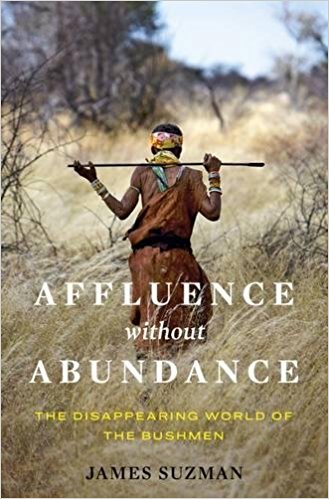
The Bushmen of the Kalahari, we learn, have in various groups assimilated into more mainstream culture, but in other groups stayed with their traditional hunter-gatherer lifestyle.
“It turns out that hunting and gathering is a good way to live. A study from 1966 found that it took a Ju/’hoansi [Bushman] only about 17 hours a week, on average, to find an adequate supply of food; another 19 hours were spent in domestic activities and chores.” … Ju/’hoansi do not accumulate surpluses. They get all the food they need, and then stop. They exhibit what Suzman calls ‘an unyielding confidence’ that their environment will provide for their needs.”
“ … the hunter-gatherer’s ability to live a life that is, on its own terms, affluent, but without abundance, without excess, and without competitive acquisition. The secret ingredient seems to be the positive harnessing of the general human impulse to envy.”
This is the thing which the Lord hath commanded, Gather of it every man according to his eating, an omer for every man, according to the number of your persons; take ye every man for them which are in his tents.
And the children of Israel did so, and gathered, some more, some less.
And when they did mete it with an omer, he that gathered much had nothing over, and he that gathered little had no lack; they gathered every man according to his eating.
And Moses said, Let no man leave of it till the morning. (Exodus 16:16-19)
And the children of Israel did so, and gathered, some more, some less.
And when they did mete it with an omer, he that gathered much had nothing over, and he that gathered little had no lack; they gathered every man according to his eating.
And Moses said, Let no man leave of it till the morning. (Exodus 16:16-19)
It’s when they get greedy that they get into trouble. Try to store it and it rots.
But when they trust that “The Lord will provide” as my generous friend Marjorie used to say, they find that their good shepherd provides all they have needed.
As Henry Baker wrote in his hymn based on the 23rd Psalm,
The King of love my Shepherd is,
Whose goodness faileth never,
I nothing lack if I am His
And He is mine forever.
Whose goodness faileth never,
I nothing lack if I am His
And He is mine forever.
For abundance read superfluity, for affluence read sufficiency. For what the anthropologist calls ‘an unyielding confidence’ read “a steadfast faith” or “a founded hope”.
This story is an illustration of the abundance of God’s mercies, the certainties of his provision.
Manna, the bread from heaven, is used as well to mean an unexpected benefit, or, spiritual nourishment, especially the Eucharist.
The farm workers of Jesus’ parable certainly some of them receive an unexpected benefit. Their daily bread descends without anticipation. (And some are jealous.)
And we - we receive that manna of the last meaning, for we do indeed receive the ultimate gift of the bread from heaven that is manifested in the Eucharist, that is, Jesus, himself; as he said, “I am the bread of life.” The one who trusts Jesus receives from him life - and that abundantly. Abundantly - beyond needful measure.
Is that fair?
AProper20 Pentecost XVI … September 24, 2017 … St Paul’s, Tombstone.

