Showing posts with label CLent4. Show all posts

Sunday, March 30, 2025

Three Men

Have you ever felt like this? Far from home, far from your self, your true self, far from what you really know your life was meant to be? Maybe you took what you could get and went and blew it - riotous living, bad investment, stupid life choices - but here you are now, at the far end of your senses, and you come to yourself, that is, you come to realize, this is not me, this is not what is meant for me, I may be no better than this but this is not it. The people who know me, really know me, would not recognize me like this. But I need them. I’m going home! 


And so you rehearse, all the bad things you have done, all the mistakes, the regrets, all the promises to change, to reform, to just give up and throw yourself on the mercy of the court of inner opinion. Maybe there is somebody you can go to. Maybe you say, “I want to get sober” or “I have made a big mistake” or “I blew it, didn’t I?” I know it, you know it, but now I am admitting it. And I want to come back to a true sense of myself, and of you. 


Is this a cry for pity? In the younger son’s story, it doesn’t work. The father does not take him back on the terms he suggests, a disgraced former offspring now fit only to be a hired hand.


But the father does not take the deal. Instead, he welcomes, runs to welcome, the son who was lost and now is found. The child who had strayed, who knows how far, is now returned. Back. From wherever. And that’s it. He’s home. That is what matters. 


What matters more, more than forgiveness, repentance, turning around, turning home, is the generosity, the unquestioning welcome, the forgiveness without solicitation or merit, the uncreated gift of the father’s love.


So, Lent. Chocolate? Coffee? Red meat? Movies? Relentless television? Newsfeeds 24/7? Is it about what you give up? Or is it about what you receive? Without merit, without limit. The father’s love precedes any repentance, it is indeed unmerited grace. And it is waiting for us, all the time.


Have you ever felt like that? Worked hard for no reward, no recognition. Just toil. Where did that younger brother get to anyway? At least I get two-thirds of the inheritance (check Deuteronomy 21:17) since I am the firstborn - not that playboy. That waster. To be kind, I saw this coming. From the day he said, give me my inheritance - now: I cannot wait until you are dead, Father. Let’s pretend you already are - dead to me, at least as far as the money goes. And the money went. I have just had it with him.


So now I pick up the pieces. We make do with what is left, Father and I. For I am the good son. The eldest. I hold it all together. I won’t let it get out of hand - again. But no, look, here he comes. Back. And what does he want now?


Have you ever been that boiled in resentment? Felt its heat from far away? No wonder the boy was hesitant, coming home. There is no indication that the younger had thought of the older, just of coming home to his father.


Have you ever felt that deserving, or that underserved, that unappreciated? 


But then again the Father seems not to care, not even to care enough to keep count of the loss.


Love does not keep account of wrong. (J. B. Phillips) But rejoices when truth prevails. The truth of the Father’s love. 


Being right won’t last forever. Remember the man who had “he was in the right” written on his tombstone. What will last is love. Forgiveness. Let this be a lesson to me. I am not ready to release all my anger, all my resentment, all my sorrow or grief at what is lost. Are you? Anyone? 


But I know the day will come. He has already forgiven me. Can I do no less? Relax my hand, and let the pebble fall I meant to throw, like the people in the Temple ready to stone a woman. Put down my hand, with its accusing finger. Not that I am no better, or much worse. That is not the point. This is not comparative justice. “Well, what about —?”


This is about love that does not wait. That comes to us, unbidden, unready, whether we like it or not. Worthy or not.


And finally — have you ever, even in the slightest, felt like this? Someone comes to you to make amends, someone comes for mercy, someone comes to be forgiven, to make things right, as right as they can, without hope or expectation? Twelve-step people may know it, from either side. Making amends is one of the steps to release from addiction. One of the steps to release from the past. With all its errors. (And it is a release to both parties.)


Not to make room for making new errors. Though errors there may be. But simply in this moment to rejoice with the recovered, the resentful, the relieved, and the joyful, in the restoration, renewal, or even better, the new life that now comes to be. 


Forgiveness, as the Father gives it, does not merely restore. It makes new. 


Behold you are a new creation. All things have become new. In Christ. Amen.


https://www.youtube.com/watch?v=humDgJ-SmHI


William Hogarth, A Rake's Progress I: The Heir
https://shop.soane.org/products/pod435408?_pos=31&_sid=c20f76fc1&_ss=r


Sunday, March 20, 2022

The way to life - “mine” or His?


“Mine” was the first word my younger brother ever learned, thanks to the anxieties of his big brother, who had to draw limits on what toys he would share and what he would keep. That was a harsh lesson but not the ungracious (to be generous) response of the older brother to the return of his prodigal sibling, who, after all, had not starved to death or been lost in a foreign country. 

They had probably given up hope, at least hope is what his parents had in their hearts, as they had experienced a death before death from their younger child. 

We don’t know how the mother reacted but the father was overjoyed. His son had given him up for dead, prematurely, by asking for his inheritance up front; which he then spent recklessly (on booze and women or cars or fine dining for fast friends) before returning in desperation and humility (apparently) to his family home. 

Dad was happy, over the moon. “Kill the fatted calf” - as if the Pope was visiting or better yet the King. As if what he had saved for a burnt offering were no longer needed, now that what he would have sacrificed for - even more than he already had - was back safe and sound.

This is the background of the famous story of the prodigal son told by Jesus in the 15th chapter of the gospel of Luke. It is a reaction to the ungenerous jealous response of the self-righteous to people they disapproved of being welcomed inside the embrace of the kingdom of God that Jesus was proclaiming. ‘This fellow welcomes sinners and eats with them.’ (Luke 15.1) They want to see justice done, man! Payback! How about it? They had it coming to them, they might say, of anyone humbly approaching the Heavenly Father as the younger son had approached his dad. 

But Jesus does not see much good in retribution. Are you any less sinful than those on whom this calamity has fallen? Jesus  asked, after tragedies were reported to him - a wall falling on pilgrims, or the cruel tyrannies of a brutal Roman prefect casually inflicted on others. No, he said, turn away from such vengeance-seeking, such jealousy, and see your own faults, your own sins, and turn toward God.

We are asked to do no less. We are asked, indeed, to answer such temptations with the most powerful of gifts:  love.

In the words of Saint Paul so often cited on a wedding day, love “does not keep account of evil or gloat over the wickedness of other people.”

As Paul went on to say, “On the contrary, it is glad with all good men when truth prevails. Love knows no limit to its endurance, no end to its trust, no fading of its hope; it can outlast anything. It is, in fact, the one thing that still stands when all else has fallen.” (1 Corinthians 13: 5, 6-8a. Phillips trans.) 

The temptation to wish wrong on others, however ‘provoked’ we may feel, is not something we can abandon lightly. Indeed our own survival - of soul even more than body - may depend on this counter-instinct: to rise to the bait not at all but to rise above all the pain and grief we rightly - or self-righteously - may feel, and seek the grueling sacrificial path of the Christ who leads us to a glory beyond shame or resentment, hate or indifference. 

That is the way, the revolutionary way, of love. And it lasts, beyond empire - as Jesus faced - or collaborator - as Jesus faced too; beyond imperial domination or invasion, beyond our own false hopes or ideals that hold us back from following the way that will lead - long and hard as the road may be - to life.

Meet the Priest

The Rev. Dr. John Leech is ordained in the Episcopal branch of the Jesus movement, and has served as a priest in northern California and western Washington, and now serves in southern Arizona. 

https://www.lectionarypage.net/YearC_RCL/Lent/CLent4_RCL.docx

March 27th 2022

Fourth Sunday in Lent


https://hermitagemuseum.org/wps/portal/hermitage/digital-collection/04.+engraving/1266400


A version of this essay was published by the Arizona Daily Star on Sunday March 20th 2022. https://tucson.com/lifestyles/the-way-to-life---mine-or-his/article_48d49c56-a3d6-11ec-acef-ff839595afe4.html

Saturday, March 9, 2013

Prodigal Son


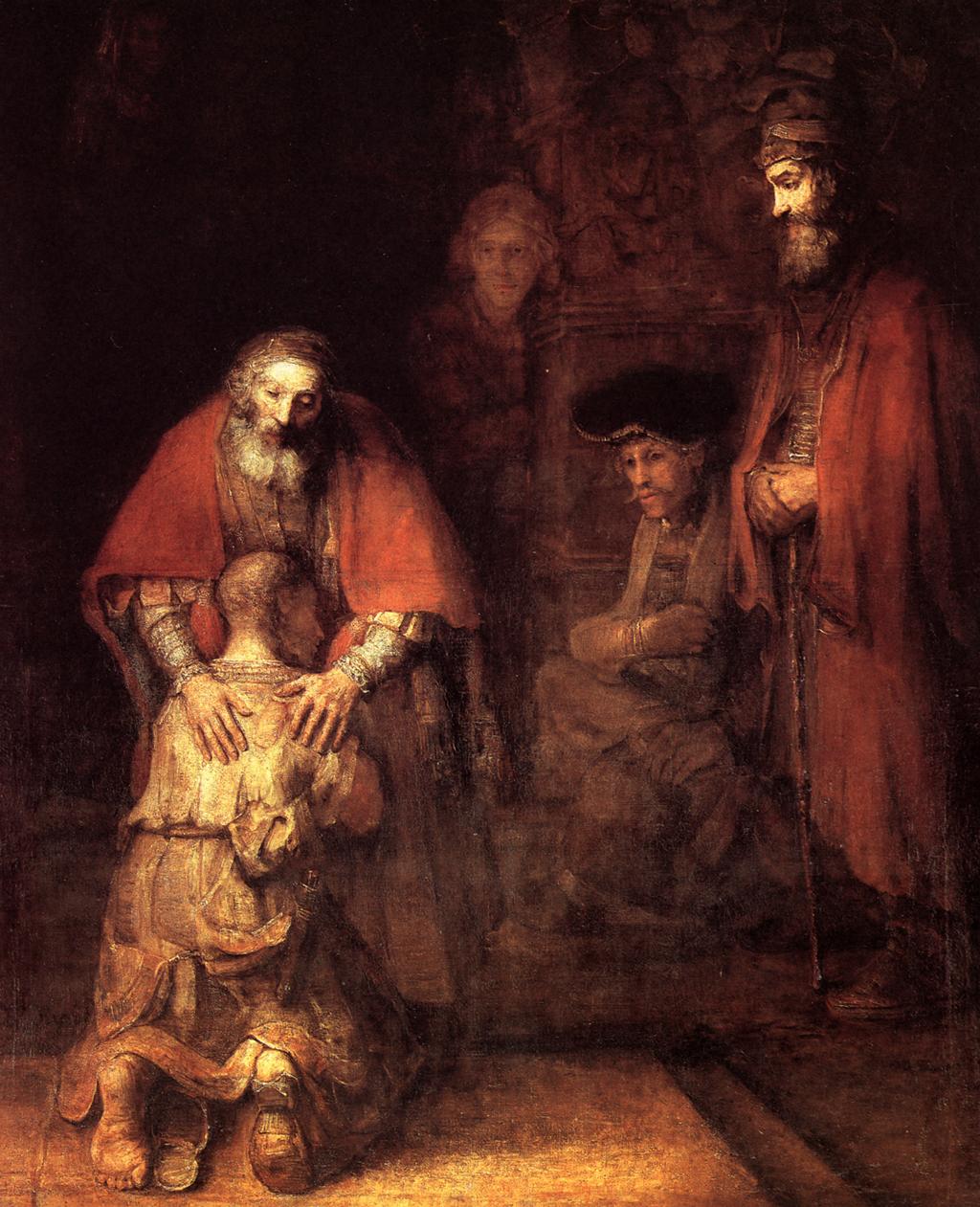
Look at the hands, reaching out in compassion. Look at them, reaching out in mercy. Look at them, reaching out in love.

Look at them. Look at them with joy, not sorrow, with gladness, not anger, with happiness, not jealousy, with peace, not hate, with love, not fear.

Look at them, the father's hands.

Reaching out to the wayward son, comforting him, bringing him home.

He was lost, and is found; was dead, and is alive; was blind, and now he sees!

The elder son - where is he? In the shadows? Is he the observer, cloaked in red like the father? Does he look on this embrace with gladness? Is his heart melting?

The father reaches out to the elder son as well. All that is mine is yours... but he who was lost is found. Can you join the celebration?
 

The Homecoming, by C. P. Snow, creates an image of returning again to the same place, the place he started from, and finding it for the first time a homecoming to a place of peace, of rest, of joy.

What was once feared, or regretted, or a source of sorrow, has now, by stint of infinite striving, become a place of welcome.

Devastating loneliness, wandering, ashamed, lonely, desperate and destitute, the younger son comes to himself: greed and lust are spent. But he is not worthy to be called a son.

Outraged, angry, jealous, hard of heart, the older son looks on without compassion or mercy. Calling him, the father extends the same grace.

Prodigality and abundance are two different things. The extravagance, the wandering wastefulness, the vagrant reckless pride and conceit of the poor wandering one.

The overflowing plentiful affluence - wealth, even - of the father's gift of love. His forgiveness is infinite in value, beyond price or measure.

God's forgiveness is abundant, but not wasteful, not really. Wandering it may seem to be - but it is we who wander, and we who are welcomed home.

It is we who in our turn are called to welcome others.

That is what Paul is on to, in his letters to the young church of the Corinthians: we are reconciled, now we are agents of reconciliation for others.

We do not simply come home. We turn, and in our turn, embrace.


These two boys - the sons - in the beginning have no sense of the value of what they have.


John Newton, writing of his sister-in-law, said, "She knew whom she believed. She possessed a peace past understanding and a hope full of glory." ("Narrative of Eliza Cunningham" by John Newton, in the third volume of a collection of tracts published by the American Tract Society of New-York, n.d.)

She possessed greater wealth than either son knew he had, at the beginning of our story today. The older son had the presence of his father; the younger, his generosity. But neither really realized the true gift they had in their hand, all the time: the unlimited, unmerited grace, the boundless mercy and love, the endless compassion of a loving Father: the overflowing joy of his love, his gladness, his delight in them. They did not have to earn it; they could not: it was there all the time.

That overflowing love - perhaps they, and we, can come home, and know it again for the first time. So we can come home through Jesus, meeting him again as if for the first time, when we open/reopen ourselves to his overflowing love.


Father of all,
    we give you thanks and praise,
    that when we were still far off
    you met us in your Son and brought us home.
    Dying and living, he declared your love,
    gave us grace, and opened the gate of glory.
    May we who share Christ's body live his risen life;
    we who drink his cup bring life to others;
    we whom the Spirit lights give light to the world.
    Keep us firm in the hope you have set before us,
    so we and all your children shall be free,
    and the whole earth live to praise your name;
    through Christ our Lord.
    Amen.
     

(Post-communion prayer, Common Worship, Church of England, Holy Communion, Order One. http://www.churchofengland.org/prayer-worship/worship/texts/principal-services/holy-communion/orderone.aspx accessed March 9, 2013)
Henri J.M. Nouwen, The Return of the Prodigal Son: A Meditation on Fathers, Brothers, and Sons (New York: Doubleday, 1992)
JRL+

Sunday, March 14, 2010

restored to life

Absalom, Absalom, my son, my son!

O how that father must have wept.

I feel for him now.

I always have.

I always knew one of my boys would leave me.

I knew he wouldn't understand - and he'd reject my love.

He would not embrace what I loved - not even if it was his own brother, lost so long ago, and now, found again.

How could it be? His own flesh and blood.

And yet...

I have waited so long. Scanning the horizon. Hope against hope, hoping to find him.

Wondering if he'd ever come home.

Should I have gone after him?

A secret: I did.

+

I'd rather not

I'd rather not talk about it.

Where has he been?

Squandering all the family money, that's where.

On the far side of the world.

What does he think?

What did he think would happen?

What was my father thinking?

What is my father doing now??

That fellow treated us like we were dead. He went to my father and asked for his inheritance. Now. While my father is alive, he asked for what he had no right to ask - not until my father is dead. You never do that. It's like saying to the person, you are dead to me - now.

Give me my inheritance. Unbelievable.

And then he took it - and wasted it.

He went far away and spent it on one big long party for himself - with loose women, and wine, and no doubt with that noise he calls music.

Now he's back, and he gets another party?

No. No way. This cannot stand. This is unacceptable.

And yet - here he is.

And my father embraces him. He welcomes him back - and throws a party for him.

As if he's regained a lost treasure, or got a dearly beloved lamb back in the fold.

Like the lost coin that woman found when she turned her house upside down looking for it.

“Rejoice with me, for I have found the coin that I had lost.”

Like the lost sheep the farmer left the flock to find - and brought back riding on his shoulders.

“Rejoice with me, for I have found my sheep that was lost.”

Now my father has a kid on his own back, again; that's for sure!

And he kills the calf we've been fattening.

No goat for me.

And this is what he has to say about it.

“Son, you are always with me, and all that is mine is yours. But we had to celebrate and rejoice, because this brother of yours was dead and has come to life; he was lost and has been found.”

I'd rather not talk about it.

+

Saturday, March 13, 2010

coming home again for the first time


It's been a long ride. Across the water, up the hill, and over the road - and finally, as the old place comes into sight once again, the welcome. Unexpected. More than could be hoped for.

"Rejoice with me, for what was lost is found, - the one who was dead is alive!"

Ring on your finger, robe on your back, the calf fattened now prepared as a feast - on the occasion of your homecoming.


and yet... you've never been here before!

This is new - it is a new place. These are new people.

... they welcome you as if you've always been known to them.

How can this be? How can they know you if they have never seen you before? never heard your name?

It comes because they see Christ in you - because they welcome the stranger, feed the hungry, bring comfort to the sick, give the thirsty something to drink, clothe the man in tattered rags, visit the prisoner. Because they see Christ in all these they see Christ in you.

And that is the hope of glory: the presence of the Lord in the cast-off, the indigent, the marginal, the lost; to tell the truth, the sinner.

In you and me, you and me.

In Christ we are made a new creation; in Christ we are made whole; in Christ we are made welcome and welcome others - to the feast, the banquet-table, the presence of the Lord.

Are we worthy? No. We are loved.

+