Showing posts with label Annunciation. Show all posts

Friday, February 25, 2022

Patrick

Patrick, a runaway slave, left civilization behind and returned to the land of his captors as a missionary bishop. There his crude Latin - an embarrassment in the civilized world - fit those to whom he wrote, notably Coroticus, a British slaver who called himself a Christian. No Christian are you, said Patrick, for you kidnap and enslave the innocent. 

Patrick didn’t write much besides his letter to Coroticus but he did write an ‘apologia’ of sorts - an account of his own fitness for ministry and his credibility as a witness to the saints. It was rough and ready, more like something from the letters of Paul of Tarsus than the literary Confessions of Augustine of Hippo.


His feast we celebrate just a few days before the equinox in March. Cultural appropriation is hardly a sufficient label: in an earlier century it was an occasion for Irish immigrants that had newly become American to proclaim their love for and loyalty to their new country. But now it is often an occasion for the wearin’ o’ the green simply to avoid being pinched, or buying the house a round.


And so we are more likely to associate the equinox with another feast of the Christian year, the Annunciation. If we celebrate the Nativity of our Savior on December 25th it is only sensible that we count nine months back to celebrate his expectation. “Here am I” says Mary, the angels let out a long held breath, and the redemption of creation begins anew. 


We nowadays seek to celebrate more than our own survival, our rescue from the pit of sin or despond: we want to mark a day in spring as a reminder of God’s creation of all things, and our place among them. 


Yet why not, this year as any other, remind ourselves that among God’s creatures are the least of people, the forgotten, the invaded, the captive: those assaulted in their own homes and drawn away to a foreign land, as the people of Patrick were, and all those who have ached for the release from captivity, the healing of wounds, and the balm of the Spirit Mary’s son bears.


Sunday, December 12, 2021

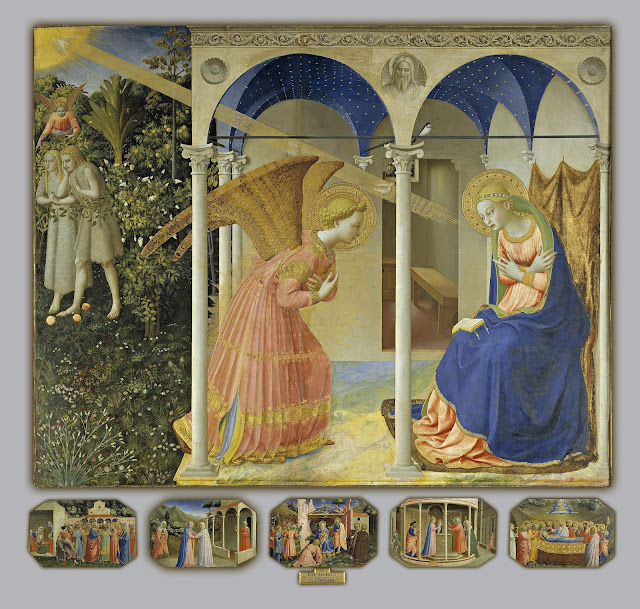
Annunciation


 Fra Angelico
Angelico, fra, approximately 1400-1455. Annunciation, from Art in the Christian Tradition, a project of the Vanderbilt Divinity Library, Nashville, TN. https://diglib.library.vanderbilt.edu/act-imagelink.pl?RC=47865 [retrieved December 8, 2021]. Original source: https://commons.wikimedia.org/wiki/File:Angelico,_prado.jpg. 

In terms of social unrest today or 2000 years ago what happens to a young Palestinian woman unmarried who turns up pregnant? How can she safely carry the child to term? And then what happens to them? 


In Bethlehem a few years ago I listened to a French speaking nun from Lydda tell a group of us North American pilgrims what happens there at the orphanage where she serves.  They take in orphans, and raise them through their first school years. 


An 18-year-old man came to their door one day with a gift. It was a thank you gift: his first paycheck. Years before he was born and cared for and raised to school-age there at la Crèche de Bethléem. Kids grow up there, up to first grade, then go to foster programs and schools until they are full grown. 


Where did these kids come from? Some are children found abandoned, or placed temporarily by social services due to serious social unrest or problems within their families. And others? Their mothers were young unmarried women from villages in Palestine who became pregnant. 


A scandal, possibly fatal, would erupt if their pregnancy was discovered or they had a child in their hometown. So on the quiet they are brought to Bethlehem where the child is born and the mother is cared for. Then the mother returns to her village. Crisis averted: the child lives, the mother lives, violence is not done to either one. 


How different it was for Mary who knew her husband but not yet intimately. Customarily he would have severed the relationship if she were pregnant by another man, wouldn’t he? But he protects her and raises the child with her and so the holy family begins its journey. 


Pregnancy is risky, always risky when the child is unwanted, and if the child is wanted by a jealous king its peril is increased. Mary took on the risk, as did Joseph, and what we see in Mary is more than courage: it is humility and obedience. She sees herself as of lowly estate, as a simple daughter of a village family. 


She is not the daughter of the king, not a daughter of Herod and certainly not the child of Caesar Augustus who was called “son of God, King of Kings.”  (Read or watch “I Claudius'' and you’ll see just how wildly different two young women can be.) 


Mary is a woman of honor and great strength. To say, “Let it be done to me according to thy word,” is to take on a great burden and a great responsibility. 


Mary Holmes, art history teacher at Cowell College, said that the virtue our society needs now is obedience – and I think she meant it in the Marian sense of docility: accepting the reign of God and the power of the spirit is not passivity. 


“Docility is to have reverence and acceptance of God’s plan for our lives in order to experience fulfillment, true happiness and closeness to God.”


(https://ct.dio.org/item/4903-docility-to-the-holy-spirit.html) 


Mary is already empowered by her creator’s love and her sacrificial response. She will now know no ordinary life nor will her son. All that is changed now and forever. She is a woman clothed with the sun: made shining and glorious by her simplicity and her humility, her obedience and her courageous response: “Here I am, Lord.” 

And so that was an ordinary extraordinary young woman, two thousand years ago. Obedience, docility, not passivity, but openness to the leading of God and the power of the Spirit at work. 


How are we nowadays to accept the gift and the call of God? What extraordinary ordinary thing awaits us this coming Christmas season? 


Mary responded to the news from God’s messenger with more than simple acquiescence. She went on to sing: My soul proclaims the greatness of God. 


And God comes to humankind to liberate them from what en-toils them. 


500 years ago it was the oppression that came with occupation and an imposed cultural hegemony. On top of the good news they carried as if it were pollen on their clothes, the people of Spain arrived in the new world with a desire for gold and conquest. 


This included spiritual conquest as if the local people had nothing to add or to offer but simple passive submission to the foreign message. But one day not long after the conquest came a second change, a revolution in spirituality. 


Juan Diego encountered a vision of the Mother of God atop a hill that had been sacred for centuries. On it he saw not a nature goddess but the Queen of Heaven. 


He told the bishop. The bishop did not believe him. In that cold gray time of year roses should not bloom, but bloom they did, that day. Open your tilma and gather them in, she instructed. 


He took the cloak to the bishop and opened it. Flowers fell on the ground. What remained was an image of a dark-skinned Mary, an indigenous Mary, resplendent, on its inner surface. 


That became the sign that showed the way. God was not to stop at human borders or inhabit human prejudices. The way was open and all were welcome.


The point was not, she is ours. She is one of us. The point was, we are hers. We are hers. And she and we belong to God. Wherever we travel, God is with us. Emmanuel.


How will we now, 2000 years after Mary, and 500 after the vision of Guadalupe, receive the Christ child and the message of angels? What are we doing, called to do? 


Venture forth into the night bearing a small burden to a foreign land? It’s being done, now, across our own desert. Are we to welcome the stranger into the inn, and make room where none was found? It’s being done, here in our own town. 


Are we to follow the words of an extraordinary messenger to an unknown land, as so many patriarchs and matriarchs did, in Old Testament days? 


And perhaps it is the simple things, the daily things, that we do, to follow God’s pathway in our hearts, as best we may. To show kindness to strangers, sympathy to the distressed, tolerance to the uneasy, support to the weary, joy to the glad, and all this, to the end that God’s purpose on earth be known.


Perhaps it is just to stand still, upon a hill, and hear and join the angelic choir as they sing, “Glory to God!”


But there is work to be done. Mary did not stop with “Here am I.” She went on, as she visited her relative Elizabeth, to sing with joy of justice and redemption, of faith and hope and the lasting challenge, the commission even, of every child of God.


He has redeemed us. He has come to his people. And he has given us a job to do.


To join in the redemption of the world by our actions of justice, mercy, and compassion. The small things, yes, the big things too: the work of the people is to join in the salvation of the world. 


No, we are not deities. We are not divine. Neither is she. But we follow the one who is.


“Now, master, let your servant go in peace according to your word, because my eyes have seen your salvation. You prepared this salvation in the presence of all peoples. It’s a light for revelation to the nations and a glory for your people Israel.”


Luke 2:29-32 (CEB)


JESUS MAFA. The Annunciation - Gabriel and Mary, from Art in the Christian Tradition, a project of the Vanderbilt Divinity Library, Nashville, TN. https://diglib.library.vanderbilt.edu/act-imagelink.pl?RC=48278 [retrieved December 8, 2021]. Original source: http://www.librairie-emmanuel.fr (contact page: https://www.librairie-emmanuel.fr/contact). 

Oh, by the way, that 18 year old was sent out with a fond farewell by his foster parents but he was back at the door in moments. “Mom, could you give me money for the bus?” He had given them his whole paycheck and it was all he had.


star


In terms of social unrest today or 2000 years ago what happens to a young Palestinian woman unmarried who turns up pregnant? How can she safely carry the child to term? And then what happens to them? In Bethlehem a few years ago I listened to a French speaking nun from Lydda tell a group of us North American pilgrims what happens there at the orphanage where she serves.  They take in orphans, and raise them through their first school years. An 18-year-old man came to their door one day with a gift. It was a thank you gift: his first paycheck. Years before he was born and cared for and raised to school-age there at la Crèche de Bethléem. Kids grow up there, up to first grade, then go to foster programs and schools until they are full grown. Where did these kids come from? Some are children found abandoned, or placed temporarily by social services due to serious social unrest or problems within their families. And others? Their mothers were young unmarried women from villages in Palestine who became pregnant. A scandal, possibly fatal, would erupt if their pregnancy was discovered or they had a child in their hometown. So on the quiet they are brought to Bethlehem where the child is born and the mother is cared for. Then the mother returns to her village. Crisis averted: the child lives, the mother lives, violence is not done to either one. How different it was for Mary who knew her husband but not yet intimately. Customarily he would have severed the relationship if she were pregnant by another man, wouldn’t he? But he protects her and raises the child with her and so the holy family begins its journey. Pregnancy is risky, always risky when the child is unwanted or wanted only by a jealous king its peril is increased. Mary took on the risk, as did Joseph, and what we see in Mary is more than courage: it is humility and obedience. She sees herself as of lowly estate, as a simple daughter of a village family. She is not the daughter of the king, not a daughter of Herod and certainly not the child of Caesar Augustus who was called “son of God, King of Kings.”  (Read or watch “I Claudius'' and you’ll see just how wildly different two young women can be.) Mary is a woman of honor and great strength. To say, “Let it be done to me according to thy word,” is to take on a great burden for any woman. To bear a child in time of danger, to take on the grace and favor that is not her due but her desire now to serve God as God calls her to serve. Mary Holmes, art history teacher at Cowell College, said that the virtue our society needs now is obedience – and I think she meant it in the Marion sense of docility: accepting the reign of God and the power of the spirit is not passivity. Mary is already empowered by her creator’s love and her sacrificial response. She will now know no ordinary life nor will her son. All that is changed now and forever. She is a woman clothed with the sun: made shining and glorious by her simplicity and her humility, her obedience and her courageous response: “Here I am, Lord.” Oh, by the way, that 18 year old was sent out with a fond farewell by his foster parents but he was back at the door in moments. “Mom, could you give me money for the bus?” He had given them his whole paycheck and it was all he had.

JRL+  


  1. Here am I Lord: let it be done to me according to thy word.
  2. Docility, obedience: Mary Holmes
  3. He hath regarded the lowly estate of his handmaiden: Martin Luther Christmas Book (1950)
  4. Risky: la Crèche de Bethléem en Palestine. (https://www.helloasso.com/associations/amis-de-la-creche-de-bethleem)

(https://youtu.be/sU6B9GzPuM8)

What happens to a young Palestinian woman who turns up pregnant?


“Docility is to have reverence and acceptance of God’s plan for our lives in order to experience fulfillment, true happiness and closeness to God.” (https://ct.dio.org/item/4903-docility-to-the-holy-spirit.html)


A version of this story was printed in the Arizona Daily Star on December 19th 2021, page E3, under the title, "Trust in God as Mary did." 

Monday, March 26, 2012

Annunciation 2012

Back on the feast of Epiphany we remembered the visit of the magi to the Holy Family, and the gifts they bring: Gold for the king, Frankincense for the priest, Myrrh for the sacrifice. There is, I submit, one more gift - for us to offer: Praise for the Living One.

Right in the middle of Lent we encounter a part of the Nativity story, nine months before Christmas Day. Raymond Brown, the Roman Catholic biblical scholar, taught that the gospels actually were written beginning with the passion narrative - proceeding through Holy Week, the Passion, the Resurrection, the Ascension, and then on around to the Birth narratives.

The birth narratives begin with the visit of the angel to Zechariah, announcing the coming birth of John. Then the focus shifts to a younger woman, cousin of Elizabeth. It is Mary. The angel comes to Mary – and hails her as full of grace: she is to bear a son, who is to be the Messiah.

Mary accepts the burden of birth and the destiny of motherhood to the Messiah, Conception to Assumption, somehow knowing that she must not count her child as hers to keep, but must let go of him, dedicate him to the Lord, as Samuel's mother Hannah dedicated him, knowing he will go from her.

Mary, mother of Jesus, takes this task on herself, knowingly, as God's servant, because she knew that he, her child to be, was sent to set the people free: that at last God's promise to redeem Israel would bear fruit in the fullness of time, and that that fulfillment was coming very soon, and was beginning to happen, quickening even now in her.

The Word would indeed ripen in her own womb. She would bear forth upon the world he who would himself bear the pain of the world.

Like Hannah's son Samuel, Jesus the Son of Mary is one consecrated, set apart for service to the Lord, as a thanksgiving offering to the Lord. Samuel is the prophet who brought justice to Israel, and yet he points beyond himself - to Saul, first, then to David, to David's son Solomon, and ultimately to Jesus.

In the birth story of Samuel, Hannah his mother rejoices that God has remembered the forgotten, and will bring relief to the poor. “My heart exults in the Lord; my strength is exalted in my God,” she sings (1 Samuel 2:1-10).

In the birth story of Jesus, Mary his mother rejoices that God remembers the forgotten and brings relief to the poor. (Luke 1:46-55) And in our prayers, even daily, we join in her song, the Magnificat, the Song of Mary, Canticle 15 in the Book of Common Prayer: “My soul magnifies the Lord, and my spirit rejoices in God my Savior...”

Sunday, December 18, 2011

The Annunciation

"The Annunciation" by Henry Ossawa Tanner (1898)

"But a shoot shall sprout from the stump of Jesse and from its roots a bud shall blossom." (Isaiah 11:1, New American Bible)


“When you think you're at the very end, the rotten stump, in decay, something grows. You keep tending to the thing that seems dead or not working, and, with your tending, something new and beautiful sprouts up.”—Father Rick Frechette, in "Children's Champion", Financial Times, House & Home, December 17/December 18 2011, p.2. http://www.ft.com/cms/s/2/a5aadbee-226c-11e1-923d-00144feabdc0.html##axzz1gr9MuKu1

 
"Then a shoot shall grow from the stock of Jesse, and a branch shall spring [Heb., bear fruit] from his roots." (Isaiah 11:1, New English Bible)

And the Word became flesh and dwelt among us... (John 1:14)


Th' angel went awei mid than/Al ut of hire sighte;/Hire womb arise gan/Thurw th'Oligastes mighte./In hir wes Crist bilok anon,/Sooth God, sooth man in fles and bon,/And of hir fles/Ibore wes/At time,/Warthurw us kam good won;/He bout us ut of pine,/And let him for us slon. 

With that, the angel went away, out of her sight; her womb began to swell through the power of the Holy Ghost. In her Christ was straightway enclosed, true God and true man in flesh and bone, and of her flesh was born in due time, whereby good hope came to us: he redeemed us from pain [of hell] and allowed himself to be slain for us.

Angelus ad virgenum, 13th C. Arundel ms. English version. (tr. E. J. Dobson, adapted). In Hugh Keyte and Andrew Parrott, eds., The Shorter New Oxford Book of Carols (Oxford, 1993) 7.


And the Word became flesh and dwelt among us, full of grace and truth; we have beheld his glory, glory as of the only Son from the Father. (John 1:14)

See, the home of God is among mortals. He will dwell with them as their God; they will be his peoples, and God himself will be with them. (Revelation 21:3)


There is a stump out back,
behind the Sunday School
by the Boy Scout shed.
A tree was cut down last spring,
rotten in the core of it,
so down it came – and now look!
Go look! New growth is springing up
like crazy, like weeds, all over the place.
You never know with life, with God.

There was an old country that had been around too long,
said some. It had the heart
rotted out of it, nothing left to say,
nothing left to give—haul it away!
But somehow a stump gave birth to something new.
And emerging from that old ruin came new growth.
Out of the stump of Jesse sprang
a branch, bearing fruit—

(As the prophet Isaiah says, in chapter 11, verse 1:
Then a shoot shall growth from the stock of Jesse,
and a branch shall bear fruit from his roots.)

The old tree was Israel and the stump its old ways
of doing things— so when the prophet came,
bearing news of new growth, it was good news.

And when the angel came to Mary
centuries later, and said,
Hello! Favored one of God,
something new is happening.
Can you bear it?
Can you bring forth— give birth to—
the Son of God?

God plans for you to do it,
to be the bearer of God,
of new Grace
shone upon the world.

It’s up to you— will you bear it?
Will you bring forth the good news?

Mary was incredulous.
How can this be? A son?!
I’m only 15 years old—
and not married yet.

Oh, Mary, said the Angel.
With God anything is possible.
Your cousin Elizabeth, like Hannah
who bore Samuel in her old age,
you own cousin Elizabeth is pregnant,
with a son to be borne 3 months from now.

She’s six months along!
And so— will You bear the Child,
the One who will redeem
his people? And she said Yes.

An impossible answer to an
impossible request. Yes.

To all that will be, Yes.

And that is how it began.

With that the angel went away—

With that, the angel went away, out of her sight;
her womb began to swell
through the power of the Holy Ghost.

In her Christ was straightway enclosed,
true God and true man in flesh and bone,
and of her flesh was born in due time,

whereby good hope came to us:
he redeemed us from pain  
and allowed himself to be slain for us.

This one, this child, was the eternal Word,
and in the flesh incarnate, come to dwell among us—
come to ‘pitch his tent’ with us—
to use the literal meaning of the word.

He came among us as of old
he walked alongside the caravans
of the people fleeing Egypt.
He walked among the trees of
the primordial Garden.
But here he is walking with us
as one of us! for the first time
taking on our poverty, setting his
wealth aside, not counting
his godhood a thing
to be grasped—
and

In this poor peasant girl
the richest of kings
God himself
found a home.

He’d promised he would
make a home for the
Son of David,
and establish his house forever,
his dominion,

But did he say he would
live in it himself?


Somehow now the Son of God
became Son of Man

and that is where our hope lives
as we live in him
and he in us

so that we too in turn are
becoming the home of Jesus.

Learn to welcome him
in the stranger;
to make him room,
and when we find him homeless,
to

TAKE JESUS IN

even as we need to make home
for his kin— the poor ones of Haiti
lost homes in the earthquake—

in them we see the face of Jesus
— and the need for shelter.

So too through all the projects
of good work through World Concern
(thanks for all the fish!)
ERD and others,
we seek to serve Christ in all persons

as our Baptismal Vows call us to do—

we seek to see in the homeless
and the forgotten
the One who made his home with us
the One whom Mary made home for,
in her womb,


THEOTOKOS

bearer of God,
she bore him
who welcomes us home
whenever we stray from God
calling us to find our home in him.

May we open our eyes to see him.
May we open our homes to welcome him.
May we open our minds to know him.

May we open our lives to bear him.
May we open our hearts to be his home:
Jesus, Christ our Lord. Amen.
 

Monday, March 26, 2007

Annunciation

Notes for a homily on the feast of the Annunciation 2007

In the name of God, Father of life, Christ of love, Spirit of grace. Amen.

Gold for the king, Frankincense for the priest, Myrrh for the sacrifice: the three kings greet the holy family with these words in the recent motion picture of the Nativity. There is, I submit, one more gift - for us to offer: Praise for the Living One.

Raymond Brown, the Roman Catholic biblical scholar, taught that the gospels actually were written beginning with the passion narrative - proceeding through Holy Week, the Passion, the Resurrection, the Ascension, and then on around to the Birth narratives. So in a way are we going through the story this week. Yesterday, Sunday, we heard the story of the Anointing of Christ; today, we hear the story of the Annunciation of the Birth of the Messiah.

Mary, brother of Lazarus, anoints Jesus' feet in anticipation of his burial and in a gesture of love.

Mary, mother of Jesus, accepts the burden of her son, conception to assumption, knowing - when? Right away? - that she must not count him as hers to keep, but let go of him, dedicate him to the Lord, as Samuel's mother Hannah dedicated him, knowing he will go from her.

Mary mother of the Messiah takes this on herself, knowingly, as God's servant, because she knew that he was sent to set the people free: that at last God's promise to redeem Israel would bear fruit in the fullness of time, and that it was very soon, and was beginning to happen, quickening even now in her.

The Word would indeed ripen in her own womb. She would bear forth upon the world he who would himself bear the pain of the world.

Like Hannah's son Samuel, Jesus the Son of Mary is one consecrated, set apart for service to the Lord, as a thanksgiving offering to the Lord. Samuel is the prophet who brought justice to Israel, and yet he points beyond himself - to Saul, first, then to David, to David's son Solomon, and ultimately to Jesus.

In the birth story of Samuel, Hannah his mother rejoices that God has remembered the forgotten, and will bring relief to the poor.

1 Samuel 1.11, 1.20, 2.1-10 (NRSV)

Sounds familiar...

In the birth story of Jesus, Mary his mother rejoices that God remembers the forgotten and brings relief to the poor. Let us together join in her song, Magnificat, the Song of Mary, Canticle 15 in the Book of Common Prayer...