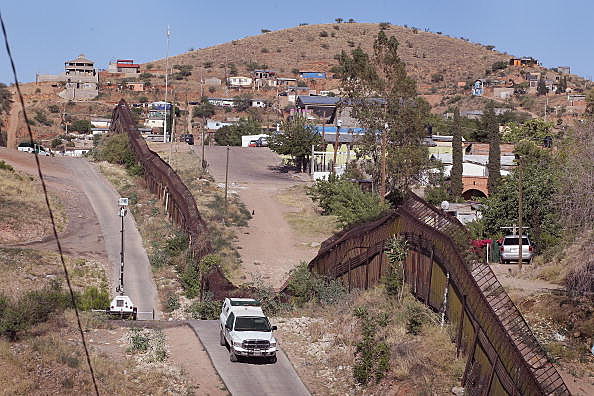
Showing posts with label migrants. Show all posts

Tuesday, October 31, 2023

el Día de los Muertos

Almighty God, you have knit together your elect in one communion and fellowship in the mystical body of your Son Christ our Lord: Give us grace so to follow your blessed saints in all virtuous and godly living, that we may come to those ineffable joys that you have prepared for those who truly love you; through Jesus Christ our Lord, who with you and the Holy Spirit lives and reigns, one God, in glory everlasting. Amen

Around Halloween, in downtown Tucson or west in the barrio neighborhoods across the river, there is a procession and a celebration, the latter of which somewhat reminds me of Burning Man. It does that because part of the ceremony is lighting a large temporary structure but this one is a brazier basket that holds tokens in memory of loved ones deceased. I have not gone that far, therapeutic though it might be. 

What I have done is stood along the parade route, noting people in wild or remarkable costumes, and especially noticing a group marching in memory of people lost in the desert. There were among that group founders of early efforts to reach migrants, including members of Derechos Humanos, Humane Borders, Tucson Samaritans, and No More Deaths, and one of the original Casa Alitas / Casa Mariposa hosts. 

We have a lot to mourn in the desert, on behalf of lost loved ones, even anonymous as many of them remain. This festival, and this presence of witnesses, reminds us that these people who have been lost have had lives to be remembered. We can celebrate them even as we deplore their fate. The desert is harsh and unforgiving. We need not be.

https://www.visittucson.org/events/festivals-and-annual-events/all-souls-procession/

Revelation 7:9-17

1 John 3:1-3
Matthew 5:1-12

https://hymnary.org/text/for_all_the_saints_who_from_their_labors

1. For all the saints, who from their labors rest,
who thee by faith before the world confessed,
thy Name, O Jesus, be for ever blessed.
Alleluia, Alleluia!

2. Thou wast their rock, their fortress, and their might:
thou, Lord, their Captain in the well-fought fight;
thou, in the darkness drear, the one true Light.
Alleluia, Alleluia!

3. O may thy soldiers, faithful, true, and bold,
fight as the saints who nobly fought of old,
and win, with them, the victor's crown of gold.
Alleluia, Alleluia!

4. O blest communion, fellowship divine!
We feebly struggle, they in glory shine;
yet all are one in thee, for all are thine.
Alleluia, Alleluia!

5. And when the strife is fierce, the warfare long,
steals on the ear the distant triumph song,
and hearts are brave again, and arms are strong.
Alleluia, Alleluia!

6. The golden evening brightens in the west;
soon, soon to faithful warriors cometh rest;
sweet is the calm of paradise the blest.
Alleluia, Alleluia!

7. But lo! there breaks a yet more glorious day;
the saints triumphant rise in bright array;
the King of glory passes on his way.
Alleluia, Alleluia!

8. From earth's wide bounds, from ocean's farthest coast,
through gates of pearl streams in the countless host,
singing to Father, Son, and Holy Ghost:
Alleluia, Alleluia!


The Hymnal 1982: according to the use of the Episcopal Church #287

Sunday, March 31, 2019

blessing the fleet

The annual blessing of the fleet— of water trucks—went well today. Regular volunteers and board members were joined by Buddhist Jewish Lutheran and Episcopal clergy as well as the current vice-mayor of Tucson. Attendees gladly laid their hands on the trucks, at the invitation of our convener, adding their own blessings...

Humane Borders Blessing of the Fleet Participants, March 31, 2019

The Rev. John Leech
Priest of the Episcopal Church

Rev. Mateo Chavez
Pastor, San Juan Bautista, Lutheran Spanish Language congregation

Vice Mayor Richard Fimbres
Life long resident of Tucson,
32yr career in Tucson Sheriff's Dept. 
US Army Vet during Vietnam era

Br David Buer, OFM
Franciscan Friar .. intentional small community living

Rabbi Avraham Alpert
Cantor, Congregation Bet Shalom

Abbot Ajahn Sarayut Amanta
Tucson Buddhist Meditation Center and Wat Buddhametta

The Rev. Steven Keplinger 
Rector, Grace-St Paul's Episcopal Church

Dinah Bear
Chair for Humane Borders Board of Directors

Rev. John Hoelter
Director, Humane Borders

https://humaneborders.org/

Here is the prayer that I offered on Sunday afternoon 31 March 2019:

Bless these trucks,
accompany their crews, 
as you accompany us
in all our journey --

LORD prepare us to receive
the gift of the stranger.
Even as they are far off
let us embrace them as
long lost family. May we not
be jealous of your Bounty
but fully let the living water
of your love refresh
the wanderer, the homecomer,
the lost, the bereaved,
the watchful, the joyous,
and all in the name
of your Love. Amen.

Thursday, December 31, 2015

Welcoming the Hidden Christ – Scripture Readings and Discussion Questions


Welcoming the Hidden Christ – Scripture Readings and Discussion Questions

Genesis 18:1-8 Abraham and Sarah entertain angelic visitors
The Lord appeared to Abraham by the oaks of Mamre, as he sat at the entrance of his tent in the heat of the day. He looked up and saw three men standing near him. When he saw them, he ran from the tent entrance to meet them, and bowed down to the ground. He said, “My lord, if I find favor with you, do not pass by your servant. Let a little water be brought, and wash your feet, and rest yourselves under the tree. Let me bring a little bread, that you may refresh yourselves, and after that you may pass on—since you have come to your servant.” So they said, “Do as you have said.” And Abraham hastened into the tent to Sarah, and said, “Make ready quickly three measures of choice flour, knead it, and make cakes.” Abraham ran to the herd, and took a calf, tender and good, and gave it to the servant, who hastened to prepare it. Then he took curds and milk and the calf that he had prepared, and set it before them; and he stood by them under the tree while they ate.

1. What is your picture of ideal hospitality?  2. Why welcome strangers?  3. What came of this meeting?  4. What can you expect from entertaining strangers?  5. Did Abraham and Sarah know what they were doing, who they were entertaining?  6. Do we recognize the people we are offering hospitality?  7. Does it matter?

Leviticus 19:33-34 (NRSV)
When an alien resides with you in your land, you shall not oppress the alien. The alien who resides with you shall be to you as the citizen among you; you shall love the alien as yourself, for you were aliens in the land of Egypt: I am the Lord your God.

Leviticus 19:33-34 (KJV)
And if a stranger sojourn with thee in your land, ye shall not vex him. But the stranger that dwelleth with you shall be unto you as one born among you, and thou shalt love him as thyself; for ye were strangers in the land of Egypt: I am the Lord your God.

Deuteronomy 10:17-19 (NRSV)
For the Lord your God is God of gods and Lord of lords, the great God, mighty and awesome, who is not partial and takes no bribe, who executes justice for the orphan and the widow, and who loves the strangers, providing them with food and clothing. You shall also love the stranger, for you were strangers in the land of Egypt.

1. These passages seem to be about respecting those who are already in the country – ‘resident aliens’. How do we treat new arrivals? “new Americans”? Do we treat temporary visitors and new citizens differently? Why?  2. What are the definitions of migrant, refugee, asylum seeker?


Deuteronomy 26:5-7 (NRSV)
You shall make this response before the Lord your God: ‘A wandering Aramean was my ancestor; he went down into Egypt and lived there as an alien, few in number, and there he became a great nation, mighty and populous. When the Egyptians treated us harshly and afflicted us, by imposing hard labor on us, we cried to the Lord, the God of our ancestors; the Lord heard our voice and saw our affliction, our toil, and our oppression.

Deuteronomy 26:5-7 (KJV)
And thou shalt speak and say before the Lord thy God, A Syrian ready to perish was my father, and he went down into Egypt, and sojourned there with a few, and became there a nation, great, mighty, and populous: And the Egyptians evil entreated us, and afflicted us, and laid upon us hard bondage: And when we cried unto the Lord God of our fathers, the Lord heard our voice, and looked on our affliction, and our labour, and our oppression…

1. This passage, and others, treats sojourners and aliens as somehow similar to widows and orphans and the sick and the imprisoned, that is, as people on the margins, but people with a special claim on our hearts.  2. How do we respond? Do our own experiences of marginalization (as children, minorities, unemployed, etc.) change our response?

1 Kings 17:8-16 The Widow of Zarephath shelters Elijah

Matthew 25:31-46 esp.
v.35 “I was a stranger and you welcomed me” and
v.43 “I was a stranger and you did not welcome me”

1. The scene of final judgment before the throne of God at the end of time is the setting of this passage. Can we imagine that?  2. Here the poor, the marginalized, and the stranger, are identified with Christ himself (though hidden). How does this help us confront the stranger in our own lives?

Romans 15:7
Welcome one another, therefore, just as Christ has welcomed you, for the glory of God.

Ephesians 2:14
For he is our peace; in his flesh he has made both groups into one and has broken down the dividing wall, that is, the hostility between us.

Ephesians 2:19-20
So then you are no longer strangers and aliens, but you are citizens with the saints and also members of the household of God, built upon the foundation of the apostles and prophets, with Christ Jesus himself as the cornerstone.

1. These passages talk about hospitality within the context of the unity within the church between Jews and non-Jews. Are there dividing walls in our own time that Christ breaks down?

Hebrews 13:2 (KJV)
Be not forgetful to entertain strangers: for thereby some have entertained angels unawares.

* * *

"Ya it's interesting how people don't make that hospitality and immigration connection." — someone who works on the border

The United Nations uses “migrant” generally to refer to people living outside their homeland for a year or more regardless of their reason or legal status and often includes international business people or diplomats who are on the move but not economically disadvantaged. The IOM’s World Migration Report 2005 defines “undocumented” or “irregular migrants” as “workers or members of their families not authorized to enter, to stay or to engage in employment in a state” … The 1951 United Nations Convention Relating to the Status of Refugees defines a “refugee” as one who, “owing to well-founded fear of persecution for reasons of race, religion, nationality, membership of a particular social group or political opinions, is outside the country of his nationality and is unable or, owing to such fear, is unwilling to avail himself of the protection of that country”… The United Nations High Commissioner for Refugees (UNHCR), … defines “internally displaced persons” as those “who have been forced or obliged to flee or to leave their homes or places of habitual residence, in particular as a result of or in order to avoid the effects of armed conflict, situations of generalized violence, violations of human rights or natural or human-made disasters, and who have not crossed an internationally recognized State border”…
            Some people may flee their homelands because of political persecution and fall under the category of forced migrants or refugees, for example, but their motivations may also stem from economic considerations and therefore the same people can be economic migrants as well. Most migrants are motivated by “push” factors that drive them away from their homelands and “pull” factors that draw them to better lives in another place. [The term] “refugees” highlights some of the most vulnerable people of the migrant population. (Daniel G. Groody CSC, “Crossing the Divide: Foundations of a Theology of Migration and Refugees” Theological Studies 70 (2009) 642-643 n.)

asylum-seeker:  “an individual who says he/she is a refugee, but whose claim has not yet been definitely evaluated.”  (UNHCR)

* * *

From Coracle, the quarterly magazine of the Iona Community (Winter 2015):

John R. Leech (USA): Recently I have observed and participated in a variety of border and immigration ministries in southern Arizona and northern Mexico, from hospitality (el comedor, Kino Border Initiative, Sonora) to deportation proceedings (Special procedures court, ‘Operation Streamline’, Tucson federal courthouse), from keeping vigil at el Tiradito shrine, remembering those who have died crossing the desert, to training with Tucson Samaritans, and serving at the comedor with Samaritans of Sahuarita and Green Valley.

I have spoken with members of St Michael and All Angels and St Andrew’s Episcopal Churches in Tucson, and with volunteers of the Casa Mariposa/Restoration Project, who have been meeting people at the Greyhound bus station in Tucson, people recently released from detention by ICE/Border Patrol.

This autumn the big news had two parts. First, the Tucson bus station began receiving eighty people a night, women with children, released with instructions to appear for a hearing within a month at an immigration court – presumably near family already in the United States – lest an order for removal close their case. No warning. Just dropped off.

Second, the incredible news that the Border Patrol has flown a thousand kids from Texas to Arizona and then put them into a warehouse (I’ve seen it from the road – it is meant for pallets of flour, not for people) in Nogales, AZ. These are unaccompanied minors from Central America (El Salvador, Guatemala, Honduras), refugees from violence and extreme poverty. The warehouse serves as a temporary (promise: 72 hours) detention facility. It is on La Quinta Road near the truck crossing into Mexico.

The ongoing need for change in policy and practice, compassionate work for change and a deeper understanding of our fellow human beings – exploited and caught in the middle of a gigantic and ongoing crisis – and the need to reach out in love across boundaries: all this continues.

One thing I have been thinking about lately is that this situation is similar to so many others in humanitarian relief and development work: there is an immediate crisis that gets our attention – and an ongoing problem that needs lasting sustained effort.

All of a sudden on our own southern border is an immense influx of refugees, in two remarkable groups, women with children seeking to be reunited with their families, and unaccompanied minors, mainly teenagers but also younger children, who have been sent north without adults.

Preponderantly these people have come north through Mexico from El Salvador, Guatemala and Honduras. Why? Besides a sell-job by human smugglers, there are economic and political reasons for this migration.

People come to Arizona to work, to re-unite with their families, or to find and begin a new chapter in their life.

We need to practice a theology of hospitality – a spirituality of migration. We were strangers once too. So – an ongoing need is there. The need for change – in our national policies, in our practices of welcome, in our influence on conditions in other countries, in our attitudes toward the ‘foreigner’ – continues.

(“Sparks of the Light”, Coracle, Winter 2014, 13-14)


Wednesday, December 9, 2015

Welcoming the Hidden Christ - reading list

Gray-Reeves, Mary, and Michael Perham. The Hospitality of God: Emerging Worship for a Missional Church. New York: Seabury Books/Church Publishing. 2011.

Morris, Clayton L. Holy Hospitality: Worship and the Baptismal Covenant. A Practical Guide for Congregations. New York: Church Publishing. 2005.

Pratt, Loni Collins, and Daniel Homan, O.S.B. Radical Hospitality: Benedict's Way of Love. Brewster, MA: Paraclete Press. 2002.

Smith, Gary, S.J. Radical Compassion: Finding Christ in the Heart of the Poor. Chicago: Jesuit Way/Loyola Press. 2002.

Spellers, Stephanie. Radical Welcome: Embracing God, The Other, and the Spirit of Transformation. New York: Church Publishing. 2006.


Friday, November 6, 2015

prayer for the migrant

Prayer for the Migrant, from the program at the conclusion of the pilgrimage to San Xavier du Bac Saturday 31 October 2015 organized by Derechos Humanos to remember those who have died crossing the desert in the past year:

Creator, full of love and mercy, I want to ask you for my migrant brothers and sisters. Have compassion and protect them, as they suffer mistreatment and humiliations on their journeys, they are labelled as dangerous, and marginalized for being foreigners.

Make them be respected and valued for their dignity. Touch with your goodness the many that see them pass. Care for their families until they return to their homes, not with broken hearts  but rather with hopes fulfilled. Let it be.

Tuesday, July 14, 2015

migrant spirituality reading list

 
Suggestions for Further Reading – Migrant Spirituality
(Cadged from Marjorie King, Suzanne Hesh, Bob Phillips, and Roxanne Ramos)
Readings about migrants in Southern Arizona
Ferguson, Kathryn, Norma A. Price, and Ted Parks. Crossing with the Virgin: Stories from the Migrant Trail. Tucson: University of Arizona Press, 2010.
Regan, Margaret.  Detained and Deported: Stories of Immigrant Families Under Fire. Boston: Beacon Press, 2015. This Tucson Weekly columnist takes an intimate look at the people ensnared by the US detention and deportation system, the largest in the world.  Using volatile Arizona as a case study, with special attention to the separation of families and the treatment of women, she conjures up the harshness of the detention centers and travels to Mexico to report on the fate of deportees stranded far from their families in the United States. The book is a humanizing and rare glimpse into the lives of those caught up in the US immigration enforcement cycle.
Regan, Margaret.  The Death of Josseline: Immigration Stories from the Arizona Borderlands.  Boston: Beacon Press, 2010.
Urrea, Luis Alberto.  The Devil’s Highway: A True Story. New York: Back Bay Books, Little, Brown Publishing, 2004.

Migration and the Church
Brown, Robert McAfee. Unexpected News: Reading the Bible with Third World Eyes. Philadelphia: Westminster Press, 1984. 
Carroll, M. Daniel R.  Christians at the Border: Immigration, the Church, and the Bible. Grand Rapids: Brazos Press, Baker Publishing, 2008.
Campese, Gioacchino, CS. El Via Crucis de Jesus Migrante, The Way of the Cross of the Migrant Jesus. Liguori, MO: Liguori Press, 2006. 
De La Torre, Miguel A. Reading the Bible from the Margins. Maryknoll: Orbis Books, 2002.
Groody, Daniel G. and Gioacchino Campese, editors. A Promised Land, A Perilous Journey: Theological Perspectives on Migration. Notre Dame, IN: University of Notre Dame Press, 2008.
Kim, Fr. Simon C., compiler. El Via Crucis: The Migrant’s Way of the Cross. Liguori, MO: Liguori Press, 2013.
Maruskin, Joan M.  Immigration and the Bible: A Guide for Radical Welcome. New York: Women’s Division, The General Board of Global Ministries, United Methodist Church, 2012.
Myers, Ched and Mathew Colwell. Our God is Undocumented: Biblical Faith and Immigrant Justice. Maryknoll: Orbis Books, 2012.
Shaull, Richard and Richard Falk. Naming the Idols: Biblical Alternatives for U.S. Foreign Policy. Meyer-Stone Books, 1988.
Soerens, Matthew and Jenny Hwang Yang. Welcoming the Stranger: Justice, Compassion and Truth in the Immigration Debate, Westmont, IL: InterVarsity Press, 2009.

Bowden, Peg. Land of Hard Edges: Serving the Front Lines of the Border. (Tucson: Peer Publishing, 2014)
Dear, Michael. Why Walls Won't Work: Repairing the US-Mexico Divide. (New York: Oxford University Press, 2013)
Oscar Martinez, The Beast: Riding the Rails and Dodging Narcos on the Migrant Trail. (Verso, 2013)
Montoya, Mace. The Deportation of Wopper Barraza: A Novel. (2014)


Cross-Border Tour Suggested Reading List (Border Community Alliance)
A Culture of Cruelty: Abuse and Impunity in Short-Term U.S. Border Patrol Custody, No More Deaths, 2011, http://www.nomoredeaths.org/Abuse-Report-Culture-of-Cruelty/View-category.html
The Devil’s Highway: A True Story, Luis Alberto Urrea, Bay Back Books 2005
Documented Failures: The Consequences of Immigration Policy on the U.S.-Mexico Border, Michael S. Danielson, American University, Report prepared for the Kino Border Initiative Nogales, Arizona, U.S.A. and Nogales, Sonora, Mexico with funding from Catholic Relief Services of Mexico, http://www.jesuit.org/jesuits/wp-content/uploads/Kino_FULL-REPORT_web.pdf
La Frontera: The Border, blog by BCA board member, Peg Bowden, www.arroya.org
Manifest Destiny | Luis Alberto Urrea | Orion Magazine
http://www.orionmagazine.org/index.php/articles/article/6813/
Mexico: What Everyone Needs to Know, Roderic AI Camp, Oxford University Press 2011
Arizona’s Senate Bill 1070: A Case Study for State-Sponsored Immigration Policy, an honors thesis by USF graduate student and BCA/FESAC summer 2012 intern Ryan Murphy is available by contacting BCA at the address below.
Why Walls Won’t Work – repairing the US-Mexico divide, Michael Dear, Oxford University Press, 2013.
Two Nations Indivisible: Mexico, The United States, And The Road Ahead By Shannon K. O'Neil, Oxford University Press, Inc. 2013

Border Community Alliance
In partnership with Fundación del Empresariado Sonorense A.C. (FESAC)
La Entrada de Tubac / 2221 E. Frontage Rd., Building F, Suite 201 / Tubac, AZ / 520.398.3229
Mail: PO Box 1863, Tubac, AZ. 85646


Kino Border Initiative (KBI) Movie List 
By: Roxane Ramos
Over the past two decades, many films have addressed the trials and struggles, hopes and dreams of families and individuals who cross the U.S.–Mexico border to seek a better life and to be with loved ones. In addition to the titles listed below, there are also My Family (1995), Sin Nombre (2009), and A Better Life (2013).
Now a classic and one of the first movies about the struggles and hardships facing those who choose to migrate to the U.S., El Norte (1983) by Gregory Nava relates the experience of a teen-aged brother and sister who flee the violence of their home in Guatemala for the promise of a better life in Los Angeles.
Among the four narratives Alejandro González Iñárritu includes in Babel (2006), one details the interwoven lives of a San Diego family and their undocumented Mexican nanny and how crossing the border to attend a family wedding can result in painful and irreparable consequences.
Under the Same Moon (2007), directed by Patricia Riggen, makes palpable the dire and complicated decisions faced by separated families. An adolescent boy leaves Mexico after his grandmother dies to seek out his mother who works as a maid in the U.S.
In Who Is Dayani Cristal? (2013), actor and activist Gael García Bernal retraces the journey of a migrant who died along the stretch of desert known as “the corridor of death,” providing a rare view of what migrants experience on el camino. Each year 400–500 migrants lose their lives during the crossing. For more information about the tragedy of migrant deaths in the desert, please see this article from the KBI July issue of Passages: www.kinoborderinitiative.org/deaths-in-the-desert/.
Documented (2013), a film by Pulitzer-Prize-winning journalist José Antonio Vargas, recounts Vargas’s experience of migrating to the U.S. at the age of 12 from the Philippines to live with his documented grandparents. Vargas speaks out about his undocumented status in the hopes of illuminating the challenges of mixed-status families and advocating for policy change.

KBI Reading List By: Roxane Ramos
The list below covers only a small selection of the books available about the migrant experience, immigration and border life. They include works of fiction, non-fiction volumes, art books, memoirs, and children’s books, and all help to inform us about the issues of immigration, cultural challenges, family separation and even basic survival.
Non-fiction:
The Devil’s Highway: A True Story
 Luis Alberto Urrea, Little, Brown and Company, 2004.
Enrique’s Journey
 Sonia Nazario, Random House, 2006.
The World of Mexican Migrants: The Rock and the Hard Place 
Judith Adler Hellman, New Press, 2008.
Dead in Their Tracks: Crossing America’s Borderlands in the New Era 
John Annerino, University of Arizona Press, 2009.
Crossing With the Virgin: Stories from the Migrant Trail
 Kathryn Ferguson, Norma A. Price and Ted Parks, University of Arizona Press, 2010.
Line in the Sand: A History of the Western U.S.–Mexico Border
 Rachel St. John, Princeton University Press, 2011.
Run for the Border: Vice and Virtue in U.S.–Mexico Border Crossings 
Steven Bender, NYU Press, 2012.
The Beast: Riding the Rails and Dodging Narcos on the Migrant Trail 
Oscar Martínez, Verso, 2013.
Up Against the Wall: Reimagining the U.S.–Mexico Border
 Edward S. Casey and Mary Watkins, University of Texas Press, 2014.
Memoir:
Becoming Dr. Q: My Journey from Migrant Farm Worker to Brain Surgeon
 Alfredo Quiñones-Hinojosa (with Mim Eichler Rivas), University of California Press, 2011.
Crossing Borders: Personal Essays 
Sergio Troncoso, Arte Público Press, 2011.
Taking Hold: From Migrant Childhood to Columbia University
 Francisco Jiménez, HMH Books for Young Readers, 2015.
The Land of Hard Edges: Serving the Front Lines of the Border
 Peg Bowden, Peer Publishing, 2014.
Fiction:
Women Hollering Creek and Other Stories
 Sandra Cisneros, Vintage, 1992.
The Long Night of White Chickens
 Francisco Goldman, Atlantic Monthly Press, 1992.
Under the Feet of Jesus
 Helena María Viramontes, Plume, 1996.
Mother Tongue 
Demetria Martínez, One World/Ballantine, 1997.
The River Flows North
 Graciela Limón, Arte Público Press, 2009.
The Madonnas of Echo Park: A Novel 
Brando Skyhorse, Free Press. 2011.
Art:
Ambos Nogales: Intimate Portraits of the U.S.–Mexico Border
 Lawrence Taylor, School of American Research Press, 2002.
Crossings: Photographs from the U.S.–Mexico Border 
Alex Webb, Essay by Tom Miller, Monacelli Press, 2003.
Curating at the Edge: Artists Respond to the U.S./Mexico Border
 Kate Bonansinga, University of Texas Press, 2014.
Children: My Name Is Jorge (poems for ages 4–8)
 Jane Medina, WordSong, 1999.
My Diary from Here to There/Mi diario de aqui hasta allá (for ages 7–10)
 Amada Irma Pérez, Children’s Book Press, 2002.
From North to South/Del norte al sur (for ages 6–9) 
René Laínez, Children’s Book Press, 2010.
In my Family/En mi familia (for ages 7–12) 
Carmen Garza, Children’s Book Press, 2013.
Pancho Rabbit and the Coyote: A Migrant’s Tale (for ages 6–9)
 Duncan Tonatuih, Harry N. Abrams, 2013.

Return to Sender (for ages 8–12)
 Julia Alvarez, Yearling, 2013.


Friday, September 19, 2014

The Angel of the South


The Angel of the South

The Angel of the North
broods beside the motorway
past and future
brought into the present
vast arms wingspread
Spitfire image
a past of glory, a future of hope,
when I saw the Angel of the North.

I would like to see the Angel of the South
brooding witness over the border crossing
Mariposa
metal fences
rework the barriers
wrought into a sign of peace
witness above us the arms widespread
“Come to me all you who are weary”
standing besides the coyotes’ spotters
the smugglers on the hill
overlooking the border
but watching the crossers
south with nothing
but what is in their hands,
north with nothing to declare,
but a few cervezas under the belt,
or a 150 Fords in the railcars
or a memory of the people with nothing
in their hands but beans and rice
and a memory of welcome at el comedor.

El comedor del Kino is a place of welcome
where people fetch up on the shore
of exile, newly deported from el Norte.
Now they have someone
who at least speaks their language
or doesn’t
but speaks the universal sign-language of peace
a plate of food
a chance to be human to human
rather than one to be expelled
or shipped
across the barriers.

So I want to see the Angel of the South
metal re-wrought
from fending off
to sheltering
sky-witness to a new horizon
a border crossing of hope not fear.


Tucson, Arizona
© September 19, 2014.

JRL

Thursday, September 18, 2014

everybody welcome

A day's wage ... how does that relate to hospitality?

A landowner recruits some day laborers. He goes down to the marketplace - or the Shell station. There are people standing around, hoping someone will hire them that day, give them a chance to get their daily bread.

Give us this day our daily bread...

So the landowner takes whom he can find and sends them out to work in the vineyard.

It is a hot day, we are told; perhaps they are in Sonoma - or Arizona.

In the heat of the day - here in America - workers get a lunch break. They take it in the shade of the trees by the side of the road. You see them on the way to the tasting room. 

How did they get here? Today - you know. This season - perhaps they live here, perhaps they have green cards, perhaps they "entered the United States by a legal point of entry." 

Perhaps they are among the one-third of vineyard workers who have no papers to show.

But they come and work, anyway.

Are they welcome?

The wine industry, one vineyard owner told me, would collapse without them.

A long time ago there was a harvest in another field. It was the barley harvest and the landowner was Boaz. It was his family farm - near Bethlehem. 

He saw someone out in his field, following his work crew, picking up the grains that had fallen, that they'd missed.

- Who is that gleaning in the field?
- It is a stranger, a foreigner, who walked across the desert, for several days, from the mountains of that other country. 

She is here, a widow, destitute.
- She came alone?
- No, she came with her mother-in-law, to look after her. Naomi.
- Naomi. My cousin.

We are all cousins here, Steven Talmadge the Lutheran bishop said. All of us here along the Borderlands. And in Tucson sometimes you feel that's true. We are all related - to the land, to each other, to our common situation.

Sometimes we are the stranger, welcomed or not. And sometimes we are the host.

Boaz put down his hoe, ran his hand across his forehead, and thought a minute. 

- Let her glean - among the sheaves ... even pull out some grain for her. And let no one bother her - tell the men that.

Later he saw her, and said, 

- I have heard about you, about all you have done for your mother-in-law, since you left your own country and came here to a land you did not know. You sought shelter under the wings of Yahweh. Bless you!


I was a stranger ... did you welcome me?


A stranger comes to town, a man goes on a journey: two stories  - the only two, some say - but they are really one.

Once some years ago I went to call on Cele Peterson in her store. She said she only had twenty minutes as she was expecting a visitor. In the time we had she said of the border, "We've got to stop doing this" - and she held her hands palms-out as if fending off a stranger - "and starting doing this" - and she faced her hands towards each other and interlaced the fingers. And then I opened the door to Gabby.

You shall also love the stranger, for you were strangers in the land of Egypt. 

For the Lord your God is God of gods and Lord of lords, the great God, mighty and awesome, who is not partial and takes no bribe, who executes justice for the orphan and the widow, and who loves the strangers, providing them with food and clothing .... You shall fear the Lord your God; him alone you shall worship; to him you shall hold fast, and by his name you shall swear.  

(Deuteronomy 10:19, 17-18, 20)

In Scotland, in Duddingston Village, I was the guest - and invited to a Queen's Jubilee wine-and-cheese party. (We were about a mile from Holyroodhouse and she was in residence.) There in the garden someone introduced me and someone identified me ... Oh, you're the foreigner ... strange feeling.

When the priest takes your offering, you shall make this response before the Lord your God:

"A wandering Aramean was my ancestor; he went down into Egypt and lived there..." (Deuteronomy 26:5)

I was a stranger and...
 ... you welcomed me.
 ... you did not welcome me.
(Matthew 25:35, 43) 

Who are we welcoming? By the oaks of Mamre Sarah and Abraham pitched their tent. In the heat of the day three strangers approached. Come stay with us. Let us prepare you something to eat. Here, let me wash your feet. You must be tired...

When an alien resides with you in your land, you shall not oppress the alien. The alien who resides among you shall be to you as the citizen among you; you shall love the alien as yourself, for you were aliens in the land of Egypt; I am the Lord your God.

Over and over in the Old Testament we hear stories of hospitality, of welcome to strangers; Lot, in Genesis 19; the father of Gideon, in Judges 6; the father of Samson in Judges 13. Like the father of Isaac (to be) they welcome strangers...

Who are we welcoming?


In the story of Abraham and Sarah and the three men at the oaks of Mamre, what do we see as the ideal of hospitality?

In the story of Ruth, who is the stranger? 

What does the story of the vineyard tell us about the abundance of God? 

In a time of harvest plenty, or of famine, what is fair? just? generous?

What do these stories tell us about fear, hope, longing, joy?

What do they tell us about home?

Come down, Zacchaeus, for tonight I must stay at your house.


"God of unfailing generosity, making no distinctions of wealth or ability, root out from us the spirit of envy and greed, and transform our bitterness into an open-hearted welcome of those we are tempted to despise. We pray this after the pattern of Jesus and in the power of the Spirit." -- collect prayed at the Come and See service, St Philip's in the Hills, Tucson, 4pm Sunday 21 September 2014. (from Jim Cotter, http://cottercairns.co.uk)

These are notes for a leading a reflection on the gospel on Sunday 21 September 2014 at the 4pm Come and See service at St Philip's in the Hills, an Episcopal Church in Tucson, Arizona. JRL+


Wednesday, July 2, 2014

The Pilgrimage of the Heart


For the last six months I have observed and participated in a variety of border and immigration ministries in southern Arizona and northern Mexico (Sonora) from hospitality (el comedor, Kino Border Initiative, Sonora) to deportation proceedings (special procedures court, "Operation Streamline", Tucson federal courthouse), from keeping vigil at el Tiradito shrine, remembering those who have died crossing the desert, to training with Tucson Samaritans - and serving at the comedor with Samaritans of Sahuarita and Green Valley.

And I have gone to meetings with a variety of pastors and deacons - witnessing in action the Children's Clinic at St Andrews Nogales Arizona with their pastor, coffee house chats with a deacon, and several committee meetings with the Border and Immigration Committee of St Philips in the Hills, as well as lectures by Fr Daniel Groody CSC at the university (a theology of migration) and film (“Who is Dayani Cristal?”).

I have spoken with members of St Michael and All Angels and St Andrew’s Episcopal Churches in Tucson, and with volunteers of the Casa Mariposa/Restoration Project who have been meeting people at the Greyhound bus station in Tucson, people recently released from detention by ICE/Border Patrol ...

This past month the big news had two parts. First, the Tucson bus station began receiving eighty people a night, women with children released with instructions to appear for a hearing within a month at an immigration court - presumably near family already in the United States - lest an order for removal close their case. No warning. Just dropped off.

Second, the incredible news that the Border Patrol has flown a thousand kids from Texas to Arizona and then put them into a warehouse (I've seen it from the road - it is meant for pallets of flour, not people) in Nogales AZ. These are unaccompanied minors from Central America (El Salvador, Guatemala, Honduras) refugees from violence and extreme poverty. The warehouse was empty recently; just reopened it serves as a temporary (promise: 72 hours) detention facility. It is on La Quinta Road near the truck crossing into Mexico.

The local volunteer agencies (including Restoration Project and more recently Catholic Community Services of Tucson) apparently already have more than they need of in-kind donations of supplies (toys, food, water, clothing) to meet the immediate needs of the refugees.

The ongoing need for change in policy and practice, compassionate work for change and a deeper understanding of our fellow human beings, exploited and caught in the middle of a gigantic and ongoing crisis, and the need to reach out in love across boundaries: all this continues.

It helps to see this effort as a pilgrimage of the heart. On my own journey to the border, and to Children's Clinic at St Andrews, Nogales, Arizona, I also visited San Xavier du Bac, the mission founded centuries ago by Fr Eusebio Kino, which continues to function as a place of pilgrimage and a spiritual center for southern Arizona and the surrounding area. The pilgrimage of the heart - from the heart of one human being to another - is the ongoing challenge, and blessing.

One thing I have been thinking about this past week is that this situation is similar to so many others in humanitarian relief and development work. There is an immediate crisis that gets our attention - and an ongoing problem that needs lasting sustained effort. All of a sudden on our own southern border is an immense influx of refugees, in two remarkable groups, women with children seeking to reunite with their families, and unaccompanied minors - mainly teenagers but also younger children - who have been sent north without adults. Preponderantly these people, in both groups, have come north through Mexico from El Salvador, Guatemala, and Honduras. Why? Besides a sell job by human smugglers there are economic and political reasons for this migration.

People come to Arizona to work, to re-unite with their families, or to find and begin a new chapter in their life.

We need to practice a theology of hospitality - a spirituality of migration. We were strangers once, too - how shall we welcome the new?

So - an ongoing need is there. The need for change - in our national policies, in our practices of welcome, and in our influence on conditions in other countries, as well as our attitudes toward the 'foreigner' - continues.

John R. Leech
Tucson, Arizona
July 2, 2014


(“Sparks of the Light”, Coracle, the quarterly magazine of the Iona Community, Winter 2014, 13-14)

http://iona.org.uk/media/coracle/