Sunday, December 28, 2025
First Sunday after Christmas
Sunday, June 23, 2024
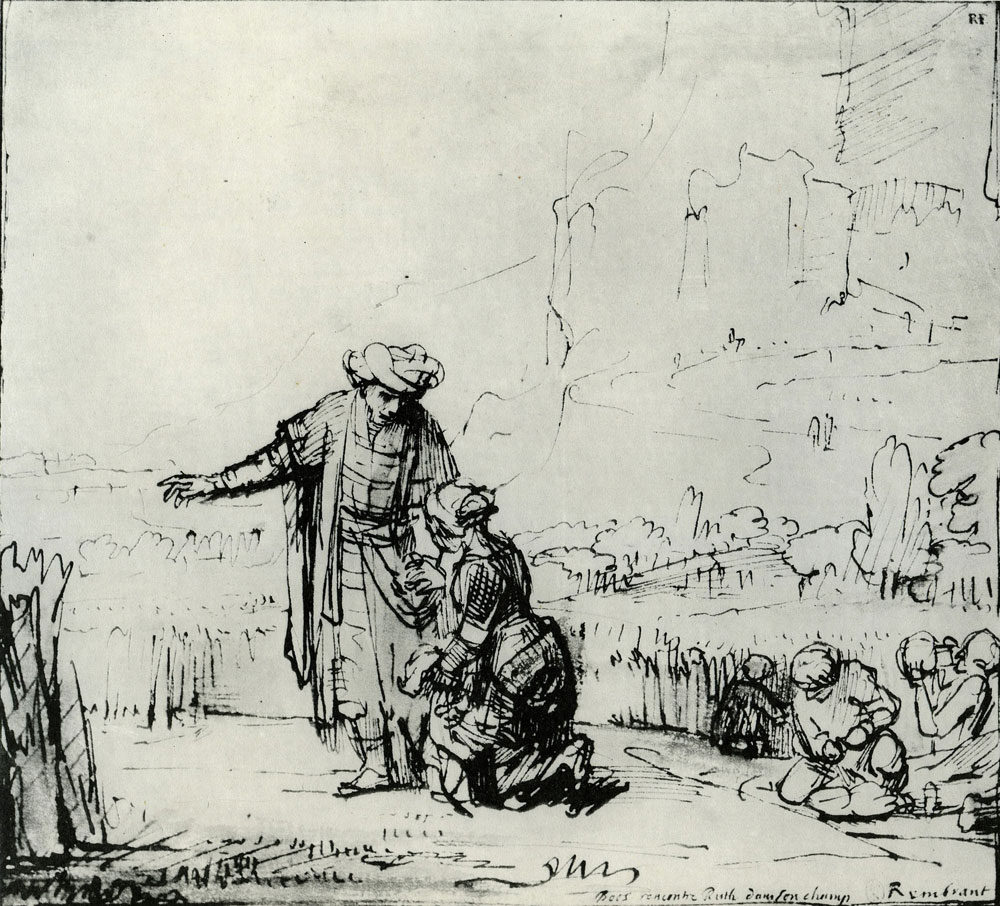
Ruth 2 : a harvest home
Rembrandt - Boaz Meeting Ruth in His Fields
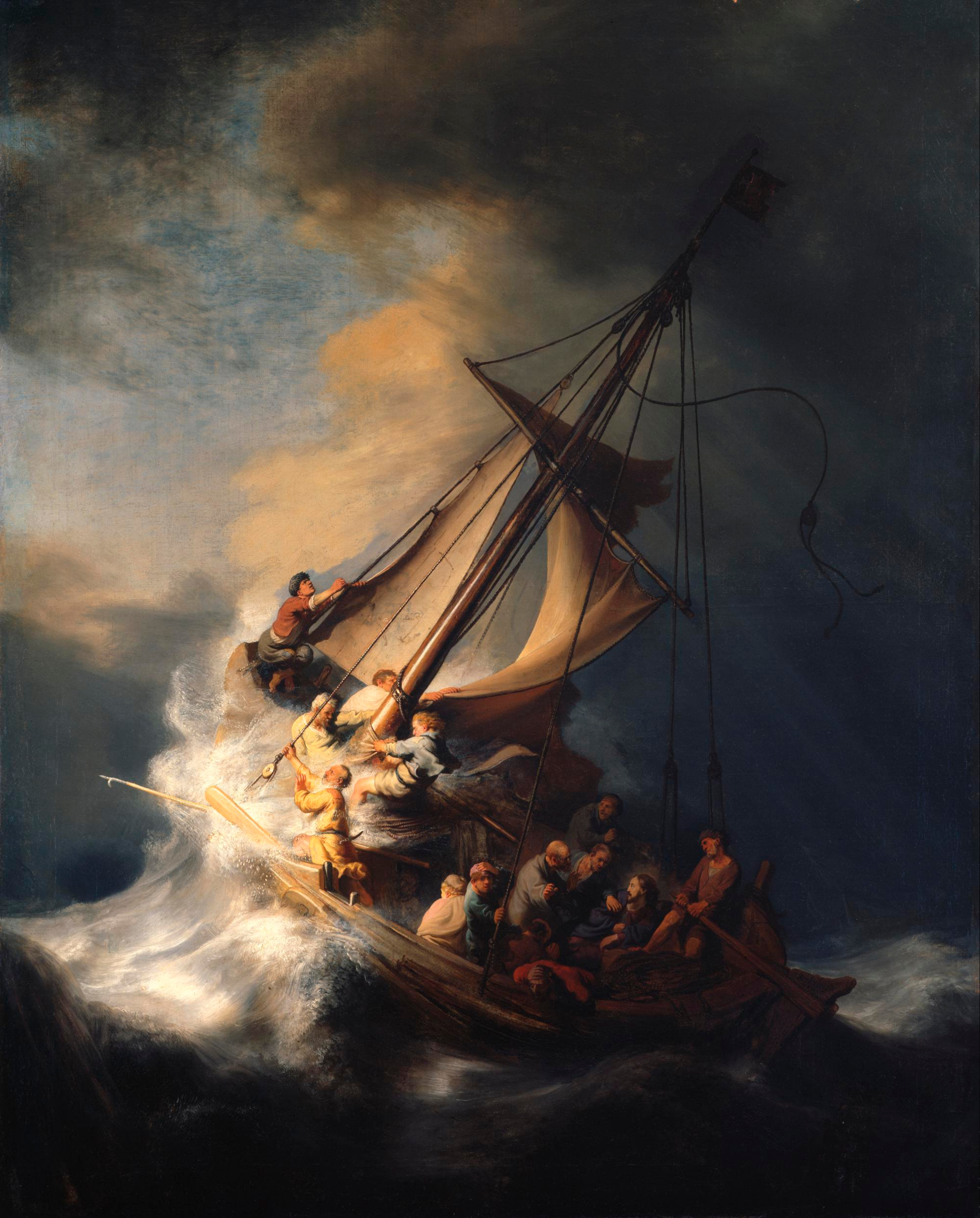
“Don’t you even care?” “Have you no faith?”
And yet when the storm waters are still, there is still need for faith, perhaps a quieter kind. Impoverished and far from home, our faithful Ruth shows a quiet confidence, a faith that means she persists; she persists when she is among the poor and hungry who follow the harvesters as they reap and gather the grain.
Whatever her status was back home in Moab, now in Bethlehem she is serving and servant, a faithful daughter, though daughter-in-law, and will not give up. She quietly continues in her service ministry to her mother-in-law. What benefit the day’s work may yield beyond a nightly staving off hunger she probably cannot know.
There is a prayer, For Quiet Confidence:
O God of peace, who has taught us that in returning and rest we will be saved, in quietness and confidence will be our strength: [Free us from want; free us from fear.] By the might of your Spirit lift us, we pray, to your presence, where we may be still and know that you are God; through Jesus Christ our Lord. Amen.
This is one prayer we each may need from time to time. Sure sometimes “sit down, sit down, you’re rocking the boat!” may be what we need to hear (or sing) but there are quieter times, even more desperate times, when hope takes quieter forms, love takes quieter forms, and faith is in the quiet work of a humble task.
As we have taken note in the past, gleaning was a custom, even a law, among the people of the ancient Bethlehem community in which Ruth found herself. Mandated in the Torah books of Leviticus and Deuteronomy, it was common custom enough to figure in the writings and the prophets of later Israel. A simple practice, it was not straightforward charity, not a hand out or a hand up, as the saying would have it. Gleaning was as much about not-selfishness, about not taking it all for yourself as if it was yours by right; and as much about abundance and dependence on God, in good times and bad, as keeping the Sabbath.
Remember the story of Elijah and the widow and her son? In later times than the time of Ruth and Naomi, another famine had come to the land, and the fugitive prophet Elijah had fetched up at the humble, hardscrabble home of a widow. They were desperate for food: the story goes on to indicate that God’s provision alone kept them alive.
But isn’t that always the case? Are we not always dependent on God for - our daily bread? In times of prosperity we may not feel so need-driven dependent but we all always live by the grace of God.
(Perhaps Boaz realized that, and lived that way. He certainly doesn’t seem to think the harvest all belongs to him, and that he should run off anyone in need. Certainly Ruth is an exemplar, modeling the best behavior of a gleaner; not all are so attractive in piety or persistence.)
But it is there all the same. Deserve has nothing to do with it; except all deserve as all depend. We all live by the grace and generosity of God. Give us today our daily bread, as you have given it to Ruth and Naomi, Boaz and the harvest hands and gleaners, from their time and before, to this day.
In the food banks of the church and of our community organizations, the custom and practice, the blessing and benefit, of gleaning continues; whether we are donor or recipient we take part in this ancient happy custom.
(In Tucson: Interfaith Community Services, Community Food Bank - and its many partners, and gleaners! at Iskashitaa Refugee Network.)
“Grief is love without a place to land” – Jennifer Harvey, ‘Grief and Love in a Difficult World: A Public Theology of “Now What?”’ [https://www.youtube.com/watch?v=xB3TJZrDdeY&t=1490s]
What does love look like when it lacks a place to land?
That would seem to describe Naomi well enough as she was left without husband or sons - menfolk - in Moab, in exile from her homeland. She is grieving. But she is not alone. She has two daughters-in-law; one does the conventional thing and goes back to her mother’s house; the other does something extraordinary, heroic: she accompanies her mother-in-law back to a land that is foreign to her and to whom she is foreigner.
As Pastor Bob Jones pointed out in his June newsletter to Santa Cruz Lutheran Church, she becomes more than friend, she is adopted into full membership in the community.
Witness how Naomi keeps referring to Boaz as “our kinsman” - not “mine” but “ours” - something is afoot. Naomi and Ruth cling, or cleave, to each other, even after the menfolk who initially bound them together are gone. Grief is love without a place to land.
And so in contrast the grief they share becomes love that does have a place to land: with each other, with community, with family reformed and renewed.
"Justice is what love looks like in public" – Reggie Willams, ‘MLK, America, & Abolition’ [https://youtu.be/rj4I_bmV8bo?feature=shared] quoting Cornel West [https://www.youtube.com/watch?v=nGqP7S_WO6o]
And one step toward that is the public embodiment, enactment, of justice, in the gleaning. It is a custom and a law, here followed with love. "Justice is what love looks like in public." Gleaning is a public revelation of what love looks like: justice.
‘When you reap your harvest in your field and forget a sheaf in the field, you shall not go back to get it; it shall be left for the alien, the orphan, and the widow, so that the Lord your God may bless you in all your undertakings.’ (Deuteronomy 24:19)
That is justice. And beyond justice, as indeed we learn with Jesus. A full measure, tamped down and spilling over, of not just what convention and custom, the letter of the law, demands; but a generous overspilling abundance of the spirit of the law. God provides; providence is God’s business.
We join in that holy task as we support or patronize food banks, and other sharing services, as we work for a world free from want, free from fear.
There is an old word from the old world we may want to revive: harvest home. Harvest home is both the work of gathering and gleaning, the threshing and winnowing, and the festival celebration when day is done.
As the parable of the sower taught us last week, the seed germinates and grows, the farmer knows not how: God tends the tender plant. And we rejoice in the harvest-home.
** ** **
JRL+
Santa Cruz Lutheran Church, Tucson, Arizona. Sunday 23 June 2024. https://www.facebook.com/1236072680/videos/1623012738554437/
https://www.iskashitaa.org/
https://www.communityfoodbank.org/
https://www.icstucson.org/
2024 June 23 Hymn of the Day: ELW #597 “My Hope is Built on Nothing Less”
First Reading: Ruth 2. Psalm: Psalm 147. Second Reading: 2 Corinthians 6:1-13. Gospel: Mark 4:35-41
Sunday, December 26, 2021
small words
In the name of God, source of all Being, eternal Word, and holy Spirit. Small words. Big meanings. Spirit. Word. Being. God.
Our first words as children sound small and seem simple. Hot, cold, brother, sister, mine, papa. Mama. But the meanings loom large. When we are small, is there anything more important than what those small words convey?
The first words of the gospel of John are small words.
Small words. Large meanings. Light. Life. Word. Flesh.
And then there are the words at the beginning of the four gospels. Matthew begins with a genealogy. Luke begins with birth announcements. Mark starts straight out with the Baptist in the wilderness. The gospel of John begins, “in the beginning” - or rather before.
“In the beginning was the Word, and the Word was with God, and the Word was God. The Word was with God in the beginning. Everything came into being through the Word, and without the Word nothing came into being. What came into being through the Word was life, and this life was the light for all people. The light still shines in the darkness and the darkness has never put it out… The Word became a human being and lived among us. We have seen his glory, glory like that of a father’s only son, full of grace and truth.” John 1:1-4, 14.
What this passage has personally meant to me has changed and grown over the years since I first read it. In high school days, “read the gospel of John first” was common advice to prospective converts.
This advice held for many years for me, until at the suggestion of Carl F. H. Henry, the Key ‘73 initiative chose Luke-Acts for widespread distribution.
Luke has the familiar Christmas story, with angels and shepherds and all. And Matthew has the magi.
Inter-Varsity used to tell people to read Mark first as the shortest and earliest. Read it without notes or advice, they said, as if it were in a sealed envelope you were opening for the first time.
Which would leave us to read it each with our own peculiar prejudices - or ones easily supplied.
John however is admittedly abstract - where are we? In the cosmic vision of Christ Pantocrator, all-ruler, as in those Byzantine ceilings. His serene serious visage looms over us, grand and remote. The human Jesus appears later in John, but appear he does.
At first though we have some basic precepts to lay down. The creator is not remote; he is Emmanuel: God with us.
Jesus was there from the beginning, in fact the beginning of all things began with him: he was already there and all that came into being came through him. Whoa! Heady concept. And how cool is that?
At least I thought so, as a teenager. And I thought I’d got it. At least a grasp on the coattails. How long could I, have I, chewed over the meaning of this passage ever since? And how long and how often have you?
However often we hear it we just seem to spiral deeper into its meaning. Once, some Sundays ago, Deacon Jefferson Bailey and I agreed that when we read the gospel in church, every time it says something new to us - and with the prolog to the gospel of John something deeper emerges.
Indeed I like what Lesslie Newbigin calls it: not so much a prolog (as to a Shakespeare play) as an overture, as to an opera. And indeed John has everything in it - except the kitchen sink.
Though it comes close even to that.
The whole cosmos - the whole created order - is in there for sure, in just the first five sentences.
Julian’s hazelnut or cosmologist’s infinitesimal particle have nothing on John: before it began, he was - he, Jesus, as the Son of God, pre-existed, existed before, anything was made that was made… and so the mind-blowing (as we said in the sixties) phrase … ‘and all that came into being came into being through him.’
Through him all things came to be. The logos, “the eternal word manifest in the reason and order of the cosmos of which it was the creative agent,” was not a new concept to first-century people.
(Massey Shepherd, The Oxford American Prayer Book Commentary, 1963, 97)
But now– something new. The Word has become flesh, and dwelt among us.
It all sounds so abstract: source of all being, eternal Word, holy Spirit.
If you had asked Mary on December 26th if it felt abstract you might have gotten a short answer. Joseph might remark that the organizing principle of the cosmos had just wet himself.
[We have just heard on Christmas Eve the story of the manger, about the humanness of Jesus, and all of heaven’s glory in a little room. Shepherds kept their watch by night; and angels sang.]
“This pre-existent, eternal and divine word has now been manifested in the flesh, in the person of Jesus Christ. And that life gives not only light to the understanding,” - intellectual knowledge - “that we may know the truth, but also power to the will, that we may be obedient sons [children] of God. For in Him [Christ] the glory of God was revealed in the fullness of ‘grace and truth.’”
(Massey Shepherd, The Oxford American Prayer Book Commentary, 97)
Words. Simple, small, profound: light, life, truth, grace. All in Him.
Water, air, breath, earth, sun : light and life.
Brother, mother, family, friend, guest : simple small words.
The great ideas are learned early. And last.
In our lives, in our lives in Christ.
The simple small words of the Gospel, repeated, almost redundant, like the cards laid on the table one by one, or bricks laid one at a time, row by row – or stones, building slowly, row by row, into a great temple.
Mind, spirit, heart.
The word, eternal, became flesh, and his tabernacle, his tent of meeting, he raised in the midst of the camp, as the sacred central place in the midst of the people of Israel on Sinai. With us he dwells and so we see his Glory. Glory - light, shining, and more than light: life in essential union with its source.
Now this little child is revealed in radiance, in sharp contrast to Caesar Augustus, as far from Roman pomp as what the planet is really all about: a power and a weakness that mean eternal, abundant life, and a light that both illuminates and empowers.
It is all a bit much for the parents of a small creature, weighing a handful of pounds, and not yet the handful he will become by the age of twelve… (Remember him in the Temple quizzing the elders?) … or the powerful teacher he will be as a full-grown man.
Here in the swaddling clothes is the mystery of the universe. A feeling common to many parents. Donald Nicholl said that a man gets serious when he becomes a father. (Dorothy, his wife, said for a woman it's as soon as she gets married.) And certainly things got serious for the first family almost immediately: shepherds, angels, soldiers, journey at night.
Right now, this morning after Christmas morning, we remember the child, and the infinite possibility he seems to awaken in us, an infinite possibility for hope and joy. And love.
And so as the light has come among us in this little child, this awesome beginning, we can say some more simple words, words Dag Hammarsjkold jotted down in his diary:
For all that has been— Thanks!
To all that will be— Yes!
(Hammarskjöld, Markings: 6, 83).
May it be so. Always. Amen.
The Overture of Light and Life
2021 12 26
https://www.episcopalchurch.org/lectionary/christmas-1/
Almighty God, you have poured upon us the new light of your incarnate Word: Grant that this light, enkindled in our hearts, may shine forth in our lives; through Jesus Christ our Lord, who lives and reigns with you, in the unity of the Holy Spirit, one God, now and for ever. Amen.
https://www.lectionarypage.net/YearABC/Christmas/Christmas1.html
Episcopal Church of Saint Matthew, Tucson, Arizona. 8:00 am & 10:30 am.
https://stmatthew.azdiocese.org/ sermon on the youtube
(17:15-30:00)
https://www.youtube.com/watch?v=lcR12Z13dhE
Sunday, December 27, 2015
Christmas1
JRL+
Saturday, December 26, 2015
The Sunday of Light
Sunday 27 December 2016
St Andrew's Episcopal Church
Tucson, Arizona
Sunday, December 30, 2007
No one has ever seen God...
We might envision the Solar System as a vast arena of bleak spaces, cold small stones separated by uncrosseable distances, held together only by the distant pull of a tiny dot of fire.
In his science-fiction novels, Out of the Silent Planet, Perelandra, and That Hideous Strength, C. S. Lewis reimagines the Solar System as the Field of the Sun, a glorious cloth-of-gold dance-floor across which parade the celestial giants, whose rays illuminate its farthest reaches.
The light shines in the darkness and the darkness has not overcome it.
• In the beginning was the Word,
At the very beginning of all things, before anything was made, Christ already was.
• and the Word was with God,
Jesus is the second person of the Trinity; he is the face of God that we see.
• and the Word was God.
Christ and God are one.
• He was in the beginning with God. All things came into being through him, and without him not one thing came into being.
The Word – the logos – is the organizing principle through which all things come into being. This is he who redeems us. The one through whom we are made is the one through whom we are redeemed; the source of our creation is the source of our salvation.
• What has come into being in him was life, and the life was the light of all people.
• The light shines in the darkness, and the darkness did not overcome it.
Dark as the world may appear, God is light: and this light surrounds us. We live in the light, we are children of the day.
• [There was a man sent from God, whose name was John. He came as a witness to testify to the light, so that all might believe through him. He himself was not the light, but he came to testify to the light.]
• The true light, which enlightens everyone, was coming into the world.
“The light which shone in Jesus, and which shines on as the name of Jesus is proclaimed throughout the world, is none other than the light of God himself, his first creation, the light that enlightens every human being.”—Lesslie Newbigin
• He was in the world, and the world came into being through him; yet the world did not know him. He came to what was his own, and his own people did not accept him.
• But to all who received him, who believed in his name, he gave power to become children of God, who were born, not of blood or of the will of the flesh or of the will of man, but of God.
• And the Word became flesh and lived among us, and we have seen his glory, the glory as of a father's only son, full of grace and truth.
The logos, the Word, the Christ, the One through whom all things come into being, this of all things the organizing principle, yet became human. This is the organizing principle of the universe – what kind of organizing principle is it that becomes a BABY????
One that is very close to humanity.
One that is personal, and loves us.
One whose Spirit acting in us causes us to cry out to God like children, “Abba! Father!”
• God has sent the Spirit of his Son into our hearts, crying, "Abba! Father!" (Galatians 4:6)
• (John testified to him and cried out, "This was he of whom I said, 'He who comes after me ranks ahead of me because he was before me.'")
• From his fullness we have all received, grace upon grace.
This divine presence, this Word that dwells among us, brings the overflowing abundance, the full being of God, into human life. No wonder he is alive! No wonder that to be near him is to become – to be called to be – fully alive.
• The law indeed was given through Moses; grace and truth came through Jesus Christ.
The apostle Paul, in his letter to the Galatians, compares the Law of Moses to a pedagogue, the slave responsible for accompanying young children to school.
• The law was our pedagogue until Christ came, so that we might be justified by faith. (Gal. 3:24)
The Law, in more modern terms, was like a schoolmaster or a teacher, or a big brother, or perhaps an au pair or a nanny, making sure a child got to school and learned its lessons.
But eventually you outgrow nannies – you don’t have someone dogging you or guiding you that closely. You make your own way to school. And you go on, into adult life.
• But now that faith has come, we are no longer subject to a pedagogue. (Gal. 3:25)
You grow up, and take responsibility for your own growth and development, your own learning. You put away childish things; you stand on your own feet.
Among the childish things you put away are the legalisms, the bad habits and false pieties, old patterns that hold you back from knowledge of the true and living God. They shielded you once from experiencing God more directly. Now they are as appetizing as baby food.
Puréed carrots. Strained beets.
It is time for something more grown up: nourishment for the adult soul.
How about some water, some oil, some bread and wine?
Grace and truth, mercy and faithfulness, come through Jesus Christ.
• No one has ever seen God. It is God the only Son, who is close to the Father's heart, who has made him known.
But how do you learn the ways of God? Nobody has ever seen him.
You learn by following Christ.
This Jesus, whom his friends knew, ate with, talked to and laughed with and wept with, this same Jesus whom Mary held close to her and nursed: this Jesus who was presented in the Temple, this Jesus was the Son of God.
And the Son has made God known, not as will and idea, principle or precept, but as living “Abba”, Father.
Through following Jesus we get to know the heart of God. And that heart is a heart of love. So in knowing Jesus, this one whom the shepherds watched as angels sang, we learn that the organizing principle at the heart of the universe is – love.
Love God, and love one another, as he has loved us. This is the heart of God.
JRL+
The Lectionary Page http://www.io.com/~kellywp/YearABC/Christmas/Christmas1.html
Oremus Bible Browser http://bible.oremus.org
Merriam-Webster Online Dictionary http://www.m-w.com/dictionary
New Proclamation, Year A, 2007-2008, Advent through Holy Week (Fortress Press, 2007)
Preaching Through the Christian Year, Year A (Trinity Press International, 1992)
Herbert O'Driscoll, The Word Today (Anglican Book Centre, 1998, 2001)
HarperCollins Study Bible, Rev. Ed. (HarperCollins, 2006)
Raymond E. Brown, S.S., Introduction to the New Testament (Yale, 1997)
Lesslie Newbigin, The Light Has Come (Eerdmans, 1982)
+
Monday, May 14, 2007
Jamestown
In the Deuteronomy passage (Deuteronomy 11:10-15) the people of God learn about the land of promise, how God gives the growth, if we keep faith with him.
The Kingdom of Heaven likewise owes its growth to God. God only knows, God only sees, what we cannot. Planting, nurturing, growth, and harvest, are all due to him.
From the smallest beginning he makes great things.
These would have been words of some comfort to the Jamestown settlers who, 400 years ago today, held their first worship service using the 1559 Book of Common Prayer.
Today we use the same psalter they would have, that of Coverdale, and the Authorised Version of the Scripture lessons, which built upon the versions common in their day.
The growth from small settlement to great nations would have been a vision of Promised Land to them. But they were not the first dwellers in the land. The Kecoughtan people were there. Their very presence and their hospitality would remind the settlers that it is God who gives the growth.
Keep his commandments, be steward to his lands, the lands he has given to your care, for you to dwell in, and then you will prosper.
It is quite a promise: keep my commandments and I will husband your growth: your growth as a nation and a people, and most of all, and above all, as a people of God.
May 14, 2007.