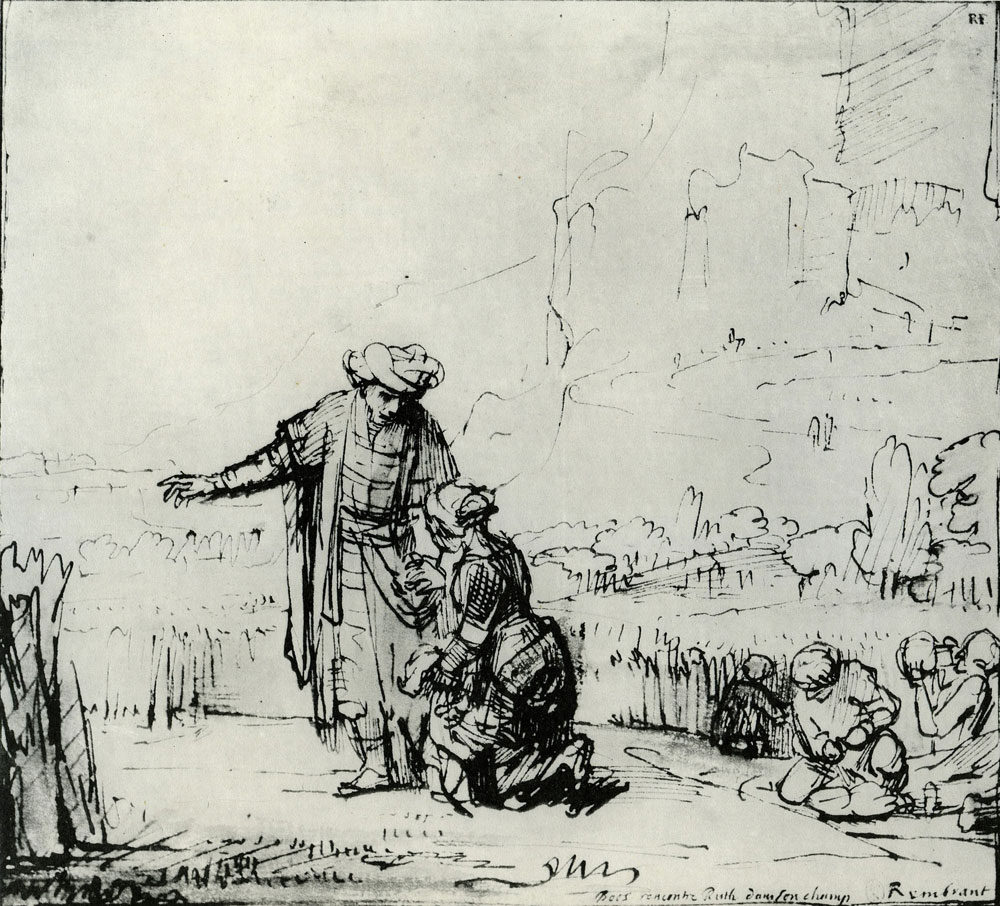
Rembrandt - Boaz Meeting Ruth in His Fields
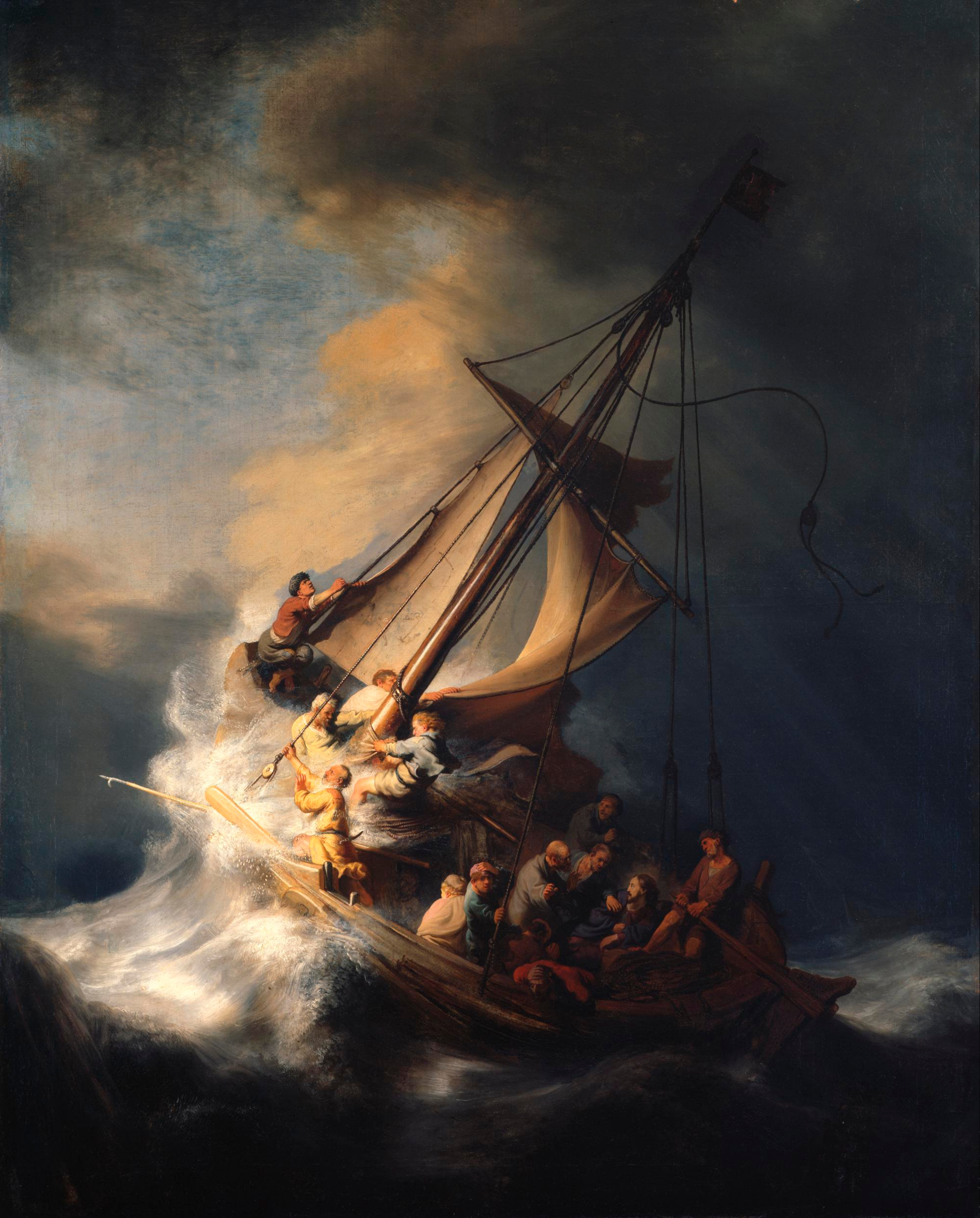
“Don’t you even care?” “Have you no faith?”
And yet when the storm waters are still, there is still need for faith, perhaps a quieter kind. Impoverished and far from home, our faithful Ruth shows a quiet confidence, a faith that means she persists; she persists when she is among the poor and hungry who follow the harvesters as they reap and gather the grain.
Whatever her status was back home in Moab, now in Bethlehem she is serving and servant, a faithful daughter, though daughter-in-law, and will not give up. She quietly continues in her service ministry to her mother-in-law. What benefit the day’s work may yield beyond a nightly staving off hunger she probably cannot know.
There is a prayer, For Quiet Confidence:
O God of peace, who has taught us that in returning and rest we will be saved, in quietness and confidence will be our strength: [Free us from want; free us from fear.] By the might of your Spirit lift us, we pray, to your presence, where we may be still and know that you are God; through Jesus Christ our Lord. Amen.
This is one prayer we each may need from time to time. Sure sometimes “sit down, sit down, you’re rocking the boat!” may be what we need to hear (or sing) but there are quieter times, even more desperate times, when hope takes quieter forms, love takes quieter forms, and faith is in the quiet work of a humble task.
As we have taken note in the past, gleaning was a custom, even a law, among the people of the ancient Bethlehem community in which Ruth found herself. Mandated in the Torah books of Leviticus and Deuteronomy, it was common custom enough to figure in the writings and the prophets of later Israel. A simple practice, it was not straightforward charity, not a hand out or a hand up, as the saying would have it. Gleaning was as much about not-selfishness, about not taking it all for yourself as if it was yours by right; and as much about abundance and dependence on God, in good times and bad, as keeping the Sabbath.
Remember the story of Elijah and the widow and her son? In later times than the time of Ruth and Naomi, another famine had come to the land, and the fugitive prophet Elijah had fetched up at the humble, hardscrabble home of a widow. They were desperate for food: the story goes on to indicate that God’s provision alone kept them alive.
But isn’t that always the case? Are we not always dependent on God for - our daily bread? In times of prosperity we may not feel so need-driven dependent but we all always live by the grace of God.
(Perhaps Boaz realized that, and lived that way. He certainly doesn’t seem to think the harvest all belongs to him, and that he should run off anyone in need. Certainly Ruth is an exemplar, modeling the best behavior of a gleaner; not all are so attractive in piety or persistence.)
But it is there all the same. Deserve has nothing to do with it; except all deserve as all depend. We all live by the grace and generosity of God. Give us today our daily bread, as you have given it to Ruth and Naomi, Boaz and the harvest hands and gleaners, from their time and before, to this day.
In the food banks of the church and of our community organizations, the custom and practice, the blessing and benefit, of gleaning continues; whether we are donor or recipient we take part in this ancient happy custom.
(In Tucson: Interfaith Community Services, Community Food Bank - and its many partners, and gleaners! at Iskashitaa Refugee Network.)
“Grief is love without a place to land” – Jennifer Harvey, ‘Grief and Love in a Difficult World: A Public Theology of “Now What?”’ [https://www.youtube.com/watch?v=xB3TJZrDdeY&t=1490s]
What does love look like when it lacks a place to land?
That would seem to describe Naomi well enough as she was left without husband or sons - menfolk - in Moab, in exile from her homeland. She is grieving. But she is not alone. She has two daughters-in-law; one does the conventional thing and goes back to her mother’s house; the other does something extraordinary, heroic: she accompanies her mother-in-law back to a land that is foreign to her and to whom she is foreigner.
As Pastor Bob Jones pointed out in his June newsletter to Santa Cruz Lutheran Church, she becomes more than friend, she is adopted into full membership in the community.
Witness how Naomi keeps referring to Boaz as “our kinsman” - not “mine” but “ours” - something is afoot. Naomi and Ruth cling, or cleave, to each other, even after the menfolk who initially bound them together are gone. Grief is love without a place to land.
And so in contrast the grief they share becomes love that does have a place to land: with each other, with community, with family reformed and renewed.
"Justice is what love looks like in public" – Reggie Willams, ‘MLK, America, & Abolition’ [https://youtu.be/rj4I_bmV8bo?feature=shared] quoting Cornel West [https://www.youtube.com/watch?v=nGqP7S_WO6o]
And one step toward that is the public embodiment, enactment, of justice, in the gleaning. It is a custom and a law, here followed with love. "Justice is what love looks like in public." Gleaning is a public revelation of what love looks like: justice.
‘When you reap your harvest in your field and forget a sheaf in the field, you shall not go back to get it; it shall be left for the alien, the orphan, and the widow, so that the Lord your God may bless you in all your undertakings.’ (Deuteronomy 24:19)
That is justice. And beyond justice, as indeed we learn with Jesus. A full measure, tamped down and spilling over, of not just what convention and custom, the letter of the law, demands; but a generous overspilling abundance of the spirit of the law. God provides; providence is God’s business.
We join in that holy task as we support or patronize food banks, and other sharing services, as we work for a world free from want, free from fear.
There is an old word from the old world we may want to revive: harvest home. Harvest home is both the work of gathering and gleaning, the threshing and winnowing, and the festival celebration when day is done.
As the parable of the sower taught us last week, the seed germinates and grows, the farmer knows not how: God tends the tender plant. And we rejoice in the harvest-home.
** ** **
JRL+
Santa Cruz Lutheran Church, Tucson, Arizona. Sunday 23 June 2024. https://www.facebook.com/1236072680/videos/1623012738554437/
https://www.iskashitaa.org/
https://www.communityfoodbank.org/
https://www.icstucson.org/
2024 June 23 Hymn of the Day: ELW #597 “My Hope is Built on Nothing Less”
First Reading: Ruth 2. Psalm: Psalm 147. Second Reading: 2 Corinthians 6:1-13. Gospel: Mark 4:35-41

