Showing posts with label Psalm 145. Show all posts

Sunday, October 30, 2022

All Hallows

Jesus said, “The fact that the dead are raised Moses himself showed, in the story about the bush, where he speaks of the Lord as the God of Abraham, the God of Isaac, and the God of Jacob. Now he is God not of the dead, but of the living; for to him all of them are alive." 

(Luke 20:37-38)

In the name of God, Father, Son, and Holy Spirit. Amen.


This is a time of sorrow, of remembrance, and sometimes of joy. It is the season, and the week, and in some homes the day, that we remember those who have died. We remember individuals close to us, loved ones, fellow worshipers, friends, and colleagues. We remember those far away. And we remember those long ago. 


Fresh it comes sometimes, the memory of the loss of someone dear to us, long ago. Or we are reminded, willy-nilly, by some random reference in a passing conversation, or news item. We pass the freeway exit. We taste something, or a fragrance comes to us, and we remember them.


We remember, too, those who are passing now, or recently, not only those we know personally, but those we hear about through news reports. This past weekend the headlines about a crush in a crowd in Korea and the murder of innocents in Mogadishu vied for space, while Ethiopia, Congo, Yemen, and other places were found further down the page, or on inside pages, or awaited their turn in our attention.


Some of us remember every day or every week those who have died coming through the desert, and we light a candle at a shrine, or remember them in our prayers.  


News items, or visitors, bring to mind tragedies of the past. Anticipated grief, expectation of loss to come, sometimes controls our consciousness. It looks like something is going to happen and we find ourselves getting ready to absorb it, or trying - in advance - to forget it, or address it, or both.


So we have a holiday or two, or three, this weekend and next. Monday is All Hallows’ Eve, the night before All Saints’ Day, Tuesday and Wednesday, November 1st and 2nd, we observe El día de Los Muertos*, and on Wednesday, All Souls, All Faithful Departed** - and next Sunday we continue our remembrances, as we listen to the gospel in which Jesus explains to cynical skeptics the resurrection of the dead and the hope it gives, as our God is the God of the living, ‘for to him all these are alive.’


That last is a hard and beautiful doctrine, hard to get your mind around and assimilate, for it is so different from our cultural messages, even well-meaning ones, and the consolations quickly offered at the time of grief. But it is good news, nevertheless. 


And well worth remembering. If the dead are alive to God, and we are alive in Christ, then especially when we come to church and take communion together, and especially these days, we should be able not only to mourn but to celebrate the lives of those who have lived before us, as they are alive in God.


* “Día de los Muertos acknowledges the symbiotic relationship between life and death. El día de Los Muertos is celebrated on November 1st and November 2nd, in which the spirits of the dead are believed to return home and spend time with their relatives on these two days.” https://www.mexicanmuseum.org/dia-de-los-muertos


** “This optional observance is an extension of All Saints' Day. While All Saints’ is to remember all the saints, popular piety felt the need to distinguish between outstanding saints and those who are unknown in the wider fellowship of the church, especially family members and friends. Commemoration of All Faithful Departed did not appear in an American Prayer Book until 1979, and it is celebrated on Nov. 2. It is also known as All Souls’ Day. Many churches now commemorate all the faithful departed in the context of the All Saints’ Day celebration.”

https://www.episcopalchurch.org/glossary/all-faithful-departed-commemoration-of/


Readings for Year C, Proper 27. The Third Sunday before Advent:


TRACK ONE

Haggai 1:15b-2:9

Psalm 145:1-5, 18-22

or Psalm 98

2 Thessalonians 2:1-5, 13-17

Luke 20:27-38


TRACK TWO

Job 19:23-27a

Psalm 17:1-9

2 Thessalonians 2:1-5, 13-17

Luke 20:27-38


A version of this essay was published in the Keeping the Faith feature of the Home + Life section of the Arizona Daily Star, Sunday November 13th 2022, page E3, under the title, "Celebrate loved ones lost." 

https://arizonadailystar-az.newsmemory.com?selDate=20221113&goTo=E03


Saturday, September 23, 2017

Is that fair?


Jonah does not like the people of Nineveh - the Assyrians who conquered the northern kingdom of Israel. He does not like them at all. The city of Nineveh, where Mosul is now, was a capital of the Assyrian empire, the people who conquered the northern kingdom of Israel and sent them into exile - the “ten lost tribes of Israel”. So it is a big thing for him to carry God’s message to them. He knows what kind of God Yahweh is - the kind who might stay his hand if they repent. Indeed, this is the God whose mercy always prevails over his wrath. And so it proves.


When Jonah finally shows up at Nineveh he walks a third of the way into the city (its walls were eight miles in circumference, enclosing 1800 acres) and delivers his message. And they do repent.


Gah!


The reluctant prophet indeed.


What this reminds me of is my first automobile. Of course. In one incident I was backing out of a parking lot in Washington DC in the dark - and backed right into a VW bug. The fender of a 1964 Pontiac Tempest is impervious to something so tin-like as the fender of a Volkswagen. As I already knew from previous occasions with other people driving. So it was dark and it was raining and it was late. And I left a note on the windshield of the other car. In Flair pen! Talk about a reluctance to do the right thing. And a few days later the other driver called and thanked me: he called my insurance company and they made good on the claim ($84). And he said, I’d done the Christian thing. Gah! After I hung up, I grumbled to myself. The reluctant Christian.


Sometimes you do the right thing. When you do not want to, Sam I am.


So Jonah. Got himself a ringside seat, under a booth, and sat back to watch the city destroyed.


God ‘sent’ - as God sent Jonah to Nineveh - a vine to grow up and shade him, then wither.


God showed mercy in a small thing to his reluctant prophet, shading every hair of his steaming angry head. And then God disappointed him. God showed mercy in the most outrageous way.


Showed mercy to Nineveh - the people who brought total destruction to Israel.


Let that be a lesson to you. I guess.


God’s mercy seems to be infinite and not under our control. At all.


And now Jesus turns the world on its head again. This week by telling the story of a master who is totally unfair.


There are a bunch of guys hanging around a Shell station or a city gate or a park south of downtown Tucson. And farmers show up to hire them for the day. It is harvest time - and workers are needed. (Hint: it is surely harvest time now, Jesus is pointing out, for the kingdom of God.)


The pay is good. A day’s wage. All you need to live on - to feed your family.


It’s enough. It’s not riches, but it is all the bread you need for today. Kind of like manna. Kind of very like manna, the bread in the wilderness, that God provided the wandering people of Moses. Kind of like the ‘daily bread’ God provides for us, in the Lord’s Prayer.


So there they are working away in the vineyard. All day long. It’s hot in the vineyard. Sunny. The grapes are ripe and full of juice. By the way it’s harvest time now, in the wine regions of the West. Across the valleys the aroma of the ‘crush’ of the harvest fills the air. It is a good time.


And these workers are part of it. Valued and paid.


And then other guys show up in the vineyard. At this hour and that hour and the close of the day.


They get paid too. Seems fair. Until - the all day workers get paid for a day’s wage - and no more.


Give us this day our daily bread - and a little extra, how about it? We worked all day!


Deserve has nothing to do with it. Apparently. This upside down story has a farmer who is willing to pay every body, each and every one, the day’s wage. Whether they have worked a full day or not.


Is that fair?


You tell me.


Is it fair to spare the Syrians who have - or are going to - prove a mortal threat to Israel?


Surely security comes first!


But God - God - allows them to live, when they repent.


That is the upside down story of Jonah.


Is it fair? Is it wise?

God forgives us.

Is it fair?


* * *


But what were they arguing about, anyway, these day laborers of Jesus’ parable?


Abundance - even the luxury of surplus - and enough, sufficient for the day.


“Give us this day our daily bread” is very much the moral background of this parable.


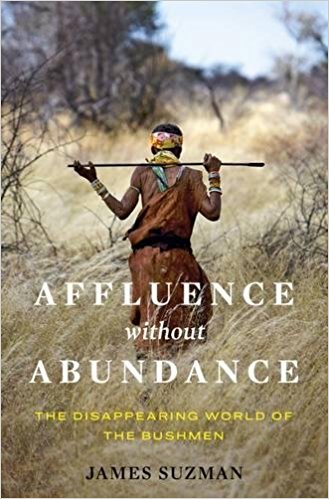
What would that look like, in today’s world? An oddly placed hint comes to us from a review in a recent issue of a magazine, of a book by an anthropologist, James Suzman, entitled, Affluence Without Abundance: The Disappearing World of the Bushmen, (Bloomsbury USA, 2017, reviewed by John Lanchester, “How Civilization Started”, The New Yorker, September 18, 2017, 22-26.)


The Bushmen of the Kalahari, we learn, have in various groups assimilated into more mainstream culture, but in other groups stayed with their traditional hunter-gatherer lifestyle.


“It turns out that hunting and gathering is a good way to live. A study from 1966 found that it took a Ju/’hoansi [Bushman] only about 17 hours a week, on average, to find an adequate supply of food; another 19 hours were spent in domestic activities and chores.” … Ju/’hoansi do not accumulate surpluses. They get all the food they need, and then stop. They exhibit what Suzman calls ‘an unyielding confidence’ that their environment will provide for their needs.”


“ … the hunter-gatherer’s ability to live a life that is, on its own terms, affluent, but without abundance, without excess, and without competitive acquisition. The secret ingredient seems to be the positive harnessing of the general human impulse to envy.”


This is the thing which the Lord hath commanded, Gather of it every man according to his eating, an omer for every man, according to the number of your persons; take ye every man for them which are in his tents.
And the children of Israel did so, and gathered, some more, some less.
And when they did mete it with an omer, he that gathered much had nothing over, and he that gathered little had no lack; they gathered every man according to his eating.
And Moses said, Let no man leave of it till the morning
. (Exodus 16:16-19)


It’s when they get greedy that they get into trouble. Try to store it and it rots.

But when they trust that “The Lord will provide” as my generous friend Marjorie used to say, they find that their good shepherd provides all they have needed.


As Henry Baker wrote in his hymn based on the 23rd Psalm,


The King of love my Shepherd is,
Whose goodness faileth never,
I nothing lack if I am His
And He is mine forever.


For abundance read superfluity, for affluence read sufficiency. For what the anthropologist calls ‘an unyielding confidence’ read “a steadfast faith” or “a founded hope”.


This story is an illustration of the abundance of God’s mercies, the certainties of his provision.


Manna, the bread from heaven, is used as well to mean an unexpected benefit, or, spiritual nourishment, especially the Eucharist.


The farm workers of Jesus’ parable certainly some of them receive an unexpected benefit. Their daily bread descends without anticipation. (And some are jealous.)


And we - we receive that manna of the last meaning, for we do indeed receive the ultimate gift of the bread from heaven that is manifested in the Eucharist, that is, Jesus, himself; as he said, “I am the bread of life.” The one who trusts Jesus receives from him life - and that abundantly. Abundantly - beyond needful measure.


Is that fair?


AProper20 Pentecost XVI … September 24, 2017 … St Paul’s, Tombstone.


Sunday, July 31, 2011

two dogs


There is no such thing as a free lunch. Not anymore.

Two dogs got away with it.

Bummer and Lazarus lived in Old San Francisco, before the Great Earthquake and Fire.

Lazarus got hit by a freight truck but he lived to wag his tail. Bummer - was the king of the moochers. He was always bumming a meal. And his friend Lazarus tagged along.

They went from bar to bar in the old Barbary Coast. And there was a free lunch.

The idea of the barkeepers was to lay out a spread - or maybe pickled eggs and franks - so that folks would come in and buy a drink. Mostly it worked.

Unless you were a dog - and a teetotaller.


* * *

Isaiah says, come and eat. Come and get it. Your money isn’t good here. There is no price. Come and eat and drink to your heart’s content. Receive the fullness of God’s grace.

His mercy is without limit or fee. You cannot pay for it. You could not afford it.

* * *

Jesus went off by himself for a while. Seeking a little peace, perhaps. He went to a deserted place. But the people followed him. Moved with compassion he went among them, healing. They were a hungry crowd, hungry for grace, hungry – for dinner. And they were in a deserted place.

His disciples saw a lack of resources. Send them away – so they can fend for themselves. They can go buy something in a village somewhere.

They don’t need to go away, Jesus responds. You give them something. Here.

You have something to give.

And it will be enough for them. It will more than satisfy. It will be an abundance of good food, the stuff of life.

But we only have this here, here in the desert, enough for ourselves.

Nonsense. Bring them here, here to me, in God’s presence.

Here and now.

What Jesus gave them was an experience of the bountiful goodness of God.

When have we been like the crowd? Hungering, in need of compassion? Thirsting for what only God can give?

When have we been like the disciples when they were lost in a sense of their own limitation and need?

When have we been like the disciples when they take the bread and give it to the people?

May we take the bread from heaven and make it bread for the world.

* * *

Jesus gave them an experience of the bountiful good ness of God.

He did not shame them, or say, “What! That’s all you got?? What good is that to me?”

No – he took the offering, and he gave thanks to God.

One true God who created all things: blessed are you – your reign is eternal. You bring forth bread from the earth.

He broke it and shared it out.

The bread they offered, the bread that came from God, bread from heaven, became bread for the world.

All are welcome at the Lord’s Table, and receive abundance there.

For his grace takes what we offer, and makes of it a miracle, a sign of God’s everlasting faithfulness and steadfast love.

The staff of life, in the hands of the source of life, is made a gift that transforms those who give it.

Once small in faith and doubting they now in faith step forward and take the bread and give it out.

Growing in confidence, they see God’s hand at work in the world through them! Through the gift they had made – from five loaves and two fishes.

All they had, they gave. God shows, in this moment, that his love is more than enough.

Humankind lives not by bread alone but by the Word of God. The Word of God – he who is before them, honoring them in the Gift.

What they gave is not wasted. It is gathered up in its abundance.

When have we been hungry, seeking, reaching out for healing and compassion?

Surely at first this was the disciples’ state too. We all need that comfort, that compassion, and that love.

When have we been like the disciples, uncertain of our offering, of its adequacy?

When have we been like the disciples, astounded by what God does with what we bring to the table?

And perhaps, rejoicing by now, we take the transformed offering and share it out.

Bread from heaven indeed – now bread for the world.

* * *

May we take the bread from heaven, the manna in the wilderness, that is the true word of true God, from whom all things depend, and make of it a gift, of holy sustenance, bread for the world.

May we not stint, but share it out in confidence, knowing that he is faithful who called us to the task. He is loving, who gave his own life that we might live. He is the foundation of our hope. He who was raised and is glorified and remembered, may we remember him, every time in the breaking of the bread. Amen.

APentecost7, Proper 13, Isaiah 55:1-5, Psalm 145: 8-9, 15-22, Romans 9:1-5, Matthew 14:13-21


+

Sunday, May 9, 2004

But to get back to our hazelnut...

The Lord is gracious and full of compassion,
slow to anger and steadfast in kindness.
The Lord is loving to everyone,
and his compassion is over all his works.

Julian had a vision -- of God holding the world in the palm of her hand
as Julian would hold a hazelnut. There we all are -- saints, sinners,
mothers, daughters, rich, poor, -- all alike held in God's love.
Everyone, everything, we know and be and are, held together by God's love
-- and our love for one another.

This small cosmos of ours -- is all we know. And yet string theory --
I've been reading Scientific American -- implies that there's more. This
universe may be 13.7 billion years old, since the Big Bang, but there may
have been someting before that -- and other universes beyond it. We may
be one of an ultimate multiplicity of universes. Suddenly the picture
changes.

But to get back to our hazelnut,

Remember those Blue Diamond farmers on TV standing up to their chests in
a roomful of nuts? Our hazelnut is suddenly one of many, an infinite
roomful, with more pouring in all the time. And yet God still holds us in
the palm of hishand. -- And holds each ofus as of infinite worth. For all
that, he sent his son to live for us -- to kneel by the roadside and
touch a blind man's eye, to laugh at a wedding, cray at a funeral, be one
of us.

And we become one with him -- in his love. Each of us is of infinite
bvalue to God -- and he reminded us, too, love one another.

We are all together -- no man is an island, entire of itself; each is a
piece of the continent, a part of the mainland. If a clod should wash
away, Europe (our little island) is the less, as much as if a peak or a
promontory were -- and we all in our cloddish -- or peakish -- way hold
this continent together. -- We all _matter_ to God -- and we each matter
to the other.

We may not always see it out in the world, but sometimes we do in
microcosm -- a little world. For instance, in a church, or on a baseball
team, or in a jazz band, or at a square dance. When I was in DC I was on
a city rec league softball team. No uniforms. We mostly just showed. One
of us was a player/manager. He'd call us all together -- booked us with
the league, and brought the bag of equipment (bat, balls). And then he
played, I don't know, third base. (I was in right field.) We could play
whether he was there or not -- he could have someone else come with the
bat & ball if he couldn't make it -- but there we all were together, each
with a glove at our positions, or up to bat. Maybe our church is a little
like that.

Or maybe we're like Dave LeFebvre's jazz band -- called together, we show
for the gig with our instruments. When we play we have a basic tune --
and each of us gets a turn to step up and shine. It's the job of a good
jazz musician to make the others look good _ when they're playing. In a
jazz band -- or a bluegrass band -- or here.

And lastly our church may be like a dance. One fall evening in high
school a bunch of us from Gaithersburg piled into my 1967 International
Travelall and drove out to Barnestown. There was a square dance. The
eight of us wandered in the room at the crossroads church.

The other dancers welcomed us in, observed that there were enough of us
to make up our square, and got us started. The caller came over when he
could -- someone alerted him -- but it was the other dancers, mostly, who
showed us the moves. And we danced. We all danced. The dance went on
whether the caller was with us that moment to show us, or not.

And the dance goes on. Each of us is part of us loving one another,
laughing with each other, supporting one another in trial or
circumstance. All held together on this continent of love. This crazy
little hazelnut in the palm of God's hand.

St John's Episcopal Church, Lakeport, California
May 9, 2004 9.30am Holy Eucharist
Fifth Sunday of Easter, Year C
Acts 13.44-52 or Leviticus 19.1-2,9-18, Revelation 19.1,4-9 or Acts 13.44-52, Psalm 145 or 145.1-9, John 13.31-35