Showing posts with label Wise Men. Show all posts

Monday, June 12, 2023

visitors


In this photo released by Russian Orthodox Church Press Service, the Trinity icon by Andrei Rublev is displayed as Russian Orthodox Church Patriarch Kirill conducts an Orthodox service celebrating Trinity Sunday with Russia’s most famous icon transferred from a museum to Moscow’s main cathedral despite the keepers’ vociferous protests in the Christ the Savior Cathedral in Moscow, Russia, Sunday, June 4, 2023. The Trinity icon by Andrei Rublev that was kept in Moscow’s Tretyakov Gallery since the 1920s was moved to Christ the Savior Cathedral for the holiday on President Vladimir Putin’s order. Putin’s sudden order to hand over the 15th century icon to the church came despite protests from the Tretyakov keepers that the icon was too fragile to move. (Oleg Varov/Russian Orthodox Church Press Service via AP)

https://apnews.com/article/russia-trinity-icon-rublev-moscow-cathedral-c78adcee0c929208013c9936f9969291

Russia's most famous icon handed over from museum to church despite protests (Associated Press, June 4, 2023 at 9:27 a.m. EDT)

On Trinity Sunday on my way to church I heard on the radio that Russia’s most famous icon, by Andrei Rublev, was on its way from a museum in Moscow to a nearby church. This icon is frequently cited as an image of the Trinity, a showing in the persons of three mysterious angelic visitors to the tent of Abraham and Sarah at the Oaks of Mamre. It is a close-up, in effect, of the larger scene, one you can see depicted by Ghiberti on the doors of the baptistry of St John  in Florence, Italy (and replicated on the front doors of Grace Cathedral in San Francisco). 


Looking at the bigger picture you can see Abraham in front of the tent offering hospitality to the strangers, while Sarah peeks from behind the flap of the tent. They are receiving strange news from strange guests. The icon that focuses in on the three visitors shows them in harmonious relation to each other, a dancing image of God, (perichoresis, reciprocal coinherence) since as they are three, or two, or one, they are a “God sighting” as Reverend Billy calls it (theophany), a miraculous appearance or vision of the presence of God.  
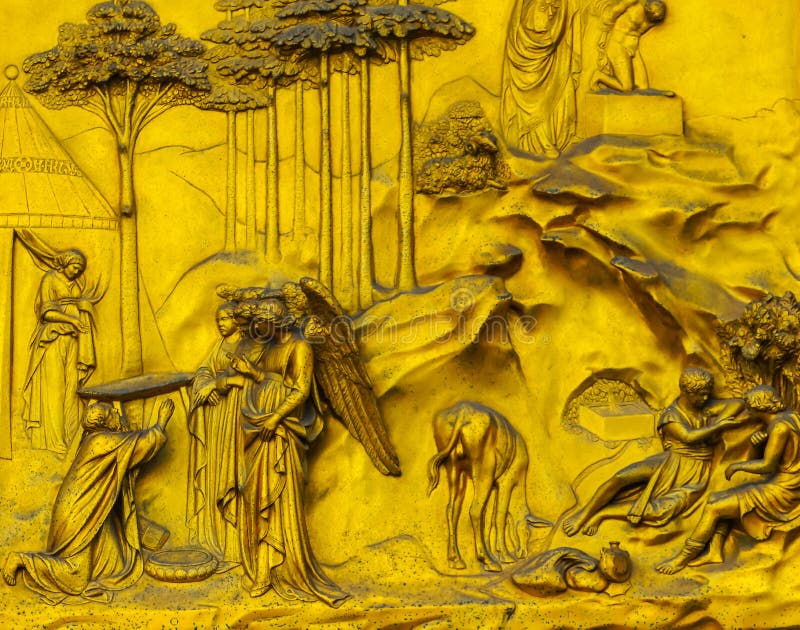


The image is from the story in the book of Genesis (18:1-15, 21:1-7) of three strangers that come to the tent of Abraham and Sarah at the Oaks of Mamre, where their flocks and herds are pastured by the trees, and they greet the old man and his old wife, and receive hospitality. And then give her a blessing. There was to be a child, and a great promise.  


For God had said to Abraham, ‘As for your wife— I will bless her, and moreover I will give you a son by her. I will bless her, and she shall give rise to nations; kings of peoples shall come from her.’ ‘And by your offspring shall all the nations of the earth gain blessing for themselves.’


There are elements in this story that probably came across with particular power over the many centuries of the Jewish people. Three strangers arrive, receive hospitality, give a blessing, and tell of a child of great promise. Hard to forget, wonderfully told, a story for the ages.


On Trinity Sunday I wondered if Mary heard it, if it came to mind as she sheltered near Bethlehem with her newborn son. (Matthew 2:1-12) Because here again, there were, so many centuries later, a mother and a child of great promise, and three strangers who said, as those earlier visitors had said, “through this child a great blessing will come to his people, and to all the world.” 


The new mother: did she smile at this? Did she laugh? Did she laugh to hear the news or did she gently accept it or did she do both? What child was this? What parents? Now this one was already born, when the strangers, this time astrologers, Wise Men, Magi from the east, said to its mother, that this child would be a blessing to his people, and to all the world. Again three strangers, again a mother and a child. Again, a great promise, and in both cases that one promise has become fulfilled.


​​http://www.lectionarypage.net/YearA_RCL/Pentecost/AProp6_RCL.html#ot1

http://www.lectionarypage.net/YearABC_RCL/Epiphany/Epiph_RCL.html


Genesis 18:1-15, (21:1-7)
Matthew 2:1-12


A version of this meditation was printed in the Arizona Daily Star, Keeping the Faith feature of the Home + Life section, pg. E3, on Sunday, July 16, 2023, under the heading, "3 visitors and a blessing."


Sunday, January 3, 2021

Good Trouble

 Our story this Sunday, the second Sunday after Christmas, is a different story of the Nativity ... or of the early infancy of the Child Jesus. For it begins with representatives of the nations, people from far away, arriving in the court of Herod the Great with a humble request to see the child who has been born king. 

Somewhat awkward. The powers that be had not expected this. There had been 'messiahs' before, and champions of freedom, and there would be again. This however was not the arrival of a warrior. 

It was worse. The prince of peace arrived innocent. In the City of David to be sure, but a shepherd boy would be more menacing. This is an opportunity, the king concludes. To get in there right away and do the right thing ... by his own lights.

But he sends the seekers on their way and they do visit the child and his family, and surprise them with gifts.  

Royal gifts - gifts for a king.

They begin to see the danger.

Have you ever woken up in the middle of the night and thought, I know what I have to do? Right now?

Something like that happened to Joseph (and more than once). He took mother and child by night and fled.

What a beginning, and what an exit.

***

Stars you say? Or perhaps a great conjunction of planets. Somehow in the skies a cosmic event heralded, to the wise, an event with earthly import. And more importantly, an earthly event had cosmic significance.

Zoroastrians might point to this as the collision of darkness and light. Certainly the powers that be, with all their dark significance and mighty power, were troubled at this small glimmering of hope in a stable.

But not even the night belonged to Herod the Great. Not truly. For it was under the cover of darkness, over those self-same planets now slowly departing from their conjunction, that the holy family made its escape.

And when they return freedom will travel with them.

***

The wise men have left. The holy family has departed, safely, by night into exile.


The story does not end there. Herod the Great waits in vain for the magi to report back to him. So he takes extraordinary expedient measures. 


From a scene of innocence and glory, from a moment of wise perception and quiet celebration, we pass into a scene of power and overweening pride.


Herod takes out a ghastly form of insurance. Knowing that the child was to be born a king, and born at Bethlehem, he tries to wipe out the threat of goodness by killing all children under two.


No child is safe until all children are safe.


When Herod saw that he had been tricked by the wise men, he was infuriated, and he sent and killed all the children in and around Bethlehem who were two years old or under, according to the time that he had learned from the wise men. Then was fulfilled what had been spoken through the prophet Jeremiah: ‘A voice was heard in Ramah, wailing and loud lamentation, Rachel weeping for her children; she refused to be consoled, because they are no more.’ (Matthew 2:16-18)

The story does not end there either! As the prophet Jeremiah went on to say, after that lamentation:

Thus says the Lord: Keep your voice from weeping, and your eyes from tears; for there is a reward for your work, says the Lord: they shall come back from the land of the enemy; there is hope for your future, says the Lord: your children shall come back to their own country. (Jeremiah 31:16-17)

And so --

When Herod died, an angel of the Lord suddenly appeared in a dream to Joseph in Egypt and said, "Get up, take the child and his mother, and go to the land of Israel, for those who were seeking the child's life are dead." Then Joseph got up, took the child and his mother, and went to the land of Israel. 

But when he heard that Archelaus was ruling over Judea in place of his father Herod, he was afraid to go there. And after being warned in a dream, he went away to the district of Galilee. There he made his home in a town called Nazareth, so that what had been spoken through the prophets might be fulfilled, "He will be called a Nazorean." (Matthew 2:19-23)

There is hope; there is a way forward. The young family return to Israel; but not to be under the eye of Herod’s son enthroned in his place they divert their steps to a small hill-town in Galilee. 


Can anything good come out of Nazareth?


Today of course if you go there you might see a small stream, and imagine Mary getting water there. You might see a little dwelling, discovered under the surface of a morning street, and remember the humble beginnings of the carpenter’s son. You might see Roman pavement in front of a street door, imagine steps of shodden foot passing close by the home of a little child.


And you might imagine the child growing in wisdom and in strength. That day will come.


For now the parents, and the shepherd and the angels and the wise men, carry the secret.


And then it will be carried forward, by evangelists, disciples men and women and children.


By us.

***

So the Christmas season continues after the birth of the Savior. 

After the angels depart. After the wise men go their way. So now what? Howard Thurman, a pastor in San Francisco, told us this way: 

When the Song of the Angels Is Stilled

When the song of the angels is stilled,

When the star in the sky is gone,

When the kings and the princes are home,

When the shepherds are back with their flocks,

The work of Christmas begins:

To find the lost,

To heal the broken,

To feed the hungry,

To release the prisoner,

To rebuild the nations,

To bring peace among people,

To make music in the heart.

Now the work begins.

Now it is our turn, our time. The story of the child is not over, not yet.

When the family returns from Egypt they go not to Bethlehem but to Nazareth. And there Mary and her husband Joseph will raise the child. They will diligently take him to the festival in Jerusalem, Passover, the feast that means so much, and promises freedom as it celebrates the faithfulness of God. But soon, we will be hearing and celebrating - and trying to understand - the story of the adult: of Jesus coming out of Nazareth to the shores of the Sea of Galilee, and returning for that festival - with cosmic consequence.

For now though it is on us.

Can we join him, join Jesus, as he grows and matures into an adult and fearless faith? Into action prophetic and natural? As he simply does the right thing, the significant thing, which is the human thing to do? And realize how in each cup of water, each tray of food, each healed sore or sadness, we proclaim the glory? 

That God is with us. 

God is with us first as a fragile child, who must be wrapped up in his innocence and born far away. God is with us in the proclamations of the angels, the singing of the shepherds, the doting of a father?

God is with us in anger over injustice, and in doing something about it. 

How we treat each other, our environment, and the creation of which we are a part, shows that glory.

Perhaps it is as simple as calling a friend or greeting a stranger: how are you doing in these dark times? Do you see the light is coming back? What can I do to help you? Or how can we pray together? Maybe it is more political than that. Maybe it is more indirect, not knowing the impact of your gift or confidence.

But it is our time now. To do what Jesus will do, to learn who Jesus is, and who we are becoming in Him.

In Him, in his footsteps, rejoicing in what he is doing, we begin to heed the words of many prophets.

"To heal the broken-hearted"

"To make his pathways smooth"

To go ourselves to Jerusalem, in our hearts, to adore - and to get busy. 

Good trouble, indeed, is on the way.


https://fcjsisters.wordpress.com/2013/01/11/when-the-song-of-the-angels-is-stilled-howard-thurman/

http://edgeofenclosure.org

https://youtu.be/fuFqCb1B5gM (Second Sunday after Christmas, January 3rd 2021, St Andrew's Episcopal Church, Tucson, 10am service)

Wednesday, December 30, 2020

Hope in a Dark Time

Flight into Egypt by Henry Ossawa Tanner


MATTHEW 2:13-15

And when the wise men were departed, behold, the angel of the Lord appeareth to Joseph in a dream, saying, Arise, and take the young child and his mother, and flee into Egypt, and be thou there until I bring thee word: for Herod will seek the young child to destroy him.
When he arose, he took the young child and his mother by night, and departed into Egypt:
And was there until the death of Herod: that it might be fulfilled which was spoken of the Lord by the prophet, saying, Out of Egypt have I called my son. (Matthew 2:13-15)

Hospital bed counts are surging; pandemic deaths are on the rise; and yet there is hope in a dark time. The vaccines are beginning to appear and county by county decisions are being made, and health care givers and others are receiving their first dose of two. (These are still experimental vaccines. Nobody knows how long immunity lasts, and it certainly does not mean letting down your guard - or your neighbors - on mask, distance, outdoors, sanitize your hands - just before you touch your face), or test, treat, trace... 

Ian Rankin wrote a book just before the pandemic hit his native Scotland, A Song for the Dark Times, with an epigram from Bertolt Brecht:

In the dark times
Will there also be singing?
Yes, there will also be singing.
About the dark times.

And sometimes it feels like that is the best we can hope for - but we have friends, from the past, and hopefully from the future, who know how it feels. We meet some of them in the story of the three kings, notably magi, Mary, Joseph, and a child. They are briefly near each other, as the planets Saturn and Jupiter have been briefly near each other this past couple of weeks, but soon they are headed in widely different directions: the magi back to their own country, the holy family headed to the land of the Nile. There they will sojourn until they get the word Big Herod is dead.

But as we learn, there is a little Herod, or two, waiting in the wings. And that may be so in our own dark times too. 

What we do have, as they had, is the faithfulness of God, and his keeping his promise, in extraordinary ways. We do not expect this Messiah, the one we get in Matthew, Mark, Luke, and John. If we needed another hero we may be disappointed. And he does not just make it all go away like magic. 

Mask, distance, outdoors, wash hands; test, trace, treat... still. And for months to come. 

What will we have learned? What will we have left behind? Whom shall we be mourning by then?

In the dark times,
there is singing:

"Nations will stream to your light and kings to the brightness of your dawning".
"A light to the nations and the glory of your people"
"The light shines in the darkness and the darkness has never overcome it."

Prophets and apostles, and the ever ending casts of Messiah, and we too, are singing -- in the darkness, but not simply of the darkness. Like the wise virgins in the parable that very child will later tell, we keep our lamps trimmed and burning, not because the darkness is not there, but because it is - and we have hope.

Hope in a dark time.


A Song for the Dark Times. Video intro with the author. https://youtu.be/FQ3PWZ7D2lU

https://www.goodreads.com/quotes/46223-motto-in-the-dark-times-will-there-also-be-singing


Saturday, December 19, 2020

The Great Conjunction


Astronomer friends in our neighborhood told me not long ago where to look in the sunset sky for something phenomenal: two planets converging night after night, coming closer together, forming one brilliant light above the crescent moon in the sunset. It formed and forms an unforgettable sight, one bound to become even more remarkable as the winter solstice approaches. It is called the great conjunction, as the light of two planets, Jupiter and Saturn, is superimposed.

2000 years ago magi (Wise Men) may have looked upon a similar sight: two planets growing closer together, forming a brilliant spot in the sky.


Why for them was this a birth announcement? Why did it tell them to pack up and go to Jerusalem? When before had far away nations paid homage to a son of David?


A child who is born became king of the Jews yet Solomon in all his wisdom never saw stars like this and never was so arrayed — and Jesus was and is so arrayed, but in the glory that came to him on the cross. It is not far from Jerusalem to Bethlehem; it is not far again from the Church of the Nativity to the Church of the Resurrection. 


The wise men Herod sent on their way from Jerusalem to Bethlehem went bearing gifts for a king.


The king they sought later bore a cross through the marketplace streets of Jerusalem— buying and selling shouting in bargaining going on around him, soldiers driving him from the pavement below Herod’s Palace to the rocky prominence of Golgotha, to place him on the cross. 


And yet this was the fulfillment; the fulfillment of the sign in the sky that drew the wise to Jerusalem to pay homage to the child who would become king.


And what was an earthly pilgrimage had as pilgrimages do portents beyond our planet. For the child born to reign was not to have a kingdom of this world as Herod held but one whose realm was cosmic. This child would set the world free; invite all people to come into the right relationship with each other, with creation, with all things. As the psalmist sings, 


He shall deliver the poor who cries out in distress, and the oppressed who has no helper. He shall have pity on the lonely and poor; he shall preserve the lives of the needy. He shall redeem their lives from oppression and violence, and dear shall their blood be in his sight. (Psalm 72:10-14)


What makes this king worth celebrating, warming hearts of children and all who look to the stars in the sky is not his majesty but his service, and the liberation from sorrow, the release into joy, that his coming calls forth from us, cause for wonder, love and praise.


“They shall bring gold and frankincense, and shall proclaim the praise of the Lord.” (Isaiah 60:6) 


Written for the Arizona Daily Star, in anticipation of the Epiphany. 

(https://tucson.com/the-great-conjunction/article_2beb7163-51cf-53a4-83ec-6ea71021f44a.html)


https://lowell.edu/the-great-conjunction/


Henry van Dyke, The Story of the Other Wise Man (Harper & Row, 1895)

Sunday, January 6, 2013

Epiphany 2013


When I lived in New York my friend and co-religionist Bill Talen was developing a one-man show, Reverend Billy. A cracked-pot street preacher, Reverend Billy would occasionally gather a congregation (audience) together and in the middle of his sermon ask us if we could testify to any god-sightings we’d been blessed with in the past week. It was wise to make one up – if you dared to volunteer: he’d turn and discount your story with explosive sarcasm.

The wise men from the East in our gospel reading today have had a god-sighting:
one they could have predicted, but didn’t;
one so extraordinary that they had to verify it – which involved considerable travel;
one that called for celebration – which involved significant gifts;
one that to us seems so absurd – astrologers from Babylon predicting the birth of the Messiah! – that we might tend to respond with sarcasm, but not Herod’s cold plotting.

Nevertheless they followed that star, and … that god-sighting changed things.

“They returned home by another road”

only to find that they had changed. They could no longer be satisfied with the old ways. Indeed that is why they left in the first place. They saw the portents of inevitable change, and went forward to embrace it.

It was good news they heard. The praise they proclaimed was sincere. Those gifts they offered were honest, generous, and fitting.

“Where is the one born king of the Jews? For we saw his star at its rising…”

We perceived in our wisdom that something new and great was coming into being, that this ordinary-looking child, breathing softly there sleeping in his mother’s arms, that this child’s birth changes the world – and changes us; we too will never be the same, and that is joyous and disorienting news.

For we are – or were – kings in the Orient, wise men from the East. We had our places. 

But we saw the signs. And now we know – we have seen that which makes all our philosophy, all our observations and calculations, seem so much packing material.

Like the straw strewn under the manger, it has its purpose – not so exalted now.

And we began to absorb our losses – to feel our grief for what is gone. No longer will we look to the stars to give life meaning.

We must look on earth. For heaven has come down to meet us.

And meeting us has changed us – changed everything.

Redemption begins with a child. Revelation begins with a baby. It ends in a scene of triumphant glory. But first, in between, in between…

In our minds’ eye we will be walking in the dust beside a young man: far away we will be his companions, as he goes about spreading the news that fell from the sky.

Now earthbound and easy to the touch, the great good news has come to earth, to human form. This boy, this man, this Son of God, has brought the message down to earth.

And he asks us to do earthbound things, things that are ready to the touch.

Love God? Love your neighbor.
Love your neighbor? Love yourself.

Be kind. Be patient, slow to take offense. Be a good neighbor. Give honest weight.

Ordinary things – so hard to do.

And build on them – in them – build the kingdom right there out of earthbound ordinary things.

Find the praise, find the proclamation, find the pardon.

Find the procession of offerings.

Follow it to the altar: as Isaiah the prophet envisioned, a gathering of all nations, to pay homage to one God.

We were just the first to arrive. You come too.

It is a great procession of all people. All are welcome. Where do you find your place?

Are you trying to go back – to retrace your former journey to a time and place when you were comfortable and everything made sense - or are you going forward, entering into joy?

It’s a different road, a hard road. 

So here’s what we do – we the wise of the East:

Hear the good news. Sing his praise. Seek him out. Worship him. And go forth into the world, rejoicing in the power of God.


"Journey of the Magi", T. S. Eliot 

http://revbilly.com/