Showing posts with label 2 Corinthians 12:2-10. Show all posts

Wednesday, July 3, 2024

She really is his Aunt Ruth

For Sunday, July 7th 2024, at Santa Cruz Lutheran Church, Tucson.

I was thinking about how people are related as family and remembered…

When I was a file clerk at the EPA Region IX office in San Francisco, I came across correspondence regarding a new water treatment plant to be sited near Grass Valley, California. The correspondence was stamped in bright red letters: HANDLE AS PRESIDENTIAL. The first item in the file was a letter from one Ruth Milhous, to her nephew Richard, complaining about what she had heard would be a ‘cesspool’ near her house. It was signed, “Aunt Ruth.” And to the letter was attached a note, “She really is his Aunt Ruth.” Subsequent correspondence politely reassured her of the facts of the matter. (It’s a modern wastewater treatment facility, not an open, stinking cesspool.) The takeaway is this, of course: She really was his Aunt Ruth. She was family.

In our story, which concludes today (aw gee!) …wait, not entirely: because Ruth really is his great-grandmother; ‘him’ being David, the son of Jesse, the son of Obed, the son of Boaz and Ruth. (The story will go on: turn the page and you are reading about the end of the time of judges and the beginning of the time of kings, in the first book of Samuel.)

One who had once been a stranger had become family indeed. But we have already noticed how Naomi referred to her daughter-in-law as ‘my daughter’ and even Boaz, Naomi’s kinsman, began by addressing her as ‘my daughter.’

She was what we call ‘married in’ but was hardly an outsider - following the laws and customs of that ancient time, family ties that had been frayed were strengthened, and the Lord, the hidden player in this drama, had been at work throughout, now revealed in the way that what was small and unpromising had been redeemed into something great and flourishing. Small beginnings, greater ends, seems to be the MO of our God.


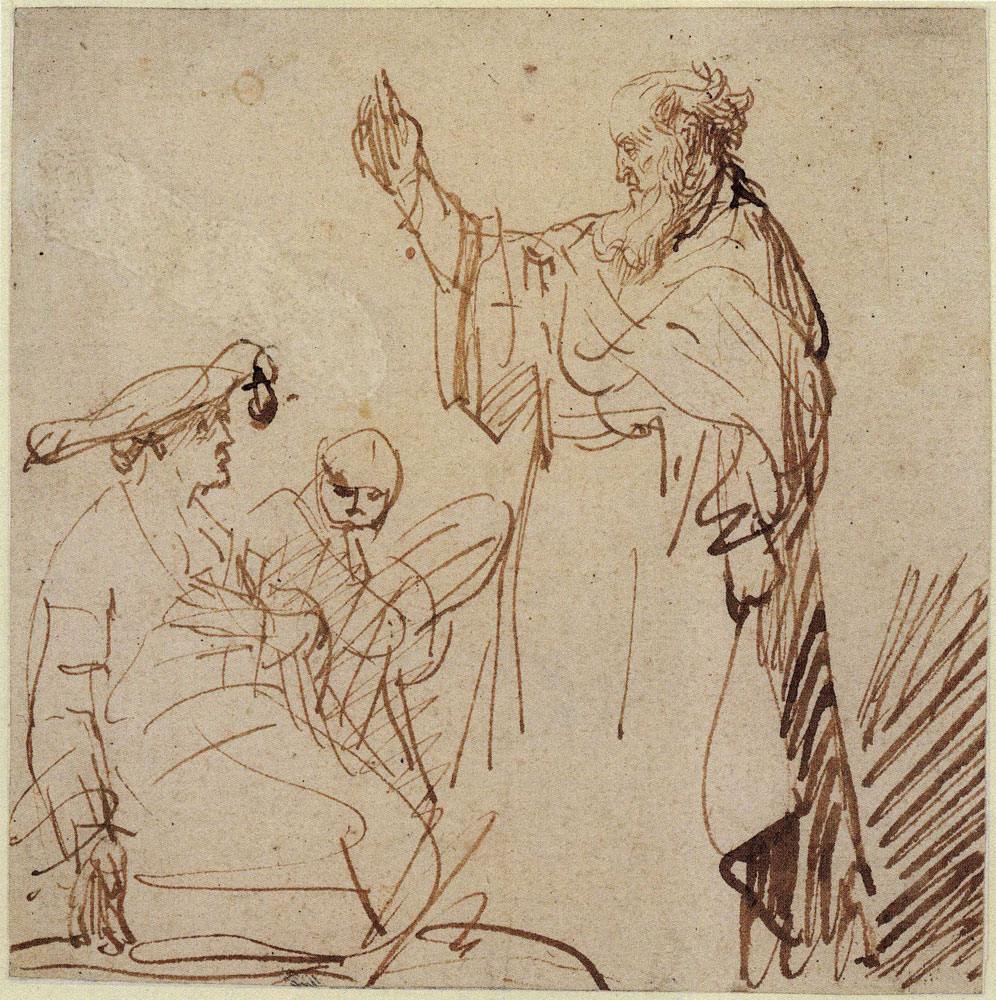
https://www.pubhist.com/works/09/large/rembrandt_boaz_ruth.jpg


Sermon Series: Ruth at Santa Cruz Lutheran Church, Tucson, Arizona.  © 2024 John Leech. All rights reserved.

June 16  ELW #681 “We Plow the Fields and Scatter”(Wir pflugen)  
First Reading: Ruth 1 
Psalm: Psalm 146
Second Reading: 2 Corinthians 5:6-10 [11-13] 14-17
Gospel: Mark 4:26-34

June 23 ELW #597 “My Hope is Built on Nothing Less” 
First Reading: Ruth 2
Psalm: Psalm 147
Second Reading: 2 Corinthians 6:1-13
Gospel: Mark 4:35-41

June 30  ELW #612  “Healer of Our Every Ill” -
or ELW #733  "Great Is Thy Faithfulness"  
First Reading: Ruth 3
Canticle: Ecclesiastes 3:1-8
Second Reading: 2 Corinthians 8:7-15
Gospel: Mark 5:21-43

July 7  ELW #676  “Lord Speak to Us that We may Speak”
First Reading: Ruth 4
Psalm: Psalm 127
Second Reading: 2 Corinthians 12:2-10
Gospel: Mark 6:1-13

First reading is from the Revised English Bible [REB] (Cambridge/Oxford, 1989).


Sunday, July 8, 2018

the first sending


Ite, missa est. Go, you are dismissed. Go, you are sent.

That is how the service of the Eucharist, commonly called the Mass, traditionally ended. 

Then the deacons got a hold of it, and recovered some of its original meaning. 

Not thank God that's over. Or go away! Go away!

But, go, you are sent.

As Jesus sent.

As Jesus sent forth his first disciples, this first time, in urgency, with a message that cannot wait.

A message they delivered barefoot or quickly shod, with nothing in their hands: just go!

And when they arrived, at one intermediate pony-express stop or another, they quickly moved to deliver their message, not with words only but with deeds. 

As Jesus himself had done where he found faith, they cured the sick, healed the lame, and cast out demons.

And where they and their message was well received, they stayed a little, and taught: what you see is this - the kingdom of heaven coming into being, right here in front of you. That is what is going on. 

So repent! Turn around. Turn toward the light of God that shines now from - of all places Nazareth.

And from this moment.

For God is at hand, and God's reign is at hand, and the world will not ever be the same.


***

Our reading today did not begin with this sense of urgency, agency, or success. Jesus shows them what to do when they fail. When they give the good news and it flops - when they are not welcome, their words are not heard, and their deeds are ignored. He goes on. And broadens the mission.

In the synagogue at Nazareth, a small but significant town, there was not a whole lot of acceptance of the message, the news, of this homegrown Messiah. They thought of him only as the carpenter's kid. What can he know?

And so it would be for his disciples, sometimes, when he sends us out. Sometimes we have spectacular results. Sometimes no one listens.

Don't be discouraged. Keep moving! Your message is too vital to quit now. 

And they went ... and we go ... and the message is proclaimed and the healing of the world begins.


But then - there are other people traveling light - with but little that they have in their hands. A staff, or no staff, sandals, or sneakers, or no shoes at all, a baseball cap with a meaningless logo, a plastic jug of water - hope, or fear - and one thing they carry with them always, each one of them, the image of God. 

People come north to Arizona for many reasons - fear of persecution or violence back home, hope to find work or a new life, love of family, and yes a few carry drugs for strangers - but all of these, even the gangsters' mules, carry with them, in them, on their face, that precious image. 

Remember Francis kissing the leper? He discarded his prejudice as extra baggage, and embraced the stranger as his brother. 

It is hard to do - this business of traveling light without extra gear, just what is needed for the mission. What we most need to give up will leave us lightened. 

It is not a matter of gear: it is a matter of Gospel.

What burden more happy to bear than the good news of Christ, the coming of the kingdom of mercy, of justice, where we walk humbly with God?

-- Ite, missa est --

And so we go, forth into God's good world, fortified for the journey with word and sacrament, two by two or many together - but nobody walks alone, for we walk with the Holy Spirit of God.


Sunday, July 8, 2018.
Seventh Sunday after Pentecost
BProper 9

Track 1
2 Samuel 5:1-5, 9-10
Psalm 48
2 Corinthians 12:2-10
Mark 6:1-13 


A prophet is not without honor but in his own country and among his own kin and in his own house.

In the name of God, Father, Son, and Holy Spirit. Amen. 

Thomas of Celano, First Life of Saint Francis. St. Francis of Assisi: First and Second Life of St. Francis, with selections from Treatise on the Miracles of Blessed Francis, by Thomas of Celano. Translated from the Latin, with introduction and footnotes by Placid Herman, O.F.M. Chicago: Franciscan Herald Press, 1963. Chapter IX, p. 22-23, and Chapter XII, p. 28-29.

David Miliband, "Stop demonizing refugees." The New York Times, Sunday, July 8, 2018. https://static.nytimes.com/email-content/NK_3666.html. accessed July 8, 2018.

Saturday, July 4, 2015

Independence

“You mean to tell me they changed the Hymnal too?!??”

That was my friend Christopher’s response. I had just showed him something he hadn’t seen before: The Hymnal 1982. And just before that, he’d shown me his beloved copy of … Hymnal 1940. I kind of laughed at him. And called him Rip Van Christopher. It had been so long since he’d been to church that he ‘missed the memo’ on all the changes after the adoption of the 1979 prayer book.

Rip Van… was actually kind of appropriate. Just imagine how Christopher would have felt if he’d gone to sleep, beloved prayer book and hymnal in hand, in 1770 or so, and woke up in 1790.

AAAGGH!

The response would be shock – anguish – even disgust. Certainly disorientation.

Not immediately – but once they got to the prayers of the people – and the prayer for the King was replaced by a prayer for the President. President? What’s that? Some kind of meeting facilitator? Is there a whiteboard in the house? Some group-process newsprint? What is going on!!?

Change happens from time to time. Even in the church.

But every once in awhile there comes a time of change. Even to the hymnal. Or the prayer book…

In the summer of 1776 the pastor of Christ Church, Philadelphia, I am told, got the news from down the street, from the building now called Independence Hall:

“When in the Course of human events…”

And so he took out his pen and his prayer book and found the places in the prayers where the sovereign and the royal family were mentioned, and he struck out “king” and wrote “president”… so I am told.

As Massey Shepherd put it, “At the time of the American Revolution the English Book of 1662 was in use, of course, in all the Anglican churches in the colonies. The success of the Revolution necessitated changes in the prayers for civil rulers…” (OAPBC, xx)

What a shock it would have been to a man reared on the prayer book of 1662 – and its strong foundation in an established church of England. And now only just over a hundred years later, with the memory of King Charles’ head and the ghost of Bonnie Prince Charlie thought safely laid to rest, there was an upheaval – a revolution.

From now on, no established church at all – not yours or mine.

We can only imagine …

… Imagine a world when something new was coming into being, and something old was lost.

Maybe it isn’t that hard after all. Not this summer...

Sometimes we lose something precious – and sometimes, when we realize what we are going to say good-bye to, we are glad to see it go. It could be a practice – or it could be an attitude. It could be a prejudice – or an unexamined presumption.

No matter.

Time to let it go.

In times of great change, Herb O’Driscoll once said, we can be mourners of the past or midwives of the future.

We are in the midst of change. Today – and all our lives.

Sometimes like my friend Christopher the change comes as a shock, the cherished object suddenly an heirloom of a past. A past we hardly knew as past.

Disbelief? Comic incredulity on our faces… but it’s gone.

How are we to live now?

Imagine him coming home, the son of Mary, coming home to Nazareth. We all know him, the carpenter. We know his brothers – name four – and his sisters. We know the little house where he grew up, the stone across the door, the Roman pavement out front where he’d play in the street, as a little boy. And now he says the world is about to change – he, of all people.

Where did he get all this?

What he says to us is worse yet – outrageous!

Repent – and repent means turning. Change your ways.

This repentance will not be televised, or announced in the town square. It will begin within you.

It will go beyond you. It will gather thousands to riverbank and hillside. To hear him of all people proclaim the good news.

Good news, my friends, is not always welcome.

That is certainly the case with Jesus, that day in his hometown.

He even wisecracked – in response to their incredulity – with the commonplace, a prophet is not without honor except in his own country.

And he had brought the message home. They did not know him as a prophet. They did not know him as a messenger of God. They knew him as a little boy, and as a man handy with his hands.

But now those hands were at other work than carpentry. They healed the sick with a touch. They cast out demons. They carried the good news with them of the coming of the kingdom of God.

It goes beyond “strike out king and write president”. There is more going on than replacing one George (the Third) with another (Washington). It is a whole new way of being.

Strike out self and write Messiah. Strike out empire and write Shalom. Strike out sin and judgment and write love and grace. War – and write peace.

Forgiveness. Reconciliation. Acceptance – and welcome – of the stranger, and of yourself.

Where there was no trust – most of the people of Nazareth that day Jesus came home – there was no healing. Only where there was trust – where people believed in him enough to come to him – did Jesus do any healing work that day. From there, however, he went on – and took disciples, students, with him.

We know that to them he gave authority – and they carried on the work in his name.

Out there in the villages they found belief, and trust, and hope – not everywhere – and they brought healing, cast out fear, and said the words of hope, and of change.

Change – turn – repent. And believe. And know that the kingdom has come among you. Peace be with you. Shalom.

Friedrich Schleiermacher somewhere defines religion as a sense of absolute dependence, that is, dependence on God (the absolute!) and that is good news, that is liberty, and true independence.

In his service is perfect freedom. Because we are dependent absolutely on him there is no need for fear of earthly powers. The prophets could speak out knowing the one they spoke for was their only security (truly the only one there is).

Because the Lord is my shepherd, my shepherd-king, I need fear no principality or power. Despite all his wanderings and all his torments and all his protests – boasts as he calls them – of these humiliations as qualifications for his apostleship, Paul knows his one true home is in Christ. That is where his safety is.

That is why power is made perfect in weakness. Sheltering in the cleft of the rock that is faith, clinging to that solidity that is paradoxical weakness, we are empowered – and free.

And so we celebrate our Independence Day. We celebrate independence from not only the sovereign of Great Britain or some other empire, but independence – liberation – from the kingdom of anxiety that would hold us in its sway.

And in that perfect freedom we too can go out into the world, taking no credit to ourselves for our security, but understanding that every step we take we are in the presence and power and under the mercy of the living God.

“Take no staff for the journey.” – I used to like this one. I thought it meant being independent, stepping out in faith. Kind of like a long-distance hiker on the Pacific Crest Trail. Or – always relying on “the kindness of strangers” – like the guy who wants a free ticket to a Dead show, holding up a sign that says, “I need a miracle.”

But take no bread, no money, no spare tunic – it does not mean taking a plunge like a bungee jumper hoping God will hold you up – or extraordinary coincidence.

It means acknowledging your dependence, accepting your weakness, admitting your need – and your connectedness.

You are not alone. Not any more, not if you have brothers and sisters in faith. Not alone – if you have an awareness that in your weakness is an openness to the strength of God.
“It is when we accept our weakness that the power of Christ is best able to dwell in us.” (Brinton, 120) God does not call the equipped; God equips the willing.

“My grace is sufficient for you...” … And in fact our dependence is absolute. In a sense that is what religion is – recognition of our dependence… on the Absolute.

We are so used to Self-Reliance, to trying to be independent. “Take care of yourself,” we say – when it is not ultimately possible. For a while, you can ride the range alone – but where are you going? Why are you out there in the first place?

“My grace is sufficient for you, for power is made perfect in weakness.” So power comes through the indwelling of God. My own power is nothing – my weakness is no more than a gift.

I am made whole in his brokenness. I am made strong when I accept that I am weak indeed, save for his grace. Amazing grace.

We have to be humble before one being – the ultimate one – and be grace receivers. It’s so much easier to hold on to pride as a grace giver – but we have nothing to give that we have not first received – and we have received no gift that we are not to pass on. 
The gifts we receive from the hand of Jesus are not to cherish, hold onto, or brag about. 

They are to use – and ultimately they become gifts in the giving. The gifts from God are gifts for others. (The church is only the church if it is for others.
The disciples, the first students of rabbi Jesus, fanned out among the villages on his mission – to call for repentance (that is, turning), to heal, to cast out – and perfect love casts out fear – to proclaim in word and deed the coming-in kingdom of God.
In all they do in those early days – casting out, healing, and preaching – they are heralding something new. As they were sent out, we are sent, too, into God’s world, to live and proclaim and be the good news. A change is coming. And it is good.
We are called to respond by a complete change of heart – of direction.
Good news is not always welcome, but whether it is received or not, be faithful in the giving. Speak the good news, but even more, be the good news. 
Then having done your work as if everything depended on you, leave the rest to God. (Mother Teresa of Calcutta)

_________________________

http://www.archives.gov/exhibits/charters/declaration_transcript.html

https://www.churchofengland.org/prayer-worship/worship/book-of-common-prayer/the-order-for-morning-prayer.aspx

http://justus.anglican.org/resources/bcp/1789/BCP_1789.htm


Lord God Almighty, in whose Name the founders of this country won liberty for themselves and for us, and lit the torch of freedom for nations then unborn: Grant that we and all the people of this land may have grace to maintain our liberties in righteousness and peace; through Jesus Christ our Lord, who lives and reigns with you and the Holy Spirit, one God, for ever and ever. Amen. (Book of Common Prayer, 1979)

"... thy kingdom come..." 

http://stalbansedmonds.org/worship/ click on: Herbert O’Driscoll – 10:30 Service January 31, 2010

For I am not ashamed of the gospel; it is the power of God for salvation to everyone who has faith, to the Jew first and also to the Greek. For in it the righteousness of God is revealed through faith for faith; as it is written, “The one who is righteous will live by faith.” (Romans 1:17-18)

“The common element in all religious affections, and thus the essence of piety, is this: the consciousness of our absolute dependence, i.e. the feeling of dependence on God.”  Schleiermacher, Friedrich. D.M. Baillie (Translator). The Christian Faith in Outline. 1831. http://www.egs.edu/library/friedrich-schleiermacher/quotes/ accessed July 2, 2015. Pastor Stephen Springer of Dove of Peace Lutheran Church, Tucson, provided this definition from memory during text study last week; the reference verifies his recollection.

Henri G. Brinton, New Proclamation, Year B, 2009. Easter to Christ the King. Minneapolis: Fortress Press, 2009. 120.

Massey H. Shepherd, Jr. The Oxford American Prayer Book Commentary. New York: Oxford University Press, 1950. xx.

1. Sufficient grace. 2. Absolute dependence. 3. Self-reliance (we try to take care of ourselves, but “we are all beggars”). We are receivers of grace, of God’s hospitality. 

"God equips the willing" adage courtesy Lance Ousley.
Thursday, July 2, 2015

Good news is not always welcome

 “You mean to tell me they changed the Hymnal too?!??”

That was my friend Christopher’s response. I had just showed him something he hadn’t seen before: The Hymnal 1982. And just before that, he’d shown me his beloved copy of … Hymnal 1940. I kind of laughed at him. And called him Rip Van Christopher. It had been so long since he’d been to church that he ‘missed the memo’ on all the changes after the adoption of the 1979 prayer book.

Rip Van… was actually kind of appropriate. Just imagine how Christopher would have felt if he’d gone to sleep, beloved prayer book and hymnal in hand, in 1770 or so, and woke up in 1790.

AAAGGH!

The response was shock – anguish – even disgust. Certainly disorientation.

Not immediately – but once they got to the prayers of the people. And the prayer for the king was replaced by a prayer for the president. President? What’s that? Some kind of meeting facilitator? Is there a whiteboard in the house? Some group-process newsprint? What is going on!!?

Change happens from time to time. Even in the church.

Once at another parish we had a visiting preacher who reminded us of the things that last – and made a helpful statement. First: the things that last. He pointed out the font. The water of baptism. That’s one. I held up the chrism for sealing the new convert as Christ’s own forever. That’s two. He talked about the bread and the wine, the sacramental elements of the Eucharist. Three and four. And, he said, we have each other – and the Holy Spirit. As long as we have those things, we will be okay. Sigh of relief from the congregation.

Sigh of relief, for they were very anxious, and somewhat angry. They’d be proud to throw tea into the harbor – but woe on he who suggests a change to the – oh, god, can’t say it – building.

But every once in awhile there comes a time of change. Even to the hymnal. Or –

In the summer of 1776 the pastor of Christ Church, Philadelphia, I am told, got the news from down the street, from the building now called Independence Hall:

When in the Course of human events…”

And so he took out his pen and his prayer book and found the places in the prayers where the sovereign and the royal family were mentioned, and he struck out “king” and wrote “president”… so I am told.

What a shock it would have been to a man reared on the prayer book of 1662 – and its strong foundation in an established church of England. And now only just over a hundred years later, with the memory of King Charles’ head and the ghost of Bonnie Prince Charlie thought safely laid to rest, there was an upheaval – a revolution.

From now on, no established church at all – not yours or mine.

We can only imagine …

… Imagine a world when something new was coming into being, and something old was lost.

Maybe it isn’t that hard after all. Not this week.

Sometimes we lose something precious – and sometimes, when we realize what we are going to say good-bye to, we are glad to see it go. It could be a practice – or it could be an attitude. It could be a prejudice. Or an unexamined presumption.

No matter.

Time to let it go.

In times of great change, we can be mourners of the past or midwives of the future.

That is what the preacher said to us that day five years and more ago, in another parish.

We are in the midst of change. All our lives.

Sometimes like my friend Christopher the change comes as a shock, the cherished object suddenly an heirloom of a past. A past we hardly knew as past.

Disbelief? Comic incredulity on our faces… but it’s gone.

How are we to live now?

Imagine him coming home, the son of Mary, coming home to Nazareth. We all know him, the carpenter. We know his brothers – name four – and his sisters. We know the little house where he grew up, the stone across the door, the Roman pavement out front where he’d play in the street, as a little boy. And now he says the world is about to change. He, of all people.

Where did he get all this?

What he says to us is worse yet – outrageous!

Repent – and repent means turning. Change your ways.

This repentance will not be televised, or announced in the town square. It will begin within you.

It will go beyond you. It will gather thousands to riverbank and hillside. To hear him of all people proclaim the good news.

Good news, my friends, is not always welcome.

That is certainly the case with Jesus, that day in his hometown.

He even wisecracked – in response to their incredulity – with the commonplace, a prophet is not without honor except in his own country.

And he had brought the message home. They did not know him as a prophet. They did not know him as a messenger of God. They knew him as a little boy. And as a man handy with his hands.

But now those hands were at other work than carpentry. They healed the sick with a touch. They cast out demons. They carried the good news with them of the coming of the kingdom of God.

It goes beyond “strike out king and write president”. There is more going on than replacing one George (the Third) with another (Washington). It is a whole new way of being.

Strike out self and write Messiah. Strike out empire and write Shalom. Strike out sin and judgment and write love and grace.

War – and write peace.

Forgiveness. Reconciliation. Acceptance – and welcome – of the stranger, and of yourself.

Where there was no trust – most of the people of Nazareth that day Jesus came home – there was no healing. Only where there was trust – where people believed in him enough to come to him – did Jesus do any healing work that day. From there, however, he went on – and took disciples, students, with him.

We know that to them he gave authority – and they carried on the work in his name.

Out there in the villages they found belief, and trust, and hope – not everywhere – and they brought healing, cast out fear, and said the words of hope, and of change.

Change – turn – repent. And believe. And know that the kingdom has come among you.

Peace be with you. Shalom.


http://www.archives.gov/exhibits/charters/declaration_transcript.html

https://www.churchofengland.org/prayer-worship/worship/book-of-common-prayer/the-order-for-morning-prayer.aspx

http://justus.anglican.org/resources/bcp/1789/BCP_1789.htm


Lord God Almighty, in whose Name the founders of this country won liberty for themselves and for us, and lit the torch of freedom for nations then unborn: Grant that we and all the people of this land may have grace to maintain our liberties in righteousness and peace; through Jesus Christ our Lord, who lives and reigns with you and the Holy Spirit, one God, for ever and ever. Amen. (Book of Common Prayer, 1979)

"... thy kingdom come..." 

http://stalbansedmonds.org/worship/ click on: Herbert O’Driscoll – 10:30 Service January 31, 2010

"Repentance is turning."--Mary Herring.