Showing posts with label Psalm 15. Show all posts

Saturday, January 28, 2023

On this mountain


Some years ago a group of New Testament scholars began to meet, to inventory, sift through, and assess all the words and deeds attributed to Jesus in the Scriptures, as well as the narrative material that tied it all together. 

They would gather twice a year around a conference table, confer, and at the end of a couple of days, reach some conclusions, and, incidentally, have a banquet.


First, they did a book reporting out the results of their findings of what Jesus really said, what sounded very much like he would’ve said it, what could be giving a sense of what he might’ve meant, and some stuff he probably just didn’t say at all. 


And then they published a second book similarly asking did he really do this? – and they came to some astonishing conclusions: 


“There are certain pieces of narrative information that probably reflect historical actuality and among them are the following: 


“Jesus was an itinerant teacher in Galilee. Jesus proclaimed the kingdom of God. Jesus cured some sick people. Jesus drove out what were thought to be demons. Jesus enjoyed a certain amount of popularity in Galilee and surrounding regions. 


These observations are almost certainly historical.”


“Historical? Outrageous! – that this is an actual person instead of a comforting myth, or more to the point, it was comforting if it were a myth, but if it’s true, historically true, then you have to take this person seriously.


What he did and what he said matters deeply, and Jesus can change your life. Jesus can change your life, personally, and as a church, and as a society and as a world. And you know what? He already has. And he is doing it now. We get to choose to follow him.


In the workings of that scholars’ group they expressed various levels of confidence in the authenticity of the words of the Bible as they have come down to us. Some words, some language, they were pretty sure came down to us direct, others carried the gist, some the general idea, and some - not so much. Among the words that sound a lot like Jesus, in which they had much confidence as conveying Jesus’ message, were these: 


3. Congratulations to the poor in spirit! 

Heaven’s domain belongs to them.

4. Congratulations to those who grieve!

They will be consoled.


6. Congratulations to those who hunger and thirst for justice!

They will have a feast.


I am reminded of the words of the prophet Isaiah (25:6-9), depicting the gathering at the end of time.


On this mountain the Lord of hosts will make for all peoples

   a feast of rich food, a feast of well-matured wines,

   of rich food filled with marrow, of well-matured wines strained clear.

And he will destroy on this mountain

   the shroud that is cast over all peoples,

   the sheet that is spread over all nations;

he will swallow up death for ever.

Then the Lord God will wipe away the tears from all faces,

   and the disgrace of his people he will take away from all the earth,

   for the Lord has spoken.

It will be said on that day,

   Lo, this is our God; we have waited for him, so that he might save us.

   This is the Lord for whom we have waited;

   let us be glad and rejoice in his salvation.


They will have a feast. Not because of what you might expect. What they experienced, what they felt, including grief and disconsolation, is a common human condition, part of life as we know it, alongside other happier feelings and experiences. These are not things we seek but they are things we know.


And somehow even that has a blessing in it. 


Some of the sayings that pretty much get the point across are these: 


10. Congratulations to those who have suffered persecution for the sake of justice! Heaven’s domain belongs to them.


11. Congratulations to you when they denounce you and persecute you and spread malicious gossip about you because of me. 12. Rejoice and be glad! Your compensation is great in heaven. Recall that this is how they persecuted the prophets who preceded you.


Congratulations?! Is this what it means to follow Jesus? Did we sign up to be prophets? Did we sign up for this burden? Or like grace, does it just come? Having taken on the good news and the joy of Jesus, have we also found in the packages under the Christmas tree something a little more formidable, the joy that is found in the midst of suffering for the sake of the gospel? 


As we follow Jesus, we are under the wings of the Holy. These things will come. But with them will come the kingdom of God. And this is a promise.


Not long ago I saw a play about a small group of people in an isolated community who shared a common, if strictly limited faith, and therefore a common, if strictly limited, attitude toward life.


Into their community comes a free spirit, a refugee from another life, someone who brings a different sense of the joy of life and of the possibilities of life to them despite her own long-standing grief …


The name of the  story is “Babette’s Feast", and as a result of the sumptuous Feast that Babette prepares for the people of the small community, they begin to embrace Joy and Grace a little more warmly than they have before. 


As they gather and share the meal they talk and reconcile; old grudges drop away as love emerges. 


They begin to embrace joy, and grace, a little more warmly than they have before – in fact, a lot more warmly, so that it is as if for an hour, they’ve had a glimpse of heaven. 


   a feast of rich food, a feast of well-matured wines,

   of rich food filled with marrow, of well-matured wines strained clear.


In the midst of this story, which I watched as a play recently, I recalled the reflection “church is church,“ as I was watching the members of the close little community bicker with each other, and then at the end, when they embraced each other, and reached a moment of grace together, I said to myself again “church is church”.  


That is, both the good and the bad, the happiness and the bickering, and the possibility of the release of mercy based on God‘s own infinite mercy— are church.


Actually, that’s the explicit point made by one of the characters: we are surrounded by God’s infinite mercy. Let’s open our hearts to it. The feast helped.


The phrase “church is church“ I heard in a group of ministers in a class in about 2010 where a black church musician and pastor name Royce Shorter was listening to people from very different faith backgrounds to his own talk about what was going on in their congregations and how they were feeling about it and he said somewhat to his surprise “church is church.” 


We all have these experiences, as pastors, as church members, as people of God.


We have a lot of the same ways of being with each other, the ways we behave, in the way we treat each other and feel about each other, in the congregation, regardless of denomination. In fact, I remember “Church is Church” when I have spoken with Sufi leaders and Sikh leaders, as well as Christians of my own and other denominations.


Church is church, and we embrace the grace as well as the grit of life together. 


Living into the kingdom - a phrase you may have heard - means living as if Jesus is real, as if what he said is true, and compelling, and may re-order the whole of life. In fact, that is what we want to happen. And that is why we are here today.


We Arizona clergy just had our annual retreat - mostly about “how are you guys coping with pandemic stress?” - and the congregations I'm involved in, here and in Tucson, are having annual meetings this weekend. Some can say 'steady as she goes' while others need to have real come-to-Jesus conversations. There are substantial issues to discuss. It’s worth sticking around.


And while we are doing that we can keep in mind last week’s closing question: What does it mean to follow Jesus? We got some answers in the Gospel this morning, and in the reading from the prophet Micah. Indeed, one Tucson congregation has adopted as its slogan for today “Do justice, love mercy, and walk humbly with our God.”


What will that mean for us going forward? This congregation, this church, each of us? Let’s pray about it, let’s talk about it, let’s let the Spirit lead us. Keep the faith. In joy.


Robert S. Jones: Exodus, Moses, Law. Requirements.  ||  Mt5  Beatitudes, New Law: Blessings. 


Steve Springer: Hymn 560. The Hymnal 1982. New York: Church Publishing. 


Robert W. Funk and the Jesus Seminar. The Acts of Jesus: The Search for the Authentic Deeds of Jesus. A Polebridge Press Book. New York: HarperCollins.1998.170.


Robert W. Funk, Roy W. Hoover, and the Jesus Seminar. The Five Gospels: The Search for the Authentic Words of Jesus. A Polebridge Press Book. New York: Macmillan. 1993. 138-139.


http://www.lectionarypage.net/YearA_RCL/Epiphany/AEpi4_RCL.html


http://edgeofenclosure.org/epiphany4a.html


“Blessed are” (Joan Baez) https://www.youtube.com/watch?v=etLe3UcptCk
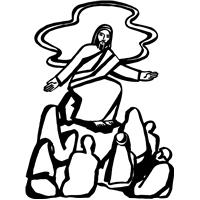


Amy-Jill Levine, a Jewish scholar of the New Testament, names ways Jesus’ life and actions echoed those of prophets familiar to her from her religious upbringing:
Jesus fusses at priests, just like Amos. Jesus tells parables, just like the prophet Nathan and a number of rabbis whose stories appear in postbiblical Jewish sources. Jesus heals and raises the dead; so too Elijah and Elisha. Jesus survives when children around him are slaughtered, just like Moses. I didn’t have to read Matthew 2–7 to know that the rescued baby would take a trip to Egypt, cross water in a life-changing experience, face temptation in the wilderness, ascend a mountain, and deliver comments on the Law—the pattern was already established in Shemot, the book of Exodus.
In spite of many similarities between Jesus and the Jewish prophets, Levine stresses that the Gospel writers view Jesus as more than a prophet:
Although Jesus himself may be perceived as heir to the legacy of Amos and Jeremiah, the Gospels present him as more than a prophet. He is, according to the Evangelists, the Son of God, who adds something new to the prophetic concern for justice. He goes well beyond the role of Isaiah and Micah, who seek what is called in Hebrew t’shuvah, return and repentance. Jesus of the Gospels seeks something new, specifically, following him. He is important not only because of what he says, but also because of who he is.
References:
Amy-Jill Levine, The Misunderstood Jew: The Church and the Scandal of the Jewish Jesus (New York: HarperCollins, 2006), 3, 110. https://cac.org/daily.../jesus-prophetic-lineage-2023-01-27/


Sunday, September 2, 2012

Give an eagle a fish ...


Deuteronomy 4:1-2, 6-9
Psalm 15
James 1:17-27
Mark 7:1-8, 14-15, 21-23
 
Give an eagle a fish – and he’ll be back tomorrow. To teach an eagle to fish – you need a flock of eagles.

Junior – or Buddy – already was an eagle, just a young one. He was immature, and he’d gotten out of the nest too early. So he didn’t know all the things an eagle needs to know before becoming a full-fledged adult bird. He needed help.

At first he was getting it from people – the simple, beginning things. He needed to eat. Throw him a fish – and he’d be back the next day.

But he needed to learn more, beyond that simple receipt of sustenance. He needed to get out there and do the things that eagles do. So how does he learn that?

A biologist from the U.S. Fish and Wildlife Service (at Iron River NFH) explained it to us. In the fall as the days get shorter and colder he’ll see other eagles soaring and circling and gathering over a road-killed deer – and he’ll want to join in the feast. 

They’ll let him know how this works. Later they’ll head south, down the river – and he’ll follow. They’ll gather below dams where the fishing is good – and again he’ll want a share. They’ll let him share – or let him know to catch his own. He’ll catch on… but it will take a flock of eagles – an aerie, a convocation – to teach him, to raise him up to maturity, to the fullness of life of a mature bird. And he’ll soar with them.

In the reading today from the letter of James, we begin a series on the Christian life – how to live after you believe.  What Christian behavior is – among this flock! 
 
James tells us the source of all we are – and all we have – in Christ Jesus. And that is why – not owing to ourselves – we are able to respond to the message of the kingdom, the gospel. It is in us – as Christ’s messengers – to share that love and joy we know as God’s gift. So we speak slowly of anger, quickly of love.  We cast off, with God’s help, the ghosts of past wrongs. And we become active agents of the word, not passive receivers only.

What we believe, what we trust, what we know, we act upon: knowledge of Christ is actionable knowledge.

“The road to holiness necessarily passes through the world of action.”—Daj Hammarskjold

What we have is given us by God – our identity, our nature, eagle or human, comes from that source. What we do with it, how we grow into the full stature of our nature as God created us to be, that is what we have to learn, from each other, in the community and fellowship gathered in the spirit of Christ Jesus. 

We learn how to act in accordance with our nature as redeemed people, people called to follow Jesus. As eagles learn from each other so we grow in knowledge, actionable knowledge, learning how to live the life of joy – together. 

And the letter of James, and the Psalm for today, lay out some steps. 

(You see the Law is not there to get you into heaven – or into trouble; it is there to guide your way into the holiness. So the Law becomes a mirror, a mirror of perfection, showing us what it looks like to become perfect – that is, made whole, complete – in Christ. It shows us how we are “in aspiration” – as God made us to be, as Christ is shaping us to become, in the fullness of created and redeemed nature.)

Indeed, Psalm 15 gives us ten steps, ten examples, ten precepts, on how to live – the goal: being able to present our selves as an offering of praise before God (as the Eucharistic prayer says for us). So how do we clean up our act so we can stand upright as God’s own people?


Psalm 15
  1              Lord, who may dwell in your tabernacle?*
                  who may abide upon your holy hill? 

  2              [I] Whoever leads a blameless life and does what is right,*
                  [II] who speaks the truth from his heart.
  3              [III] There is no guile upon his tongue;
                  [IV] he does no evil to his friend;*
                  [V] he does not heap contempt upon his neighbour.
  4              [VI] In his sight the wicked is rejected,*
                  [VII] but he honours those who fear the Lord.
  5              [VIII] He has sworn to do no wrong*
                  and does not take back his word.
  6              [IX] He does not give his money in hope of gain,*
                  [X] nor does he take a bribe against the innocent. 

  7              Whoever does these things*
                  shall never be overthrown.

This is in a sense, then, a call to conversion – to continuing conversion, a transformation of manner of life, the turning, turning, of our souls ever more God-ward, showing forth in our lives – making it real in the world – what is in our hearts.

Blessed one, bless us, as you call us forth, out of our own preoccupations, into your service, out of our shadows, into your light; help us leave behind the wrong-doing, the slander, the deceit, the gossip, – all that makes mockery of our souls – the impediments to our freedom in Christ. May the gospel show forth in our lives as we embrace it with our minds and hearts and hands and voices. Amen.


Wednesday, July 14, 2010

family reunion

Summer time people often travel - to back home. They may go to new and exciting places. Quite often, though, they go where they are known: where they know the people, and know the place, and know where they fit - or used to fit - in that landscape and that group of people. It's you, they say, and so it is - if you want it to be. May be you don't - could be painful. May be you do: it could be, after all, a place and a people where you fit, and fit well. That well-come may be just what you need.

If it's been a hard year, if you lost your job, if illness means you cannot do that work anymore, if you cannot be to someone what you once were, it comforts to know that you are known. For yourself, hopefully.

For yourself, in God's eyes, for ultimately who you are. Ultimately who you are at the end of things is the person God meant you to be, the person God saw all along, knew you could be - if you want to be, if you let it be, if you let God be the one who makes it be: the one who made you redeems you, fills you over-top with gifts that spill over into the lives of those around you. Because you are not the only one coming home, you are not the only one who needs that welcome.

In fact you are one of the family - the welcoming family, that God calls into being, that God calls together from place to place, from time to time, in little groups of two or three, or family gatherings.

Maybe it's just a favorite uncle and you, meeting for a drink and a little something to eat - or a great gathering of cousins, aunts, and uncles. Long forgotten and daily familiar - and brand new, first time here, just gathered into the family, the family gathering at this time, at this place.

Make them welcome - (especially) if they are strangers - strangers to you. For many have been entertained by angels unawares.

Under the oaks of Mamre, an Old Testament trinity of Abraham and Sarah and their long-suffering silent servant provide hospitality to three strange visitors.

It's a test of sorts - or a celebration. Depending on how you look at it.

It's a feast, in Abraham's eyes. Go prepare a calf, they tell the servant. Make cakes of meal and oil. Serve them. Water for their feet? A bit of rest, a seat in the shade - the shade of the trees, the oaks of Mamre.

The meeting place, already ancient then, no doubt, of humans crossing paths in the middle of a strange new land.

It's a land of promise to Abraham - and a promise comes.

It's a promise of comic hope, to Sarah - and she shouts in surprise with laughter, greeting the news - the strangers bring: how do they know? Is it just a blessing - a guest's wish? Or more? - They say: your wife is going to have a baby. We shall see.


Martha, Mary, sisters of Lazarus. They greet a greater One than these Three.

And they welcome him - according to custom, as it would be, having Abraham's example before them - and overcoming custom, as one of the sisters takes a man's place - or a disciple's place - at the foot of the Master, Teacher, Rabbi.

Tell her to come help me...

Martha, Martha, my dear. Don't you worry. Don't fret yourself or her. All will be well.

All manner of thing shall be well - and she has chosen the better part: better because the Lord is with her, with her now, and all these things shall be looked after -


Come sit with us, Martha, for a moment - let the dishes soak. Let my feet remain unwashed (yes even the Master's feet) - for a moment.

Let's refresh each other in a greater hospitality: the hope, the love, the great gifts of God.

And then, let's get on with the feet washing, the bread making, the dishes, - and the plowing, the sowing, the harvest - and the baking, again.

But for now - together - Martha and Mary and Lazarus and all - together - be at peace.

The Lord is here.


+

Saturday, July 21, 2007

Martha and Mary in the presence of the Lord

CProper11 BCP
Eighth Sunday after Pentecost

Genesis 18:1-10a(10b-14)
Psalm 15
Colossians 1:21-29
Luke 10:38-42

1. This week’s gospel, the story of Mary and Martha, is the second of two stories about the kingdom of God, about listening and not listening to the good news of what it really is, what really is, what we really are. It is also the second of two illustrations of the summary of the law: Love God, and love your neighbor.

Last week we listened in as a lawyer asked Jesus, “What must I do to inherit eternal life?” He himself supplied the answer:

Love God, and love your neighbor. These are the first and greatest commandment, and the second, which is like unto it. “Do this, and you will live.” But then, because the lawyer wanted to secure his hold on the kingdom, he asked Jesus to clarify his terms. “But who is my neighbor?” Jesus told the story of the Good Samaritan, and the lawyer learned there is more to the kingdom than fulfilling his obligation under the law.

In this week’s story, of Martha and Mary, we have another chance to see what the kingdom is – and more explicitly, who Jesus is. We see a woman being reminded of the first law, the love of God: the very reason for what we do, for all that we do, is the love of God.

There are two sisters. Mary takes the place of a disciple, sitting at Jesus’ feet. Martha -- distracted and worried by many things -- objects to this.

What she is doing is fine, in a way: it is the ordinary task of an ordinary day in an ordinary household. This is, however, no ordinary day: Messiah has come and he is under our roof, at this very moment. Rabbi is teaching: what are you doing in the kitchen when you could be listening, picking up pearls as they fall from his lips?

For a woman to take the place of a disciple was NEW: it was unexpected, unheard of. Jesus’ message of the kingdom breaks down traditional barriers. The love he shares with Martha, Mary, and us is so expansive, so outrageous, and so extraordinary that it overflows. The channels of ordinary piety cannot contain the Spirit. It floods into our lives. This is no ordinary day.

Maybe that makes Martha a little nervous. Maybe that is why she is busying herself among the pots and pans. She is doing hospitality – at a moment when the one thing necessary is to wait – to wait not on tables but to wait on the Lord, to listen to what the Lord is saying. To see that this is the day when righteousness and peace embrace: the kingdom has come to our house, Martha, and it is time to rejoice.

2. Like the lawyer Martha made a good effort. She wanted to do what is right. She may even have wanted, as the lawyer who asked the question did, to inherit eternal life. What is missing is that you do not earn your way into heaven. You celebrate its arrival in the midst of you. It is present, even in an ordinary day, even in the completion of ordinary duties. But when the day comes to listen to the Lord, take off your apron, drop the duster, set down your pen, turn off your computer, hang up your cellphone, and sit at Jesus’ feet.

Our culture values the doer. We say: “Come on, let’s get going; let’s get something done.” We get up early so we can ride the elevator up to the twelfth floor with the boss. At least I have. We spend our week getting things done, and at the end lean back in satisfaction at what we have accomplished. At least I have. But then on that same Friday evening, in the very next moment, I asked myself: What was this all for? Have I lost track of the very reason for what I was doing, as I was so busy doing business? Do I need to step back, take a long look, and remember why I am here?

The lawyer meant well but he may have forgotten the relationship, to God and the neighbor, which was the reason behind the rules. Jesus breaks the rules; but he fulfills the Law. He reinstates the relationship between God and us. He reminds us why we are here. And he does it in part by overcoming judgment with mercy, by showing us the outrageous abundance and the exuberant overflowing of the kingdom of Heaven. Remember this is the Christ who, presented with the need to feed five thousand, had them sit down and share five loaves and two fish – and they all were well fed. Maybe Martha is worrying too much.

3. Mary, who sat at the Lord’s feet and listened to what he was saying, took a disciple’s place. Martha, on the other hand, was “distracted and anxious” about many things.

“Mary has chosen the better part” – there is that word “chosen”. As Canon Lynell Walker has pointed out, the good news is that you can choose, that your time has come, that now it is your turn to be in the presence of the Lord. The part “which will not be taken away from her” – what is that? As Dean Brian Baker sees it, clearly Jesus is only there for the night but the Word of God will remain forever … as will the Spirit.

4. By the oaks of Mamre – the scene of this morning’s Old Testament lesson – Abraham, the exemplar of faith, saw three strangers approach. He was host to the three men. Sarah, in the tent, made cakes; a servant prepared a calf; and Abraham served the men himself, standing by them under the tree while they ate. One promised to return in due season, and that Sarah should have a son. [Sarah laughed.]

This is the classic example of Middle Eastern hospitality – the welcome to strangers, preparing them food. The blessing in return, here a promise of children – and thus a future with hope – is probably characteristic too: but here it has a larger purpose. The three men represent the three persons of the Godhead, indeed icons of this scene are entitled “The Old Testament Trinity”.

So here we have the image of hospitality – and the roles of men and women – that Martha and Mary and Jesus grew up with. For Mary to break with this pattern was a surprise. Yet here she is, sitting at the feet of the Lord and listening to what he is saying: she has taken her place among the disciples. This, even though tradition would indicate that those who sit in the presence of the guest would be men – the man of the house – and that the women would like Martha concern themselves with children, church, kitchen. … leaving the men to themselves to discuss man stuff like … what?

Is the Messiah here only for men? Is the Kingdom of Heaven exclusive? No, in one situation after another we see Jesus break the rules. The kingdom of heaven is for all people. He is here to announce it, to proclaim it, to manifest it, to usher it in.

So this is not your typical guest, nor your typical meal. The occasion is extraordinary. Jesus, the Messiah, is here present now in Martha (and Mary’s) living room. What to do?

Maybe it’s all a bit upsetting. I mean, Jesus breaks the rules. Who knows what he’ll do to my life? Maybe he’ll change it all around, stretch my boundaries, and eliminate my preconceptions. Maybe he’ll call me to some new level of service of which I’m afraid.

Martha may want a bit of business, ordinary business in the household, to occupy her hands while her mind races to take it all in. What we hear from her, though, is a plea: Lord, make my sister come help me in the kitchen.

Is this what you would ask Messiah for? If he were to come to dinner today at your home, what would you say to him?

“My Lord, if I find favor with you, do not pass by your servant. Let a little water be brought, and wash your feet, and rest yourselves under the tree…”

“Lord, do you not care that my sister has left me to do all the work by myself? Tell her then to help me.”

And what will he reply to you? Is anything too wonderful for the Lord?

5. I used to read a lot of mysteries. Mysteries come in several sorts. There are puzzle mysteries, like Agatha Christie novels. There are mysteries that present problems to solve, situations to investigate, and secrets to be discovered. There are stories to be told. Some mysteries are only resolved in the telling of the story. And some mysteries are only fully revealed as they are lived. “The mystery that has been hidden through the ages and generations but has now been revealed to his saints,” – “which is Christ in you, the hope of glory” – is one of these last. To begin to tumble to the truth, in this story, takes all your living. God, who was present to Abraham and Sarah, Mary and Martha, is present to you, now, this morning.

Your freedom to act is in the present moment. It is today not yesterday or tomorrow that you receive the divine invitation. Now it is your turn. Today you are invited to sit at the feet of Jesus and listen to what the Lord is saying. This morning he has come to your tent – and he is here to share with you a meal. The cup is your salvation and the bread his presence.


Sources

Tom Wright, Luke for Everyone (SPCK, 2001)

Herbert O'Driscoll, The Word Today: Reflections on the Readings of the Revised Common Lectionary, Year C, Volume 3 (Toronto: Anglican Book Centre, 2001)

Herbert O'Driscoll, Patrick's Well (www.herbodriscoll.com)

Barbara Crafton et al., Geranium Farm (www.geraniumfarm.org)

Arthur J. Dewey, The Word in Time (New Berlin, WI: Liturgical Publications, 1990)

Sharon H. Ringe, Luke, Westminster Bible Companion (Louisville, KY: Westminster John Knox Press, 1995)

Thomas W. Walker, Luke, Interpretation Bible Studies (Louisville, KY: Geneva Press, 2001)

Fred B. Craddock, Luke, Interpretation (Louisville, KY: John Knox Press, 1990)

Michael F. Patella, O.S.B., The Gospel According to Luke, The new Collegeville Bible commentary, New Testament; v. 3 (Collegeville, MN: Liturgical Press)

Keith F. Nickle, Preaching the Gospel of Luke: Proclaiming God's Royal Rule (Louisville, KY: Westminster John Knox Press, 2000)

Common Worship (Church of England, 2000) http://www.cofe.anglican.org/worship/liturgy/commonworship/

The Book of Common Prayer (Church of England, 1662)

Oremus Bible Browser http://bible.oremus.org/

Stephanie Frey, “Living with Martha (Luke 10:38-42)”, Living by the Word, The Christian Century Magazine, July 13, 2004