Sunday, December 8, 2024

Free to worship him without fear, *

Preachers tell us we need prophets. Prophets tell us what is really going on. They are not primarily people who predict the future. They tell us what is going on right now in our present situation and what it means in the light of the sovereignty of God. Sometimes what they have to say lasts beyond their own time. Isaiah and Baruch, for example. John the Baptist, for another. And Zechariah, John's father.

A more modern prophet lived in the last century. He was a German Lutheran theologian, and he spent most of his life in Berlin. Most of his life. He visited Spain, New York City, England, and Sweden. And at the end of his life he was not in Berlin, he was in a prison camp.

What had he done to earn that? From the beginnings of his country's turn to national socialism, he had spoken out to his fellow Christians about what it meant. What it ultimately meant. 

To some of them, it meant good times ahead. What could be better than a strong leader who would clean house and bring church and state together to strengthen the nation? 

Dietrich Bonhoeffer, for that was his name, saw differently. He was not alone, but he did not, at the end, have many friends. There were family members who were much more, or much less, implicated in resistance to the national socialist regime that took over their country.

What he did at first and for many years was simply to point out what it meant for the church to merge its identity into a national project. What it meant not to be an independent voice, for justice, for the poor, for the person on the edge of society, and for the person pushed there by politics. 

During the war he became involved in working for military intelligence, but while he worked there he was also a courier for the resistance movement, trying to build bridges for democracy with people in other countries. And his main clandestine work for awhile was raising money to allow Jews to seek safe haven in Switzerland.

He was famously involved, but only peripherally, in a plot to kill Hitler. That plot failed in July 1944 and gradually the conspirators were rounded up. Eventually they came for Dietrich Bonhoeffer.

But that is not the end of the story. In prison he was able to write friend and family, and continue to develop his understanding of what was going on. He continued to be a prophet.

One thing he said that I have been thinking about puts a different spin on Advent.

Advent we rightly hold to be a time of preparation, of repentance and renewal, in anticipation of the arrival of Christ at Christmas. 

It is a time of hope, hope that bridges the distance between faith and love, between what we hold to be true and how we put it into action.

That is what got Dietrich Bonhoeffer into trouble. Most pastors just went along with what was going on - or took quieter ways to resist.

Dietrich Bonhoeffer had taught something important to think about.

What Christmas means to us, Christmas that is coming, is hope. It means the arrival of God in our world, bringing peace on earth. The good news is even better: Christmas means that he is already here.

God is already active in the world. How can we not love a season that invites us to begin to live like that? We are invited this pre-season, as every season pre- Savior, to look at ourselves and see what God sees in us: not mortal sinners but eternally beloved children.  

We see the love of parent and stranger, community and chorus of angels, shining the love of God on one child. But not only him.

Children in the Holy Land today, in places torn by war, civil strife, or natural disaster, children desperately crossing waste places through the desert to hoped-for new homes of safety, children placed in foster homes or cherished by grandparents, children safe and embraced by loving families, all these have the light of the love of God shone on them.

And when they grow up, they may not be as cuddly, but they are still children of God's grace. They are beloved of God. Each of them, all of them. We are with them. 

We know we need Advent. It's short notice to get ready. To begin to see the impact of God's present - since the beginning - in the world.

We know we want Advent. We want wreaths and glory to the king and simmering cider and cookies and greetings from strangers and all the rest. The chance to give to relieve the suffering and brighten the days of the lonely. The chance to give and the chance to receive. For we have all received, before we have had a chance to give, God's love.


God of Freedom, protect those who worship amid fear, and grant courage to those barred from sacred spaces. Soften the hearts of those in power, that they may choose mercy over oppression. Bring peace to every street and let justice flow through the land. May all worship in freedom and safety, and may peace and dignity be restored to all.

Lord in your mercy…hear our prayer


Sabeel weekly newsletter, November 11, 2024. 
https://sabeel.org/wave-of-prayer-218/

Second Sunday of Advent
Year C
RCL
Baruch 5:1-9 
Philippians 1:3-11
Luke 3:1-6
Canticle 16

Second Sunday of Advent, 2024: December 8th. Episcopal Church of Saint Matthew, Tucson. 8 & 10:30am.

Free to worship him without fear, *
holy and righteous in his sight
all the days of our life.

http://opera.stanford.edu/iu/libretti/messiah.htm

Comfort ye, comfort ye my people, saith your God.
Speak ye comfortably to Jerusalem, and cry unto her, that her warfare is accomplished, that her iniquity is pardoned.
The voice of him that crieth in the wilderness; prepare ye the way of the Lord; make straight in the desert a highway for our God.
 
(Isaiah 40: 1-3) 


Ev'ry valley shall be exalted, and ev'ry moutain and hill made low; the crooked straight and the rough places plain. 
(Isaiah 40: 4) 

And the glory of the Lord shall be revealed, and all flesh shall see it together: for the mouth of the Lord hath spoken it. 
(Isaiah 40: 5) 

Thus saith the Lord, the Lord of hosts: Yet once a little while and I will shake the heavens and the earth, the sea and the dry land.
And I will shake all nations; and the desire of all nations shall come.
 
(Haggai 2: 6-7)

It is the time of year that we remember that the Christ has come before. Much of the run-up to Advent, at the end of the long season after Pentecost that culminates in the feast of Christ the King, reminds us that we await the Messiah. His second coming is anticipated with fear and desire; His first coming, with joy.

Joyful anticipation is a way to see Advent through to Christmas. Penitence or at least preparation is another. In fact we do both, as we recall and renew the promise of ages, that the Lord will comfort his people and set them on the right path. They will need to seek the right path. This applies not just to the ancient nation of the Hebrews in time long remembered, but in our own time and in our own lives.

For at the very last, when Zechariah proclaims in song the prophecy and its fulfillment, we grasp fundamental freedoms: freedom to worship him without fear. This comes out of promise and out of preparation. Anticipation, of the coming liberation. Not domination, but freedom. 

FDR addressed his country once (January 6th 1941) on the state of the union in a speech noted for his articulation of Four Freedoms:

In the future days, which we seek to make secure, we look forward to a world founded upon four essential human freedoms.

The first is freedom of speech and expression--everywhere in the world.

The second is freedom of every person to worship God in his own way--everywhere in the world.

The third is freedom from want--which, translated into world terms, means economic understandings which will secure to every nation a healthy peacetime life for its inhabitants-everywhere in the world.

The fourth is freedom from fear--which, translated into world terms, means a world-wide reduction of armaments to such a point and in such a thorough fashion that no nation will be in a position to commit an act of physical aggression against any neighbor--anywhere in the world.

That is no vision of a distant millennium. It is a definite basis for a kind of world attainable in our own time and generation.


https://www.archives.gov/milestone-documents/president-franklin-roosevelts-annual-message-to-congress
https://www.fdrlibrary.org/four-freedoms

FDR was an Episcopalian. He kept the Book of Common Prayer by his bedside. And every morning that he said Morning Prayer out of that book, he would have heard the words of the song of Zechariah:

Free to worship him without fear.

He did not say freedom would only come with the second coming of Christ. He did not say that it fully had with his first. But with Christ we could strive to see the day when that freedom, and those freedoms, became clear, evident, more real in our lives and in our deeds that ever before. 

There is sliding backwards. There is failure. There is often despair. These are only human. 

The divine hope, the divine promise, and the human response in faith and love, persevere.

What will we do this Advent day to prepare the way? The way to the Cross, yes, but through the Cross to the dawn from on high that shall break upon us, as promised, as the reign of God becomes real to us.

To shine on those who dwell in darkness - is partly our job. Near and far, friend and stranger, there are those among us in the human family with whom we walk the way of peace who need our company.

We accompany those of different abilities, backgrounds, and even faiths, as we walk toward peace. 

The reign of God - 'already but not yet' in the familiar phrase - comes closer when we come closer to God.


JRL+

Sunday, October 27, 2024

Hope is the bridge...


In the first chapter of Genesis, on the fourth day of creation, we are reminded that we know where we are in time: most primordially in the seasons and days and years marked by the stars and the planets and the rotation and revolution of the Earth. (Genesis 1:14-19)   

The Christian calendar, like the Hebrew calendar, follows the sun and the moon. The traditional calendars of the indigenous peoples of southern Arizona show us the seasons of growth and of waiting. (As I recall from a visit to the Arizona Historical Museum, in some traditions we hereabouts have six, based on not only heat and cold, rain and drought, but the fruition times of various local food plants.) And later the arrival of Spanish and Mexican cultivators meant these two calendars were integrated into such festivals as the Nativity of Saint John the Baptist, which is the time of harvest for wheat and also marks the beginning of the monsoon.

We know where we are in time also and that we are in the in-between time of hope.

Psalm 126

6  Those who sowed with tears * 

will reap with songs of joy.

7  Those who go out weeping, carrying the seed, * 

will come again with joy, shouldering their sheaves.


Between the sowing and the reaping, 

In between now and then, between what was and what is to come, between the seed time and the harvest, the apparently infertile soil is the place of hope.

Of faith in things not seen, as yet, but believed.

This is about much more than simply the turn of the agricultural calendar, between the sowing and the reaping. In our lives we may experience times of nascency, of no apparent growth, indeed some times of sorrow and bereavement, when things are yet happening below the surface.

One time I encountered the then- archbishop of Canterbury, George Carey, and as a conversation opener remarked to him that he had had great success as bishop of Bath and Wells, a time of great revival in the churches there. And he replied, that another had sown, and another tended, and he had merely been in at the harvest. He might have been quoting Saint Paul, “So neither the one who plants nor the one who waters is anything, but only God who gives the growth.” (1 Corinthians 3:7)

We may, as Canon Anita reminded the congregation during the diocesan convention, see about us a desolate apparently barren place, as the Israelites returning from the Babylonian Captivity perceived when they arrived back in the land of their ancestors. Return from exile did not mean easy street. They were confronted with choices that tested their faith. 

She gave the example of a householder holding a handful of grain. This could be the seed corn for the harvest to come, or she could use it to feed her family. Consuming the seed grain is a short-sighted move, but understandable in a time of desperation. The farmer would have to hold onto faith that the family would be sustained through the growing season, but as Paul wrote to the Corinthians, one plants, another waters, but God gives the growth. (cf. 1 Corinthians 3:6)

A time of waiting. Sleeping seeds: when shall they wake? When will the harvest come?

Hope is the bridge between faith that is theory and belief, and love that is practice and action.

At a time like that faced by the farmer, faith in theory is challenged to become love in action. And in between is the time of hope.

I do everything I can as if it all depends on me, said Mother Teresa; then I leave the rest to God. (to Malcolm Muggeridge, in ‘Something Beautiful for God,’ documentary film)

[And yet even she said, "I do not pray for success, I ask for faithfulness." Mother Teresa (https://www.catholic.org/clife/teresa/quotes.php)]

The story of Bartimaeus helps us to begin to make real this distinction between ideal and action, between potential and fulfillment. As he waits by the side of the road blind beggar Bartimaeus can only imagine a healing to physical sight. This in itself is a powerful sign of the hand of God at work through the one that Bartimaeus cries out to as ‘son of David’, which is pretty much equivalent to hailing him as Messiah. (Mark 10:46-52) 

(The Greek is helpful here: he cries out, ‘anaboaō’ – that he might see again, ‘anablepsō’.)

Calling Jesus Teacher, ‘Rabbouni’, (as Mary Magdalene will address him at the Empty Tomb, in John 20:16) begins to reveal that the blind man’s insight goes beyond physical appearances.

A more-than-physical health is for us to enjoy, too, as we perceive the full extent of the gift of vision that Jesus gives us and Bartimaeus. The gift is beyond his expectation, and ours, for this is the gift not simply of seeing things that are visible but the gift of Jesus himself : and of the arrival in his person of the coming reign of God. 

When Bartimaeus casts aside his begging-cloak he begins this journey, a journey that will take him from supplicant to disciple and will take him and Jesus to their next stop: Jerusalem. Jerusalem, where the fulfillment of Jesus’ purpose as the Son of David, the anointed one of God, will be revealed.

The days and years and seasons illuminated for us by sun and moon and stars tell us where we are in time - chronometer time. The life that is the light of humankind, that is Jesus, lights our way as we follow him into a greater sense of time - holy time - and a greater truth than simple sight. There is more than the marking of time passing at work here: in the kingdom of God, from Genesis through Revelation, God is at work in Christ, healing and reconciling us to himself. And we, thus enlightened, are called to live out our new insight in receiving, embodying, and carrying forth the gifts of faith, hope, and love, that make the kingdom of heaven real in our lives.

Things we begin to make real, to realize, by acting into them: we begin living into the kingdom, the reign of God. 

The reality of the kingdom in our lives does not depend on or equate to anything less than the reign of God.

Present, social order or economic situation may change, but what continues is the story of the people of God, the story from creation through the life of Christ to resurrection, the story which is enacted sacramentally in water and oil in wine and bread, and in our fellowship with each other, and, in the spirit, becomes active in our care for each other, for all people, and for the created world.   

Faith we have and we work toward love as we hold onto what we know that is true: God’s love and the work to make it actively present in our lives in society and world.   

In a sense more evident for us than for many people of the past, we are aware of the world society that is both a mission field, encompassing the globe, and also our common home.  

Hope is the bridge between faith that is theory and belief, and love that is practice and action.

May the kingdom come on earth, as we act in love, as it is, as we know in faith, in heaven.


Genesis 1: 

14 And God said, Let there be lights in the firmament of the heaven to divide the day from the night; and let them be for signs, and for seasons, and for days, and years:

15 And let them be for lights in the firmament of the heaven to give light upon the earth: and it was so.

16 And God made two great lights; the greater light to rule the day, and the lesser light to rule the night: he made the stars also.

17 And God set them in the firmament of the heaven to give light upon the earth,

18 And to rule over the day and over the night, and to divide the light from the darkness: and God saw that it was good.

19 And the evening and the morning were the fourth day.


Jeremiah 31:7-9. Psalm 126. Hebrews 7:23-28. Mark 10:46-52.

Sermon for October 27, 2024 [Proper 25. Year B]

JRL+ 


Friday, August 9, 2024

speaking peace

 As the Psalm calls us to do,

Let us listen to what the Lord God is saying, for he is speaking peace to his faithful people and to those who turn their hearts to him.Truly, Mercy and truth have met together; righteousness and peace have kissed each other. Truth shall spring up from the earth, and righteousness shall look down from heaven. Righteousness shall go before him, and peace shall be a pathway for his feet. (from Psalm 85)

***

It is a call not to despair but to repentance. However dire the current situation, God is still extending a hand to humankind, stirring life and hope.

What is the Lord God saying?

Not to the people of the past, anymore, but to us. What shall we do in our current situation? What shall we do, facing eternity?

The Russian novelists of the 19th Century, in their great literature, asked the question, how are we to live?

It is not so different from the question people asked Peter, when he had baptized them: what do we do now?

Now what? is where we are now, where we always are, after the crucifixion of Jesus, after his resurrection and ascension, before the fullness of the kingdom of heaven is revealed in all its joyous power. Now what?

How are we to live - now? Or they asked Peter after Pentecost, what must we do?

Simple words, simple actions, in the telling of the gospels. Don’t cheat, don’t lie, don’t steal, give right weight and proper measure, share, look after the needy. Wait, but not just sitting around. Prepare by being ready, by getting into the habit, by living into the kingdom that is not yet - but whose citizens we already are.

Above and beyond and always questioning our earthly loyalties, to tribe or even family, is that divine calling, that allegiance unpledged, unbought, unvoted for, but ultimately demanding: the welcome undertow of the holy word, the joyous laughter of the Lord of mirth, the happy ending beyond all sorrow, that comes when we come to the Lord, and lay ourselves at his feet.

In our words and in our actions, together as a congregation, individually in our daily lives, and as citizens and people of common humanity, we are making positive steps toward inhabiting the kingdom of heaven that is coming into being.

And – despite all anxieties and threats to the contrary – the kingdom of heaven comes ever closer and even shows itself in places. May it become ever more visible in our lives and the lives we touch.

Let us pray for all worried about or touched by political violence or its threat, that there be listening instead of reaction, compassion instead of anger, and seeking of peace instead of reaching for a sword.

Let us not seek to relieve anxiety in rash and harmful ways but live and act in the compassionate love to which we are always called.

https://tucson.com/life-entertainment/local/faith-values/do-as-the-psalm-calls-us-to-do/article_e0205f1e-4e88-11ef-8a12-0711518687c7.html

Sunday, July 14, 2024

Bastille Day 2024

One of the most well known acts of political violence in history is remembered today in Paris. In 1789 on 14 July a mob released about eight people from a decrepit prison in the center of Paris. The building was then demolished. It was called the Bastille; today is Bastille Day.

Yesterday at noon the US secretary of state sent best wishes to the people of France, eighty years after the liberation of Paris and 75 years after the founding of NATO… and 235 years after the storming of the Bastille, which marks the beginning of the French Revolution.

Yesterday also a twenty-year-old man got to the top of a building near a political rally in Pennsylvania and shot his rifle at the former President. Mr Trump was hit in the top of the ear, and rushed to safety. One spectator was killed, two more seriously injured, and the Secret Service found and killed the shooter.
Between the 18th century and yesterday there were many acts of individual violence, gun violence, assassinations and attempted assassinations, of presidents, prime ministers, and many others. There have been revolutions, rebellion, wars, and riots. 

Two thousand years ago two acts of political violence were committed that are connected in today’s gospel. King Herod ordered the death of the popular preacher John the Baptist. Later the Roman governor of Judea would order the death of John’s cousin, Jesus of Nazareth. 

Both were killed in part because of political anxiety. Within decades the upheaval of rebellion after rebellion led to the demolition of Jerusalem. Of the Temple only a part of the western wall remains.
I do not equate any of these acts with another in specific motive, purpose, or result. 

We can however know as people of God that acts of violence, gun violence, political violence, however motivated, are against the will of God. 

As Presiding Bishop Michael Curry said last night, on Trump rally shooting: 
"The way of love—not the way of violence—is the way we bind up our nation’s wounds. We decry political violence in any form, and our call as followers of Jesus of Nazareth is always to love. We pray for the families of those who were killed. We pray for former President Trump and his family and for all who were harmed or impacted by this incident. I pray that we as a nation and a world may see each other as the beloved children of God."

As the Psalm we sang today calls us to do, 

Psalm 85:8-13
Benedixisti, Domine

8 I will listen to what the Lord God is saying, *
for he is speaking peace to his faithful people
and to those who turn their hearts to him.
9 Truly, his salvation is very near to those who fear him, *
that his glory may dwell in our land.
10 Mercy and truth have met together; *
righteousness and peace have kissed each other.
11 Truth shall spring up from the earth, *
and righteousness shall look down from heaven.
12 The Lord will indeed grant prosperity, *
and our land will yield its increase.
13 Righteousness shall go before him, *
and peace shall be a pathway for his feet.

***

It is a call not to despair but to repentance. However dire the current situation, God is still extending a hand to humankind, stirring life and hope.

What is the Lord God saying?

Not to the people of the past, anymore, but to us. What shall we do in our current situation? What shall we do, facing eternity? 

The Russian novelists of the 19th Century, in their great literature, asked the question, how are we to live? 

It is not so different from the question people asked Peter, when he had baptized them: what do we do now?

Now what? is where we are now, where we always are, after the beheading of the Baptist, after the crucifixion of Jesus, after his resurrection and ascension, before the fullness of the kingdom of heaven is revealed in all its joyous power. Now what? 

How are we to live - now? Or they asked Peter after Pentecost, what must we do?

Simple words, simple actions, in the telling of the gospels. Don’t cheat, don’t lie, don’t steal, give right weight and proper measure, share, look after the needy. Wait, but not just sitting around. Prepare by being ready, by getting into the habit, by living into the kingdom that is not yet - but whose citizens we already are.

Above and beyond and always questioning our earthly loyalties, to tribe or even family, is that divine calling, that allegiance unpledged, unbought, unvoted for, but ultimately demanding: the welcome undertow of the holy word, the joyous laughter of the Lord of mirth, the happy ending beyond all sorrow, that comes when we come to the Lord, and lay ourselves at his feet.

In our words and in our actions, together as a congregation, individually in our daily lives, and as citizens and people of common humanity, we are making positive steps toward inhabiting the kingdom of heaven that is coming into being.

This includes collective action as citizens and as assembled people of God.

This spring, United Methodists, Presbyterians, Lutherans, and Episcopalians each gathered to discuss their future, enact resolutions, and elect leaders for a new era.

More people will vote around the world this year than ever before.

Americans are voting. Arizona voters have begun to make their choices.  St Matthew’s is again a voting center.

And – despite all anxieties and threats to the contrary – the kingdom of heaven came ever closer and even showed itself in places. May it become ever more visible in our lives and the lives we touch. Amen.

Let us pray for all worried about or touched by political violence or its threat, that there be listening instead of reaction, compassion instead of anger, and seeking of peace instead of reaching for a sword. 

Let us not seek to relieve anxiety in rash and harmful ways but live and act in the compassionate love to which we are always called.

O Lord, mercifully receive the prayers of your people who call upon you, and grant that they may know and understand what things they ought to do, and also may have grace and power faithfully to accomplish them; through Jesus Christ our Lord, who lives and reigns with you and the Holy Spirit, one God, now and for ever. Amen.

July 14, 2014. JRL+


***

U.S. Department of State
Bastille Day
07/14/2024 12:01 AM EDT
Antony J. Blinken, Secretary of State
On behalf of the United States of America, I extend my warmest wishes to the people of France as you celebrate Bastille Day.
France, our oldest Ally, holds a cherished place in American hearts. Our enduring relationship is built upon the shared values of democracy, human rights, and freedom. Together, we have faced the trials of two World Wars and have worked in unity to build a more prosperous and secure world.
As we navigate the challenges of the 21st century, our partnership remains strong and multifaceted. We commend France’s leadership in addressing global issues such as climate change, including through the Paris Agreement, and we appreciate our close cooperation on security matters in Europe, Africa, the Middle East, and the Indo-Pacific. Our united efforts to end Russia’s war against Ukraine and to combat the climate crisis underscore the depth of our collaboration.
This year marks significant anniversaries and milestones, including the 80th anniversary of the Liberation of France, the 75th anniversary of NATO, and France’s role as host of the 2024 Olympic and Paralympic Games. We celebrate the sacrifices made by those who have fought for freedom and democracy and honor their legacy by continuing to work together to promote peace and prosperity.
Best wishes to the people of France for a joyous Bastille Day and a successful year ahead. Vive la France!
***
Episcopal Church Office of Public Affairs
 
Sat, Jul 13 at 7:00 PM
Statement from Presiding Bishop Michael Curry on Trump rally shooting
"The way of love—not the way of violence—is the way we bind up our nation’s wounds. We decry political violence in any form, and our call as followers of Jesus of Nazareth is always to love. We pray for the families of those who were killed. We pray for former President Trump and his family and for all who were harmed or impacted by this incident. I pray that we as a nation and a world may see each other as the beloved children of God."
***
 

now what


What came to mind for me first on being asked to preach on July 14th was Bastille Day. Then I looked up the readings and noticed the infelicitous phrase “head on a platter” - one that I will not use blithely around in-laws whose ancestors escaped France in the face of the Terror - or didn’t.

In the gospel reading the beheading of Saint John the Baptist is not an enforcer’s work, unless you count heedless teenagers. Even the Lord’s Resistance Army in the east African jungle had to groom and train children to be soldiers. Here the queen’s daughter just seeks to please her.

What a ghastly family. But that is hardly the point. How less ghastly are the people who shout, crucify! or the governor who washes his hands of the whole business. or the people who make money off it, or jeer, or gape blankly, as the man with the cross, John’s cousin, is led to death.

Amos in the first reading delivers the unwelcome news that there will not be a second Passover, no exemption for the people of Israel this time, as God passes judgment on the unholy of the world. That is what “I will never again pass them by'' means. No more passing over. Just as the spiritual, recalling the flood of Noah, warned, No more water; the fire next time. (2 Peter 3:7)

“God gave Noah the rainbow sign, no more water but the fire next time.” https://blog.adw.org/2018/06/fire-next-time-meditation-second-letter-peter/

“But by the same word the present heavens and earth have been reserved for fire, being kept until the day of judgment and destruction of the godless.” (2 Peter 3:7, NRSV)

What Amos does is prophesy, and forewarn of the coming exile of the people of Israel, –the northern kingdom,– soon to be overrun by then-powerful Assyria, a neighbor to the north.

All this cleansing is in response to sin. Pretty harsh punitive measure, or pretty clear warning of consequences. The point is - though ignored by the hearers of John the Baptist - REPENT!

“Turn back O man forswear thy foolish ways,” as they sing in Godspell. 

But the invitation is more positive and joyful than these words and worries would suggest. 

Look at the psalm we sing or say in response to Amos:

Psalm 85:8-13  Benedixisti, Domine

8 I will listen to what the Lord God is saying, *
for he is speaking peace to his faithful people
and to those who turn their hearts to him.
9 Truly, his salvation is very near to those who fear him, *
that his glory may dwell in our land.
10 Mercy and truth have met together; *
righteousness and peace have kissed each other.
11 Truth shall spring up from the earth, *
and righteousness shall look down from heaven.
12 The Lord will indeed grant prosperity, *
and our land will yield its increase.
13 Righteousness shall go before him, *
and peace shall be a pathway for his feet.

It is a call not to despair but to repentance. However carbon soaked the atmosphere, however dire the current situation, God is still extending a hand to humankind, stirring life and hope.

The composer Armand Russell, my fellow bass in the choir at St Patrick’s, Kenwood, set the psalm to music, on the occasion when - one of the occasions when - the United States was about to go to war in the Middle East.

Were we doing the right thing? (The president, a Methodist son of an Episcopalian father, certainly sounded confident that we were.)  Were we listening? What is the Lord God saying?

Not to them, anymore, but to us. What shall we do in our current situation? What shall we do, facing eternity? 

The Russians of the 19th Century, in their great literature, asked the question, how are we to live? In a more awkward form, the 20th Century American Evangelical speaker Frances Schaeffer IV lectured and wrote on the topic, How should we then live? : the rise and decline of western thought and culture. I can tell you it was quite a ride. All my cohort of Christian friends were there hanging on his words, and I wrote them down feverishly, and then forgot them.

But the question of the Russians remains: how are we to live? It is not so different from the question people asked Peter, when he had baptized them: what do we do now?

There’s an old Robert Redford movie, The Candidate, where he plays a young idealist running against an old political pro, mostly to speak up for what he believes, and when he is unexpectedly elected, he turns to his campaign svengali and asks, now what?

Now what? is where we are now, where we always are, after the beheading of the Baptist, after the crucifixion of Jesus, after his resurrection and ascension, before the fullness of the kingdom of heaven is revealed in all its joyous power. Now what? 

How are we to live - now? Or as people asked Peter, what must we do?

Simple words, simple actions, in the telling of the gospels. Don’t cheat, don’t lie, don’t steal, give right weight and proper measure, share, look after the needy. Wait, but not just sitting around. Prepare by being ready, by getting into the habit, by living into the kingdom that is not yet - but whose citizens we already are.

Above and beyond and always questioning our earthly loyalties, to tribe or even family, is that divine calling, that allegiance un-pledged, un-bought, un-voted for, but ultimately demanding: the welcome undertow of the holy word, the joyous laughter of the Lord of mirth, the happy ending beyond all sorrow, that comes when we come to the Lord, and lay ourselves at his feet.

In our words and in our actions, together as a congregation, individually in our daily lives, and as citizens and people of common humanity, we are making positive steps toward inhabiting the kingdom of heaven that is coming into being.

This includes collective action as citizens and as assembled people of God.

This spring, United Methodists, Presbyterians, Lutherans, and Episcopalians each gathered to discuss their future, enact resolutions, and elect leaders for a new era.

Arizona voters began to make their choices; St Matthew’s is again a voting center.

And the kingdom of heaven came ever closer and even showed itself in places. May it become ever more visible in our lives and the lives we touch. Amen.


O Lord, mercifully receive the prayers of your people who call upon you, and grant that they may know and understand what things they ought to do, and also may have grace and power faithfully to accomplish them; through Jesus Christ our Lord, who lives and reigns with you and the Holy Spirit, one God, now and for ever. Amen.


For the Episcopal Church of Saint Matthew, Tucson.

14 July 2024

Eighth Sunday after Pentecost

Proper 10

Amos 7:7-15

Psalm 85:8-13

Ephesians 1:3-14

Mark 6:14-29

http://edgeofenclosure.org/proper10b.html


Sunday, July 7, 2024

Ruth 4 : wear sandals


https://www.levasiondessens.com/wp-content/uploads/2019/04/fiancee-.jpg


Mark 6:6  And he was amazed at their unbelief.


Not much of a welcome-home for Jesus. Who is this guy to tell us what is what? Who does he think he is? We know his family! Or do they?

Who are Jesus’ family? Those who do the will of God.

What we have learned from the story of Ruth, Naomi, Boaz, and the Bethlehem community, is that family - and community - can be fluid and flexible, and belonging can begin with something other than familiarity, ancestry, or common origin. We see people acting on the basis of a larger community, a family of faith, we tend to call church, or the people of God. That, I think, is who Jesus is seeking out: in this passage and others. “Who are my mother and brothers and sisters? Those who keep my Father’s commandments.” (cf. Mark 3:35) 

Who is doing the will of God: his family. How do we become his family? 

Individually? Are we born with it? This is easy to answer if we think faith is something we keep to ourselves, some sort of membership card that can be flashed to collect benefits or enjoy discounts. But becoming part of God’s family is more than a private individual matter: it involves ourselves in humankind. Human. Kind. Not always those we have known from birth, or growing up; sometimes total strangers or people we won’t even know. Whoever they are, ‘family’, those who do the will of God, are kin to me and you.

So how extraordinary it was that Jesus was not welcomed home with more joy. Except possibly for what he had to say, and what he was going to do. From his hometown, he set out once more on his mission, and commissioned messengers, we call apostles, to spread out - and to move fast - to get the message out, too. 

And what was that message? Good news! Turn, turn around, and make your way from the land of sadness, exclusion, them vs. us, cruelty, idolatry, into a new life, a new community, a new world. The kingdom of God, the reign of compassion and mercy, are at hand, right here among you: see the signs of wonder that warn you. It is here. Step into it; live it and believe it.

And, as they say in Doctors without Borders, 

COMPASSION HAS NO BOUNDARIES.

In some ways the story of Ruth is an early warning of this in-breaking kingdom of joy: we are learning, and the people of Israel around her are learning, that the reign of God does not depend on an earthly sovereign or dominion power over others. It depends on power with - not over - others. It comes out of mercy and kindness, compassion and forgiveness. And it is strong. Strong as death, as the psalm says, and on its way, even already among us, at hand.

Was Ruth a prophet? Ruth bore in her own person a prophetic message as her presence revealed more about God: God was at work in the world bringing people together beyond kinship groups or survival alliances for a holy and great purpose.


I was thinking about how people are related as family and remembered…

When I was a file clerk at the EPA Region IX office in San Francisco, I came across correspondence regarding a new water treatment plant to be sited near Grass Valley, California. The correspondence was stamped in bright red letters: HANDLE AS PRESIDENTIAL. The first item in the file was a letter from one Ruth Milhous, to her nephew Richard, complaining about what she had heard would be a ‘cesspool’ near her house. It was signed, “Aunt Ruth.” And to the letter was attached a note, “She really is his Aunt Ruth.” Subsequent correspondence politely reassured her of the facts of the matter. (It’s a modern wastewater treatment facility, not an open, stinking cesspool.) The takeaway is this, of course: She really was his Aunt Ruth. She was family.

In our story, which concludes today (aw gee!) …wait, not entirely: because Ruth really is his great-grandmother; ‘him’ being David, the son of Jesse, the son of Obed, the son of Boaz and Ruth. 

Before we go on there is that zany custom of theirs, closing a deal with a sandal…

“Now this was formerly done in Israel in cases of redemption or exchange: to validate any transaction, one party would take off a sandal and hand it to the other. Such was the practice in Israel. So when the redeemer said to Boaz, “Acquire for yourself,” he drew off his sandal.” (Ruth 4:7-8, JPS/2023)  

(And thus Boaz took on the responsibility of the next-of-kin, and of a husband.)

This is not the deal we might expect from the later arrangement of the levirate marriage, where refusing to raise up kin to the deceased caught the response of a shoe in the face. That was a gesture of disgust and contempt. Happier times for Boaz and his cousin. It was simply an acknowledgment of the exchange: who was going to act as next-of-kin, as redeemer, for Ruth and Naomi and the late Elimelech and Mahlon. 

One who had once been outside, a stranger, had become family indeed. Two isolated, lonely women had been welcomed into the embrace of a whole city. From widowhood they become mother and grandmother. But we have already noticed how Naomi referred to her daughter-in-law as ‘my daughter’ and even Boaz, Naomi’s kinsman, began by addressing her as ‘my daughter.’

She was what we call ‘married in’ but was hardly an outsider - following the laws and customs of that ancient time, family ties that had been frayed by famine and death were strengthened. The Lord, the hidden player in this drama, had been at work throughout, and the hand of God is now revealed in the way that what was small and unpromising, the remnant of the broken family of Elimelech, had been redeemed and welcomed into something great and flourishing, that will become the forebears of the family of David. Small beginnings, greater ends, seems to be the MO of our God. 

Acting into the kingdom of heaven and making it real in our actions on earth, becoming like Ruth and Naomi steadfast comforters and hope-bearers, and claiming God’s way of compassion as our own - bring us into the story: we are now the people of God, who welcome and are welcomed in turn; thus giving the world around us a foretaste of the kingdom of heaven.

Two lonely widows: does that look like the start of a kingdom? A small act of kindness: will that change the world? Perhaps it does, perhaps it might. 

“...for the Lord does not see as mortals see; they look on the outward appearance, but the Lord looks on the heart.” (1 Samuel 16:7b)

Compassion knows no boundaries. 

How do we expand ours?

In some ways the answer may be as obvious as next door. New neighbors, while the noise of construction may not be soothing to the ears, may mean a new set of friends, and certainly of people to whom to offer a welcome.

In the old days in Russia a new neighbor was greeted with bread and salt. I haven’t seen that yet, here, but I have seen invitations extended and received, to getting-to-know you gatherings. 

Beyond that sort of step, – and by the way, no strings attached: we cannot ask them to walk our dogs or join our committees, just yet anyway! – there are broader ways to spread the good news of the kingdom and to live into it. The acts of compassion symbolized and exemplified by food banks, clothes closets, soup kitchens, children’s clinics, and the other ministries of the church and the community around us, are part of that good-news spreading. They show that the kingdom is coming; it is already beginning.

Kingdom. Funny word. It usually brings up the image of a guy in a crown, or a woman waving to a crowd. But the kingdom of heaven is not that; it is more than that, and oddly less: there is no need for a crown. There is only need for compassion. Mercy. Kindness. Forbearance. Loving kindness.  When you have those cooking the real kingdom is on its way. Let us rise up and welcome it.


Sermon Series: Ruth at Santa Cruz Lutheran Church, Tucson, Arizona. The Rev. Dr. John Leech.


July 7  ELW #676  “Lord Speak to Us that We may Speak”

First Reading: Ruth 4. Psalm: Psalm 127.

Second Reading: 2 Corinthians 12:2-10. Gospel: Mark 6:1-13.


Wednesday, July 3, 2024

She really is his Aunt Ruth

For Sunday, July 7th 2024, at Santa Cruz Lutheran Church, Tucson.

I was thinking about how people are related as family and remembered…

When I was a file clerk at the EPA Region IX office in San Francisco, I came across correspondence regarding a new water treatment plant to be sited near Grass Valley, California. The correspondence was stamped in bright red letters: HANDLE AS PRESIDENTIAL. The first item in the file was a letter from one Ruth Milhous, to her nephew Richard, complaining about what she had heard would be a ‘cesspool’ near her house. It was signed, “Aunt Ruth.” And to the letter was attached a note, “She really is his Aunt Ruth.” Subsequent correspondence politely reassured her of the facts of the matter. (It’s a modern wastewater treatment facility, not an open, stinking cesspool.) The takeaway is this, of course: She really was his Aunt Ruth. She was family.

In our story, which concludes today (aw gee!) …wait, not entirely: because Ruth really is his great-grandmother; ‘him’ being David, the son of Jesse, the son of Obed, the son of Boaz and Ruth. (The story will go on: turn the page and you are reading about the end of the time of judges and the beginning of the time of kings, in the first book of Samuel.)

One who had once been a stranger had become family indeed. But we have already noticed how Naomi referred to her daughter-in-law as ‘my daughter’ and even Boaz, Naomi’s kinsman, began by addressing her as ‘my daughter.’

She was what we call ‘married in’ but was hardly an outsider - following the laws and customs of that ancient time, family ties that had been frayed were strengthened, and the Lord, the hidden player in this drama, had been at work throughout, now revealed in the way that what was small and unpromising had been redeemed into something great and flourishing. Small beginnings, greater ends, seems to be the MO of our God.


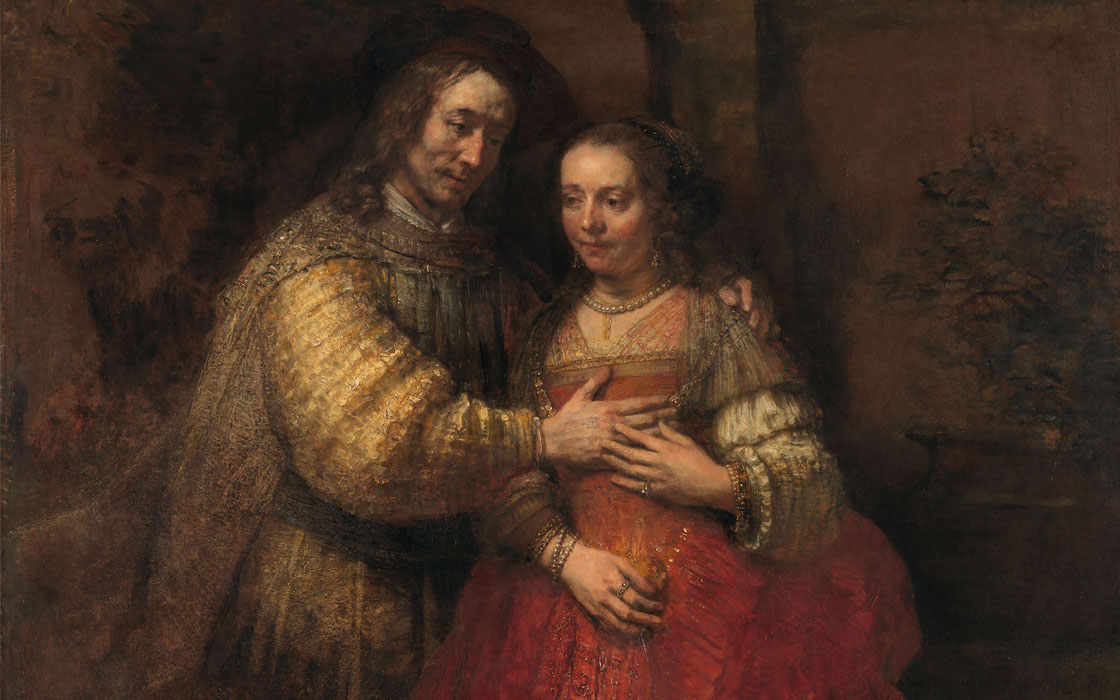
https://www.pubhist.com/works/09/large/rembrandt_boaz_ruth.jpg


Sermon Series: Ruth at Santa Cruz Lutheran Church, Tucson, Arizona.  © 2024 John Leech. All rights reserved.

June 16  ELW #681 “We Plow the Fields and Scatter”(Wir pflugen)  
First Reading: Ruth 1 
Psalm: Psalm 146
Second Reading: 2 Corinthians 5:6-10 [11-13] 14-17
Gospel: Mark 4:26-34

June 23 ELW #597 “My Hope is Built on Nothing Less” 
First Reading: Ruth 2
Psalm: Psalm 147
Second Reading: 2 Corinthians 6:1-13
Gospel: Mark 4:35-41

June 30  ELW #612  “Healer of Our Every Ill” -
or ELW #733  "Great Is Thy Faithfulness"  
First Reading: Ruth 3
Canticle: Ecclesiastes 3:1-8
Second Reading: 2 Corinthians 8:7-15
Gospel: Mark 5:21-43

July 7  ELW #676  “Lord Speak to Us that We may Speak”
First Reading: Ruth 4
Psalm: Psalm 127
Second Reading: 2 Corinthians 12:2-10
Gospel: Mark 6:1-13

First reading is from the Revised English Bible [REB] (Cambridge/Oxford, 1989).