(I wrote this for a class assignment at San Francisco Theological Seminary, June 23, 2011.)
(The course was on Loss, Grief, and Trauma, taught by Scott Sullender.)
A personal theology of loss and grief – John Leech – June 23, 2011 – SFTS
What is the nature of loss?
What is the meaning of loss?
Why has the Creator created a universe filled with loss?
What is the meaning of pain?
What is the purpose of grief and sorrow?
How is grief related to love?
What poetic, philosophical or theological or Biblical resources
do you find helpful to understand loss and grief?
How would you respond when a parishioner asks you,
“How come sooner or later we lose everyone we love?”
What does it mean to have faith in the context of loss and grief?
Loss is the experienced absence or removal of a valued person, relationship, place, thing, value or quality. Loss tells us this world is finite, contingent, incomplete. This is not all there is. Grief tells us we care. The Creator trusts us to be a part of a contingent, incomplete, sorrowful world. As Paula Parker has pointed out to me, we experience God in times of trouble not as rescuer but as strength giver. God sees us through, not over or around. Pain is a sensation – that tells us of a wound or potential wound, to person or psyche. Pain can be felt at the wound or hurt of another. Pain, in the larger sense, is the experience of the feelings of wounded-ness or hurt. Grief is a response to that wounding or pain.
The central image of bereavement in western culture is the cross and the crucified Christ upon it – this is the image of the God who is there with us in the midst of our own pain, suffering, loss and grief, as he has experienced himself, along with us as a human being. It is a symbol that transcends and transforms its apparent meaning – the humiliating engine of death fashioned by imperial hands becomes to the believer paradoxically a sign of hope, redemption, and even power, in the face of death.
It is this human experience of Jesus – this openness to human experience by the source of all Being – that gives the Christian hope of redemption of sorrow and grief its foundation. It is not that Jesus of Nazareth went through what I am going through but that his passion – his experience of pain and grief, in its uniqueness and horror as well as in its atoning self-donation (emptying, giving, freely offering of himself to suffer what he need not), signifies that God cares.
Let the same mind be in you that was in Christ Jesus, who, though he was in the form of God, did not regard equality with God as something to be exploited, but emptied himself, taking the form of a slave, being born in human likeness. And being found in human form, he humbled himself and became obedient to the point of death – even death on a cross. (Philippians 2:5-9)
To have faith in the context of loss and grief is to put trust in something beyond oneself, a transcendent spiritual reality that gives meaning to existence beyond sense experience or physical limitations of what we might perceive. Faith in the context of loss and grief is not a denial of the reality of loss or suffering or pain. Indeed faith makes it possible to acknowledge their reality and to ‘face facts’ with a courage that ‘reason’ does not know. (Courage is a heart-faith; a belief that strengthens in the face of the daunting.)
We lose everyone we love, sooner or later, don’t we? Do we? Perhaps – and perhaps we find them again, in some transcendent and transformative way. This is consolation, and perhaps not science based, but if we are present to Christ in the Eucharist and the dead are in Christ are we not present to each other in Christ through the Eucharist?
Ultimately the world is not a random or cruel place, as Donald Nicholl maintained even as he came to terms with his own terminal illness:
When the consultant said to me on Monday that he wouldn’t be needing to see me any more, I could just go home, and so on, there came into my mind the thought – well, now my sails are set for the journey home. And I remembered Jesus’ words as a farewell to the disciples, when he said: ‘I go to prepare a place for you’.
And that’s what going home means: you go to the place that is prepared for you. And I am also hoping that, in some measure, if you are a follower of Jesus, you can also do something which he does, that is to say, prepare a place for your loved ones who are going to follow after. Going home means also preparing a place for others to come when their time arrives.
But there is no possibility of our finding a home, we are lost, lost in the universe, unless we have the faith that the universe is not a hostile place to us, is not in the last resort hostile to us. On the contrary, the centre of the universe is a loving heart, and we are responses to that creative, loving heart. Which means that the last word is not with corruption and death and nothingness, but with love, just as the first word of creation is love. If we have that faith, we can then trust ourselves, with our bodies and our spirits, to the universe, to the centre of the universe, to the heart of the universe.
That’s not to deny, of course, that there are terrible things that happen in the universe. It’s inevitable in any act of creation, especially the act of creating life, that there will be a risk. Life means vulnerability, whether through injury or death, anguish or tragedy, and all those kind of things.
(A Testing of Hearts, ed. 2 (London: Darton, Longman and Todd, 1998) p. 235)
Grief and sorrow find their purpose in the healing of loss. One cannot move on until one has let go – until acknowledging the reality of the loss we cannot embrace the future. I hesitate to say ‘the gain’ – as if in loss there is a quid pro quo balance-sheet act.
Loss is permanent. The universe has been forever altered. What we gain – what we go forward to – is something new. What we hold out in faith is that the new possibility, the ultimate new possibility, is the redeeming of all sorrows, the healing of pain and the recovery of the grieved, through their transcendent subsumption into the reality of the divine.
For some religionists, this is annihilation or absorption into the ultimate Being; for Christians, we become more ourselves as we become closer to God. We are creatures completed in Christ. We are developing creatures that become completed, perfected, in his presence.
On the way to that perfection we are creatures who experience loss, pain, grief and sorrow. Grief is related to love as a necessary complement. To my anticipated grief, to love someone or something is to accept the possibility of its loss (or its loss of you). Love is worth the risk.
“Love in reality, as opposed to love in dreams, is a harsh and dreadful thing.”—Dostoevsky
To love someone though, truly and freely, is to accept their independence of fate; they do not exist to please you. Not ultimately. What the relation of grief and love, of sorrow and love, teach us is that we are (in God’s hands) just clay; we are not the potters.
These faith statements are made in the context of a western-European/north-American culture that insulates itself from the reality of pain, suffering, loss, and grief, through the invention of such mechanisms as “The Invisible Death” as captured and described by Philippe Ariès in The Hour of Our Death (New York: Alfred A. Knopf, 1981): “…the denial of death is openly acknowledged as a significant trait of our culture. The tears of the bereaved have become comparable to the excretions of the deceased. Both are distasteful. Death has been banished… Mourning is a malady. The bereaved is in quarantine.” (p. 580) With piercing words, Ariès impales the comfortable numbness a desensitized, de-ritualized, ‘processing’ of death can bring: “At a memorial service, friends and family and relatives of the deceased gather together without a body to pronounce the eulogy, console the family, indulge in a little philosophical speculation, and, if the occasion warrants, perhaps say a few prayers.” (Op. cit., p. 600, italics mine)
My own experience is that detached from faith such an observance of formalities can be meaning-draining. What is the point – beyond proper disposal of the remains?
In face of such a cultural pre-disposition to desensitization, through insulation and sanitization, or the opposite error of sentimentalizing and hence trivializing the lost, the faithful person’s reverent acknowledgment of the reality of loss, and of the experience of grief, can be (however humbly) annoyingly prophetic. In my own experience both personal and pastoral, the role of the minister and the believing community in acknowledging the death and comforting the bereaved, friends and family and community members alike, enables the good news of the gospel, and our hope in Christ, to be apprehended by people at a time when they are open to it and need to hear it.
So ultimately how we experience loss and grief can be redemptive – not of oneself, and not in the Dostoevskian sense of the redemption of the sinner (Raskolnikov) through the sufferings of the loving faithful, but only as a witness or sign testifying beyond itself, to the presence of God with us, the holy one who is not aloof but alongside, who comforts and strengthens rather than protects, who is present even when we most feel his absence, who is just even in his apparent enmity.
Faith gives us hope, and hope gives us means to accept and live within and beyond an experience of loss and grief, to take the risk of love, and to continue to embrace life in its fullness.
Appendix on Resources
Among the resources that have been helpful to me are poetry – and popular songs. One of the poems, “Dry as Dust”, privately published around 1979, expresses the desert-landscape feel of the end of a love affair.
Songs of love and longing are often about romance. A better-known piece on a theme of sorrow is “Lo siento mi vida” by Linda Ronstadt, Kenny Edwards, and Gilbert Ronstadt. Although written by two touring musicians in a motel room – with the singer’s father on the telephone giving long-distance help with the Spanish – about the ending of a romance, it imparts a feeling of loss and grief that carries over beyond its immediate origins. Dolór, sadness or lament, is a key element in that popular song. Years after first hearing it I found myself singing the opening phrase of the song over and over like a mantra-prayer as I absorbed the loss of a loved one.
More conventionally and perhaps elegantly, Alfred Lord Tennyson’s poetic observation on the loss of a friend, “better to have loved and lost than never to have loved at all”, and John Donne’s Meditation XVII, “No man is an island…” express loss and grief in apprehensible and memorable terms. Finally there are the psalms of lament in the Bible (and elsewhere, cf. Anne Weems) and the Lamentations per se, which help express feelings surrounding loss and grief, including anger and sorrow, in terms bolder than one might choose oneself in addressing the Deity.
Belden C. Lane, The Solace of Fierce Landscapes (New York: Oxford University Press, 1998) is among the spiritual resources I am beginning to consult. While it is mostly about spirituality and the experience of desert and mountain wilderness it has as one frame his lingering grieving over the anticipated and ambiguous losses he experienced surrounding his mother’s failing health and the final grief of her death.
Donald Nicholl, in A Testing of Hearts, ed. 2 (London: Darton, Longman and Todd, 1998) begins his story with journal entries made at the time of the dying and death of his father, including healing and illuminating memories. The second edition includes an appendix: the transcription of audiocassette recordings (I’ve heard them: his voice is dry as dust) and jottings of notes as he reflects on the coming of his own death. (“Tell the Californians,” a friend related, “that I am not experiencing a ‘transition’ – I am dying!”)
Appendix II
“Grief is an energy that works at mellowing the mind, heart, and body. An agitated or prolonged expression of grief exhausts the body to the point where rest is needed. One notices that a baby sometimes cries heavily before going to sleep. Grief takes us to the top of the hill and then lets us walk back down slowly, peacefully. It helps relieve the person who is in sorrow and leads him or her toward acceptance of the phenomenon of death, separation and love.” (Malidoma Patrice Somé, Ritual: Power, Healing, and Community (Penguin/Arkana, 1993, p. 75)
Thursday, October 5, 2017


Saturday, September 23, 2017
Is that fair?
When Jonah finally shows up at Nineveh he walks a third of the way into the city (its walls were eight miles in circumference, enclosing 1800 acres) and delivers his message. And they do repent.
Gah!
The reluctant prophet indeed.
What this reminds me of is my first automobile. Of course. In one incident I was backing out of a parking lot in Washington DC in the dark - and backed right into a VW bug. The fender of a 1964 Pontiac Tempest is impervious to something so tin-like as the fender of a Volkswagen. As I already knew from previous occasions with other people driving. So it was dark and it was raining and it was late. And I left a note on the windshield of the other car. In Flair pen! Talk about a reluctance to do the right thing. And a few days later the other driver called and thanked me: he called my insurance company and they made good on the claim ($84). And he said, I’d done the Christian thing. Gah! After I hung up, I grumbled to myself. The reluctant Christian.
Sometimes you do the right thing. When you do not want to, Sam I am.
So Jonah. Got himself a ringside seat, under a booth, and sat back to watch the city destroyed.
God ‘sent’ - as God sent Jonah to Nineveh - a vine to grow up and shade him, then wither.
God showed mercy in a small thing to his reluctant prophet, shading every hair of his steaming angry head. And then God disappointed him. God showed mercy in the most outrageous way.
Showed mercy to Nineveh - the people who brought total destruction to Israel.
Let that be a lesson to you. I guess.
God’s mercy seems to be infinite and not under our control. At all.
And now Jesus turns the world on its head again. This week by telling the story of a master who is totally unfair.
There are a bunch of guys hanging around a Shell station or a city gate or a park south of downtown Tucson. And farmers show up to hire them for the day. It is harvest time - and workers are needed. (Hint: it is surely harvest time now, Jesus is pointing out, for the kingdom of God.)
The pay is good. A day’s wage. All you need to live on - to feed your family.
It’s enough. It’s not riches, but it is all the bread you need for today. Kind of like manna. Kind of very like manna, the bread in the wilderness, that God provided the wandering people of Moses. Kind of like the ‘daily bread’ God provides for us, in the Lord’s Prayer.
So there they are working away in the vineyard. All day long. It’s hot in the vineyard. Sunny. The grapes are ripe and full of juice. By the way it’s harvest time now, in the wine regions of the West. Across the valleys the aroma of the ‘crush’ of the harvest fills the air. It is a good time.
And these workers are part of it. Valued and paid.
And then other guys show up in the vineyard. At this hour and that hour and the close of the day.
They get paid too. Seems fair. Until - the all day workers get paid for a day’s wage - and no more.
Give us this day our daily bread - and a little extra, how about it? We worked all day!
Deserve has nothing to do with it. Apparently. This upside down story has a farmer who is willing to pay every body, each and every one, the day’s wage. Whether they have worked a full day or not.
Is that fair?
You tell me.
Is it fair to spare the Syrians who have - or are going to - prove a mortal threat to Israel?
Surely security comes first!
But God - God - allows them to live, when they repent.
That is the upside down story of Jonah.
Is it fair? Is it wise?
God forgives us.
God forgives us.
Is it fair?
* * *
But what were they arguing about, anyway, these day laborers of Jesus’ parable?
Abundance - even the luxury of surplus - and enough, sufficient for the day.
“Give us this day our daily bread” is very much the moral background of this parable.
What would that look like, in today’s world? An oddly placed hint comes to us from a review in a recent issue of a magazine, of a book by an anthropologist, James Suzman, entitled, Affluence Without Abundance: The Disappearing World of the Bushmen, (Bloomsbury USA, 2017, reviewed by John Lanchester, “How Civilization Started”, The New Yorker, September 18, 2017, 22-26.)
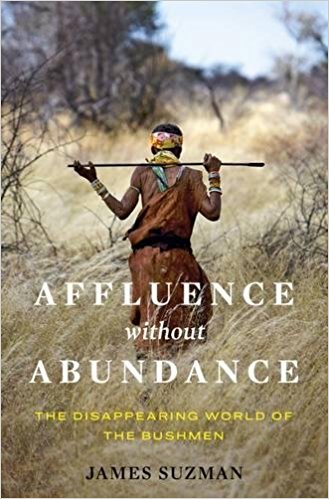
The Bushmen of the Kalahari, we learn, have in various groups assimilated into more mainstream culture, but in other groups stayed with their traditional hunter-gatherer lifestyle.
“It turns out that hunting and gathering is a good way to live. A study from 1966 found that it took a Ju/’hoansi [Bushman] only about 17 hours a week, on average, to find an adequate supply of food; another 19 hours were spent in domestic activities and chores.” … Ju/’hoansi do not accumulate surpluses. They get all the food they need, and then stop. They exhibit what Suzman calls ‘an unyielding confidence’ that their environment will provide for their needs.”
“ … the hunter-gatherer’s ability to live a life that is, on its own terms, affluent, but without abundance, without excess, and without competitive acquisition. The secret ingredient seems to be the positive harnessing of the general human impulse to envy.”
This is the thing which the Lord hath commanded, Gather of it every man according to his eating, an omer for every man, according to the number of your persons; take ye every man for them which are in his tents.
And the children of Israel did so, and gathered, some more, some less.
And when they did mete it with an omer, he that gathered much had nothing over, and he that gathered little had no lack; they gathered every man according to his eating.
And Moses said, Let no man leave of it till the morning. (Exodus 16:16-19)
And the children of Israel did so, and gathered, some more, some less.
And when they did mete it with an omer, he that gathered much had nothing over, and he that gathered little had no lack; they gathered every man according to his eating.
And Moses said, Let no man leave of it till the morning. (Exodus 16:16-19)
It’s when they get greedy that they get into trouble. Try to store it and it rots.
But when they trust that “The Lord will provide” as my generous friend Marjorie used to say, they find that their good shepherd provides all they have needed.
As Henry Baker wrote in his hymn based on the 23rd Psalm,
The King of love my Shepherd is,
Whose goodness faileth never,
I nothing lack if I am His
And He is mine forever.
Whose goodness faileth never,
I nothing lack if I am His
And He is mine forever.
For abundance read superfluity, for affluence read sufficiency. For what the anthropologist calls ‘an unyielding confidence’ read “a steadfast faith” or “a founded hope”.
This story is an illustration of the abundance of God’s mercies, the certainties of his provision.
Manna, the bread from heaven, is used as well to mean an unexpected benefit, or, spiritual nourishment, especially the Eucharist.
The farm workers of Jesus’ parable certainly some of them receive an unexpected benefit. Their daily bread descends without anticipation. (And some are jealous.)
And we - we receive that manna of the last meaning, for we do indeed receive the ultimate gift of the bread from heaven that is manifested in the Eucharist, that is, Jesus, himself; as he said, “I am the bread of life.” The one who trusts Jesus receives from him life - and that abundantly. Abundantly - beyond needful measure.
Is that fair?
AProper20 Pentecost XVI … September 24, 2017 … St Paul’s, Tombstone.
Friday, September 15, 2017
But who’s counting?
Peter asks Jesus a question about forgiveness. In response, Jesus tells the Parable of the Unforgiving Servant. The exaggerations, hyperbole, huge numbers, and extreme reactions, push us into a theater of the absurd. A huge debt is forgiven freely, then a small one is choked out of a second debtor, and then the first debt is reinstated - plus torture! No forgiveness holiday here, not once a line is crossed. But it all goes to show up the real absurdity: trying to quantify grace, trying to qualify mercy. Only how often do I forgive another member of the church? Seven times - that’s a lot! To put up with. Fool me once, twice… but seventy-seven times is extravagant, absurd: it’s past counting. It’s almost as if… almost as much… as God has already forgiven us. Not you or me individually, guilty, but the whole human race, the whole creation, is in need of reconciliation that is beyond its own means to achieve. Anselm of Canterbury said only man must pay the price, but only God can do it. (Cur Deus Homo) So how often, how can we…? Only in the capacity of God’s grace, which is ever abundant and always new.
September 17, 2017.
Fifteenth Sunday after Pentecost
Sunday, August 13, 2017
after the storm
One day someone caught me out, making a lot of noise, apparently, for he mocked me, "Raar! Raar! Raar!" A guy making big noises meaning nothing.
Well sometimes maybe we think storm and noise and thunder clouds will make the answer. But perhaps peace and silence, the peace and silence after the storm, may be where God speaks to us.
Tenth Sunday after Pentecost.
Proper 14, Year A.
1 Kings 19:9-18Psalm 85:8-13Romans 10:5-15Matthew 14:22-33
"I will listen to what the Lord is saying" psalm setting by Armand Russell of Psalm 85:8-13, on the brink of the first Gulf War.
Well sometimes maybe we think storm and noise and thunder clouds will make the answer. But perhaps peace and silence, the peace and silence after the storm, may be where God speaks to us.
Tenth Sunday after Pentecost.
Proper 14, Year A.
1 Kings 19:9-18Psalm 85:8-13Romans 10:5-15Matthew 14:22-33
"I will listen to what the Lord is saying" psalm setting by Armand Russell of Psalm 85:8-13, on the brink of the first Gulf War.
Saturday, August 12, 2017
A Day of Dread and Miracles
The day had not started well. Cousin John, his mother had heard quicken in the womb, that first kick! Was dead. Dead. Herod Antipas had had him killed - for a lark, for a trick, to show off to his guests - and to a woman and a girl. And so he had reason to be disconsolate, and reason to be afraid.
He was not alone. No one would let him be.
Crowds gathered. They had heard the news. The Baptizer, the one who heralded a new day for Israel, had been executed. The powers of this world were strong. And so they came to Jesus. The new shepherd. The good shepherd. Can you feed us?
And maybe that is a miracle too. For he turned their hearts as he turned his own, from fear to faith. Dread walked the earth, but they were no longer afraid.
He did feed them - or rather, taught them that their Father did.
Sit down. And they sat down.
Share what you have. And they broke the bread, and shared it out.
And soon all were well fed.
Jesus’ disciples were exultant. They were released from anxiety and felt ! like ! kings !
So off they went, rowing as they had rowed before, this time with a miraculous catch on land, and a good star to guide them. Singing they rowed and sailed, see you later, Jesus.
He was ashore. Alone. Silence, in the breeze. And he went up the hill. Maybe on top he’d recall the blessings he’d once preached there, the happiness of the poor, the blessedness of those who seek God.
Quiet, and remembering. And then, full of his Father’s new sense of purpose, he left off grieving, and sought out the others, his friends.
They were out on the sea by now. And they did not expect him to come to them as he did.
Remember John the Baptist was just dead. Fearsome forces were at work. And now like the ghost of Banquo or the spirit of Hamlet’s Father, a figure came to them - across the water.
It’s me, boys. Don’t worry.
Gathering up his courage Peter called: if it is you, call me to come to you. (No ghost would do that, right?)
And Jesus said, what he always said: Come.
What is there to do but follow?
And out on the water he came, Peter came, Rock of the Disciples, faithful … to a point. The wind was sharp and he felt it cut through his warm heart.
Jesus, save me!
And Jesus did. What he always did … to a point.
The wind dropped at last. You really are God’s Son, aren’t you? And they were no longer afraid.
****
Did anyone see last week’s headline? Remember it? The Economist had: Venezuela in Chaos.
Chaos. Fear. A world of disorder.
It is the Lord, it is God, who moved, his Spirit like a breath upon the waves, as he ordered the chaos at the beginning of Genesis. It is God, who moved, his voice like the sound of sheer silence, as Elijah waited in the cave. It is God, who came, walking on the water, stiling the chop and quelling the storm.
It is now … that time. The always-time. When the ways of this world and its rulers are not enough.
And so we turn to God, again. For peace. We shall listen to what the Lord is saying. Words of peace and not of fear. Righteousness and peace shall kiss each other, and this world’s woes will be brought to an end.
Tenth Sunday after Pentecost
Sunday, August 6, 2017
Transfiguration: Theory and Practice

(Mount Tabor)
Looking ahead to this Sunday's feast of the Transfiguration, I thought first of the remoteness of the cosmic figure revealed on Mount Tabor, to only his most intimate disciples and only to be spoken of or understanding attempted until after his resurrection. Then I began to think of other figures "clothed in white" and even the "woman clothed in the sun" of the Apocalypse (12:1). Thomas Merton wrote an essay titled after that verse. But then, even that led me to another vision of people all "shining like the sun": Merton's vision as he waited for a ride back to the monastery after a dental appointment:

“In Louisville, at the corner of Fourth and Walnut, in the center of the shopping district, I was suddenly overwhelmed with the realization that I loved all these people, that they were mine and I theirs, that we could not be alien to one another even though we were total strangers. It was like waking from a dream of separateness, of spurious self-isolation in a special world. . . .
This sense of liberation from an illusory difference was such a relief and such a joy to me that I almost laughed out loud. . . . I have the immense joy of being man, a member of a race in which God Himself became incarnate. As if the sorrows and stupidities of the human condition could overwhelm me, now that I realize what we all are. And if only everybody could realize this! But it cannot be explained. There is no way of telling people that they are all walking around shining like the sun.
Then it was as if I suddenly saw the secret beauty of their hearts, the depths of their hearts where neither sin nor desire nor self-knowledge can reach, the core of their reality, the person that each one is in God’s eyes. If only they could all see themselves as they really are. If only we could see each other that way all the time. There would be no more war, no more hatred, no more cruelty, no more greed. . . . But this cannot be seen, only believed and ‘understood’ by a peculiar gift.”
― Thomas Merton, Conjectures of a Guilty Bystander
Merton’s joy was at the revelation that he was part of a race all transcendent, but one in which God himself had become incarnate. There is awe and wonder and humility in that. As C. S. Lewis once said, to be a son of Adam or a daughter of Eve, there is enough in that to be both humbled and glorified.
This sense of liberation from an illusory difference was such a relief and such a joy to me that I almost laughed out loud. . . . I have the immense joy of being man, a member of a race in which God Himself became incarnate. As if the sorrows and stupidities of the human condition could overwhelm me, now that I realize what we all are. And if only everybody could realize this! But it cannot be explained. There is no way of telling people that they are all walking around shining like the sun.
Then it was as if I suddenly saw the secret beauty of their hearts, the depths of their hearts where neither sin nor desire nor self-knowledge can reach, the core of their reality, the person that each one is in God’s eyes. If only they could all see themselves as they really are. If only we could see each other that way all the time. There would be no more war, no more hatred, no more cruelty, no more greed. . . . But this cannot be seen, only believed and ‘understood’ by a peculiar gift.”
― Thomas Merton, Conjectures of a Guilty Bystander
Merton’s joy was at the revelation that he was part of a race all transcendent, but one in which God himself had become incarnate. There is awe and wonder and humility in that. As C. S. Lewis once said, to be a son of Adam or a daughter of Eve, there is enough in that to be both humbled and glorified.
Have you ever known someone whose face was shining, whose encounter with grace or God or love or forgiveness so lightened the load of the world on their shoulders that they looked relieved and joyful? Or just in a moment of inspired perception you saw them as they always were, as Donald Nicholl says, “in aspiration”, as the Holy Spirit conceived them? A reality, an identity, deeper than sin can ever reach?
One time Donald saw a young woman of a lower class (he’s English) dressed up and made up for a Saturday night (or a Sunday morning) and at first he judged her sharply, to be cheap, as her outfit of clothes and her choice of coiffure were not the best. But then he countered himself, she is doing very well. And so he said, inside himself, something British that meant, “you go, girl!” For he felt he finally saw her a bit with the eyes of God, the eyes of love, “in aspiration.”
It’s a lame example, isn’t it? But Donald was himself striving toward perception - with openness - and so perhaps we should see his anecdote and his attitude themselves “in aspiration.”
God is not finished with us yet - and yet he is, “in aspiration”, fully conscious and complete in conception of what we are called to be, meant to be, and in some ways already are, if only we saw it, beneath all the layers of fault or failing or even just ordinary crust of everyday inattention.
So it is that not only Jesus shines with the sun - we are to be caught up, too, along with Moses, Elijah, Peter and James and John, in a vision and a revelation of how God means us to be...
That openness, that vulnerability, that Donald Nicholl exposed to a roomful of California undergraduates, is of a piece with Mary’s own openness - in that “Woman Clothed with the Sun” essay, Thomas Merton points this out. Receiving the incarnate Word, as Mary did, receiving the Word of the Law, as Moses did, receiving the self-awareness dawning in us, as my teacher did, all involve a willingness to surrender, a willingness to accept defeat of ego by a greater purpose: to serve, to reveal, to accept, the presence and working in us of the spirit of God.
That’s a hard one to sell. How do we know that God is by? That God is near us, and that the light is shining in us, through us?
Not sure we need to answer that. More compelling and more convincing is the call to witness to the light itself, not our ‘en-candle-ment’ - we testify to the light that is not of ourselves but in us.
The light that is a light to all nations. And we know it as Jesus. The one who, equal with God as the incarnate Word, nevertheless became a human being as one of us, and brought that light, that revelation, that joy of being, down to earth.
And even he did not point to himself but pointed to the cosmic wonder of the grace of God and the immanence of his Spirit and of his Kingdom…
What Jesus reveals on the mountain is not just his own transcendence but ours. We are called to that divinization, that transformation into godliness, into the fullness of our own created natures, which is the goal of God’s plan. Of course not for ourselves but as transformation agents of the cosmos, so that this world may become what it is yearning to be, made to be.
(There is an American pattern of hermitage - Thoreau at Walden Pond, Merton at Gethsemane, Bruno at New Camaldoli - of a cabin in the woods a mile or so from one’s friends or family, where one could retreat in silence and yet stay in touch, through a family dinner, Eucharist, an evening’s common prayer.)
So Moses on Sinai, Jesus on Tabor. But do we need to be on a mountain top to experience change and transformation? Illumination? Transfiguration? What about when we come down? “Morning after”/”Monday Christians”? A common worry - will we keep the momentum going?
Is the buzz all that important? What Moses did - and the people did, or tried to do - thereafter was when the Revelation took root in the soil. When Jesus spoke to Peter and the Sons of Thunder he said, don’t tell anybody about this (like the hidden Messiah of Mark) - not until after… and then you’ll begin to understand....
Once the Spirit had descended and Ordinary Time arrived, then it was the Revelation of the Word, the glory of the Gospel, came into its fullness. The completion of the task was pushed off into the future because we must carry on his work - proclaim, heal, embody, transform - and be transformed in the task.
The Revelation becomes complete in the Practice.
____________________
A great portent appeared in heaven: a woman clothed with the sun, with the moon under her feet, and on her head a crown of twelve stars. (Revelation 12:1)
Kathryn Hogan. “The Secret of All Joy”: Finding Mary in the Month of May. Catholic News Live. http://catholicnewslive.com/story/133212 accessed August 4, 2017.
Robert Pogue Harrison. The True American. The New York Review of Books. August 17, 2017. Vol. 64, No. 13. http://www.nybooks.com/issues/2017/08/17/ accessed August 4, 2017.
Transfiguration 2017
Subscribe to:
Posts (Atom)