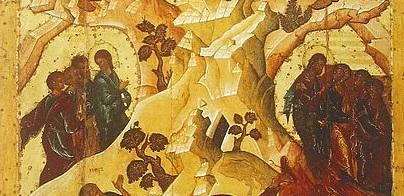
Showing posts with label Transfiguration. Show all posts

Sunday, March 2, 2025

with shining faces

Jesus and the disciples go up the Galilee side of the mountain and come down the Jerusalem side.
http://edgeofenclosure.org/epiphanylastc.html


You have to wonder how it felt there. He had walked with them a long way and talked with them and taught them many things and now he was going up the mountain, and he went up the mountain to talk to God. Then later, we learn, he came back down and had some more ordinary experiences, and they had some more ordinary experiences. We could be talking about Moses or Jesus.


When we’re talking about Moses on the mountain, he had lead the people through the desert in an exodus, a departure from Egypt and from slavery, and a departure into freedom and a new land and indeed a new relationship with God – because now their leader had spoken to God face-to-face… that is, had prayed, and then returned to them.


By the time of this episode he had already brought them the 10 “words” or 10 Commandments.


What we see in both this story and the story of the Transfiguration is that it is the experience of the followers, the people who followed their leader, that we are told about.


Moses did not know that his face was shining. They did.


Jesus did not pay any attention to his own appearance. They did.


Jesus like Moses had led his followers on a long wandering walk, and now had gone up the mountain to pray and talk to God.


When his disciples saw him, they saw that his clothes were whiter than an earthly laundromat could make them, and his face was shining.


That is what they saw. That is what they experienced.


And that is what we hear about in both of these two stories that have been read to us this morning. The experience not of the leaders but of their followers.


Like those followers, we recognize that what we have, what we own, is our own experience of what has happened and what it reveals about who our leader is and what their message is to us.


What is astonishing about the stories we heard today, about Moses and Jesus, was the agreement between witnesses, on what had happened and what it meant, though this did not come to them all in a rush at the very moment that it happened. 


The disciples did not at the time even talk about what had happened. Peter, James, and John didn’t say a word to anybody until after Jesus was resurrected.


As you may recall, after they experienced the Resurrection, Mary Magdalene and the other women didn't say a word to anybody at first. 


It took a while to figure out what was really going on below the surface of what had happened, what they had seen and heard and what it meant.


But they, like the men on the mountains, did come away with some experiences, reflected on them, and then taught their insights to others.


A historian at a recent academic conference evaluating a presidency said, “Not surprisingly, people mix their opinion of what they think should have happened with what really did happen.” It takes a while to sort it out.


There is another should that matters today and that is how we should respond to the stories and to what the leaders had passed on to their followers from what they had already taught them on the way and what they brought down with them from the mountain top experience.


And you have to have some sympathy for the leader. 


On his first return from the mountaintop Moses found the people had strayed far from what he had taught them, threw down the first copy of the 10 Commandments in disgust and then had to go back up and ask for another set — from God.


And it was after his mountaintop experience that Jesus had to step in and do what he thought the disciples at this point should’ve been able to do for themselves and heal a child.


But however they responded, however they reacted, however they experienced or recollected their experience or related to it or understood it over time, the disciples of Jesus and the followers of Moses had some questions that would sound very familiar to us today.


Not just : what happened and what did it mean? But also : now what? What is next?


Of course we are not caught in the moment between ascending a mountain from Galilee and then descending toward Jerusalem, or ascending Mount Sinai and then descending toward the promised land. 


When we are at an in-between place, it may not feel like a mountain top to us but rather a valley. Like the Israelites left to their own devices in the camp, or disciples waiting for the Big 4 to return from Mount Tabor.


In some ways, it can be very exciting to be on your own and trying to figure out what was that and what’s coming next.


In other ways, it can be disconcerting and provide a source of anxiety.


In the in-between time, we realize that who our leader was following is the one whom we really need to learn from.


Moses’ face shines as it reflects the glory of God; Jesus’ shines as he reveals the glory of God.


In both of the readings, with Moses and with Jesus, the person who led them on their long wandering, who then went up the mountain to pray to God, was revealed to them as the messenger of God chosen for that moment. In the first case, the leader was Moses, who brought them the 10 ‘words’ of the law. In the second case, it was Jesus who was himself the Word, the embodiment of the reign of God.


So what are we to make of it when leaders are with us for a time and then make their departure?


One thing we know for sure is that they have given us a model to follow, which is whether you up on a mountaintop or down in a valley, to turn our faces toward God – God, where the source of all that light reflected in their faces, shining faces, came from in the first place and we like them should pray.


There is a prayer written, especially for our kind of situation, a prayer for the calling of a new minister, and of course it’s a prayer for them as well as us. Now Moses was certainly not appointing his successor when he was on the mountain, and Jesus simply said after me will come an Advocate to help you and be with you forever— 


What we are expecting is that we will be guided by the Spirit into the future with a new understanding of what we have learned not only from past leaders, but from our God, and we will continue in the teachings and in the prayers. That incidentally is how the disciples carried on. They continued in the teachings and fellowship, in the breaking of bread and in the prayers: so should we.


Almighty God, giver of every good gift: Look graciously on your Church, and so guide the minds of those who shall choose a rector for this parish, that we may receive a faithful pastor, who will care for your people and equip us for our ministries; through Jesus Christ our Lord. Amen.


At this point in the Christian year, we are at the hinge point, the bridge from the revelations of Epiphany season, when the reality of Jesus became more and more apparent;  his true nature shining through and the disciples beginning to grasp it, and what happened once that truth was revealed in one extra extraordinary experience after another. Now crossing into Lent we accompany Jesus as he sets his face – so recently shining – towards Jerusalem and his mission to be accomplished there. 


That mission will end not in defeat but in his glorification and the glory of God his father. And as we seek to follow Jesus, not up the mountain of shining faces but down the road to the events of Holy Week, we seek his face in the darkness of Good Friday as well as in the light of Easter. And God’s glory will be reflected in our faces.


*** 

Last Sunday after the Epiphany

http://edgeofenclosure.org/epiphanylastc.html


* These are the same readings as for the feast of The Transfiguration (August 6) except on that day the Epistle is: 2 Peter 1:13-21 *

https://www.nytimes.com/2025/02/26/arts/writing-history-biden-presidency-trump-era.html


Saturday, January 6, 2024

Epiphanytide

Have you ever experienced an epiphany? Epiphanies are showings, revelations, appearances. They are God-sightings, times God shows up and transforms lives among us. 

On the Sundays of the season of Epiphany, which runs from January 6th to just before Lent, the Gospel lessons relate a series of epiphanies. The Gospel tells of times the Holy Spirit revealed that God is present in Christ. 

The season of Epiphany, or Epiphanies if you will, begins with the visit of the Magi - wise people from the East. There are three of them, generally, in pictures we see: and they are visiting three ordinary-looking people, a father, a mother, and a tiny infant.

Around them - at least in manger scenes - may also be shepherds and angels. But the essential image is three beholding three, and finding in that beholding a revelation of the mystery of Christ: that God has come down to us and become one of us, in order to bring us salvation.

The next Sunday we remember and celebrate the Baptism of our Lord. When Jesus came up out of the water a voice from heaven was saying, “This is my beloved Son, in whom I take delight.” (Matthew 3:17) Soon Jesus himself proclaims the words of the prophet, come true: “The people that lived in darkness have seen a great light.” (Cf. Isaiah 9:1-2) It is then that he begins to call disciples to follow him. (Matthew 4:19)

In the first few weeks of Epiphany the focus of the gospel is on Jesus, and discoveries of who he is. In his sermon on the mount, Jesus himself begins to turn the camera around. He shows the people God is at work in the world around them – and, as they begin to live as citizens of the kingdom of heaven, they begin to see Jesus at work in their own lives.

Somehow in the very struggle, the pain, even the persecution, that believers endure in this life, God is present - he is there, he is here, God is with us. In the middle of darkness there is a light shining that it cannot smother; in the middle of despair there is hope; in the middle of doubt, faith; in the middle of sorrow, joy. How can this be - unless God reigns?

In the middle of the Epiphany season there is a special celebration, which recalls our Christmas festivities. It is the feast of the Presentation of our Lord in the Temple (Candlemas or Candelaria). As the Christ Child is dedicated, Anna and Simeon, old and faithful people who have been awaiting this event, look on and praise God for sending salvation to his people.

The season of Epiphany ends with three beholding three again: the Transfiguration. On a mountaintop Peter, John, and James witness the meeting of Moses, Elijah, and Jesus. 

It’s a strange moment. It’s a moment when a man they thought they knew becomes, before his friend’s eyes, a living, visible revelation of God’s glory. Moses saw it; Elijah proclaimed it; Jesus - is it!

The disciples see Jesus’ face shine: he is clothed in white, radiant, transfigured; bathed in the light of the glory of God. A voice proclaims: “This is my beloved Son, in whom I take delight: listen to him.” (Matthew 17:5) These words hearken back to the beginning of his ministry and the purpose of his life – and call us forward to the fulfillment of time.

He is changed – but still their friend, he is awesome and intimate in one. No wonder they are astonished, no wonder they are afraid, no wonder they are for a moment demobilized: but Jesus comes to them, gently calling: “Stand up; do not be afraid.” (Matthew 17:7) And together they descend the mountain, to the world’s ordinary time.

Jesus exhorts us: Be that light; be the presence of God. Be the Good News of Jesus Christ - in your neighborhood, your city, and your school; in the desert or on the mountain; in your solitude and in the community. You cannot hide a city set upon a hill; let your light shine before people. Rejoice and be glad! “You are light for all the world.” (Matthew 5:14)

Let that light shine in all you do – as Jesus shone on the mountain. Don’t be afraid: God will turn fear into courage. All you can do is this: “Put first in your mind God’s kingdom and his justice; the rest will come.” (Matthew 6:33)

So we, showing Jesus in our lives, are sharing in these moments of Epiphany, these God-sightings in troubled times when God is mostly likely to show up, and come to us, gently calling, “do not be afraid”, and helping us get onto our feet again and walk with him.

Christ extends his hands to us as he did to those frightened men - and bids us rise. Let us, then, come to know and share God’s love with all people.


JRL+ 

Epiphany, Presentation, Transfiguration 2024


Sunday, August 6, 2017

Transfiguration: Theory and Practice


(Mount Tabor)


Looking ahead to this Sunday's feast of the Transfiguration, I thought first of the remoteness of the cosmic figure revealed on Mount Tabor, to only his most intimate disciples and only to be spoken of or understanding attempted until after his resurrection. Then I began to think of other figures "clothed in white" and even the "woman clothed in the sun" of the Apocalypse (12:1). Thomas Merton wrote an essay titled after that verse. But then, even that led me to another vision of people all "shining like the sun": Merton's vision as he waited for a ride back to the monastery after a dental appointment:

Thomas Merton

“In Louisville, at the corner of Fourth and Walnut, in the center of the shopping district, I was suddenly overwhelmed with the realization that I loved all these people, that they were mine and I theirs, that we could not be alien to one another even though we were total strangers. It was like waking from a dream of separateness, of spurious self-isolation in a special world. . . .

This sense of liberation from an illusory difference was such a relief and such a joy to me that I almost laughed out loud. . . . I have the immense joy of being man, a member of a race in which God Himself became incarnate. As if the sorrows and stupidities of the human condition could overwhelm me, now that I realize what we all are. And if only everybody could realize this! But it cannot be explained. There is no way of telling people that they are all walking around shining like the sun.

Then it was as if I suddenly saw the secret beauty of their hearts, the depths of their hearts where neither sin nor desire nor self-knowledge can reach, the core of their reality, the person that each one is in God’s eyes. If only they could all see themselves as they really are. If only we could see each other that way all the time. There would be no more war, no more hatred, no more cruelty, no more greed. . . . But this cannot be seen, only believed and ‘understood’ by a peculiar gift.”

― Thomas Merton, Conjectures of a Guilty Bystander

Merton’s joy was at the revelation that he was part of a race all transcendent, but one in which God himself had become incarnate. There is awe and wonder and humility in that. As C. S. Lewis once said, to be a son of Adam or a daughter of Eve, there is enough in that to be both humbled and glorified.


Have you ever known someone whose face was shining, whose encounter with grace or God or love or forgiveness so lightened the load of the world on their shoulders that they looked relieved and joyful? Or just in a moment of inspired perception you saw them as they always were, as Donald Nicholl says, “in aspiration”, as the Holy Spirit conceived them? A reality, an identity, deeper than sin can ever reach?


One time Donald saw a young woman of a lower class (he’s English) dressed up and made up for a Saturday night (or a Sunday morning) and at first he judged her sharply, to be cheap, as her outfit of clothes and her choice of coiffure were not the best. But then he countered himself, she is doing very well. And so he said, inside himself, something British that meant, “you go, girl!” For he felt he finally saw her a bit with the eyes of God, the eyes of love, “in aspiration.”


It’s a lame example, isn’t it? But Donald was himself striving toward perception - with openness - and so perhaps we should see his anecdote and his attitude themselves “in aspiration.”


God is not finished with us yet - and yet he is, “in aspiration”, fully conscious and complete in conception of what we are called to be, meant to be, and in some ways already are, if only we saw it, beneath all the layers of fault or failing or even just ordinary crust of everyday inattention.


So it is that not only Jesus shines with the sun - we are to be caught up, too, along with Moses, Elijah, Peter and James and John, in a vision and a revelation of how God means us to be...


That openness, that vulnerability, that Donald Nicholl exposed to a roomful of California undergraduates, is of a piece with Mary’s own openness - in that “Woman Clothed with the Sun” essay, Thomas Merton points this out. Receiving the incarnate Word, as Mary did, receiving the Word of the Law, as Moses did, receiving the self-awareness dawning in us, as my teacher did, all involve a willingness to surrender, a willingness to accept defeat of ego by a greater purpose: to serve, to reveal, to accept, the presence and working in us of the spirit of God.


That’s a hard one to sell. How do we know that God is by? That God is near us, and that the light is shining in us, through us?


Not sure we need to answer that. More compelling and more convincing is the call to witness to the light itself, not our ‘en-candle-ment’ - we testify to the light that is not of ourselves but in us.


The light that is a light to all nations. And we know it as Jesus. The one who, equal with God as the incarnate Word, nevertheless became a human being as one of us, and brought that light, that revelation, that joy of being, down to earth.


And even he did not point to himself but pointed to the cosmic wonder of the grace of God and the immanence of his Spirit and of his Kingdom…


What Jesus reveals on the mountain is not just his own transcendence but ours. We are called to that divinization, that transformation into godliness, into the fullness of our own created natures, which is the goal of God’s plan. Of course not for ourselves but as transformation agents of the cosmos, so that this world may become what it is yearning to be, made to be.


(There is an American pattern of hermitage - Thoreau at Walden Pond, Merton at Gethsemane, Bruno at New Camaldoli - of a cabin in the woods a mile or so from one’s friends or family, where one could retreat in silence and yet stay in touch, through a family dinner, Eucharist, an evening’s common prayer.)


So Moses on Sinai, Jesus on Tabor. But do we need to be on a mountain top to experience change and transformation? Illumination? Transfiguration? What about when we come down? “Morning after”/”Monday Christians”? A common worry - will we keep the momentum going?


Is the buzz all that important? What Moses did - and the people did, or tried to do - thereafter was when the Revelation took root in the soil. When Jesus spoke to Peter and the Sons of Thunder he said, don’t tell anybody about this (like the hidden Messiah of Mark) - not until after… and then you’ll begin to understand....


Once the Spirit had descended and Ordinary Time arrived, then it was the Revelation of the Word, the glory of the Gospel, came into its fullness. The completion of the task was pushed off into the future because we must carry on his work - proclaim, heal, embody, transform - and be transformed in the task.


The Revelation becomes complete in the Practice.


____________________


A great portent appeared in heaven: a woman clothed with the sun, with the moon under her feet, and on her head a crown of twelve stars. (Revelation 12:1)


Kathryn Hogan. “The Secret of All Joy”: Finding Mary in the Month of May. Catholic News Live. http://catholicnewslive.com/story/133212 accessed August 4, 2017.


Robert Pogue Harrison. The True American. The New York Review of Books. August 17, 2017. Vol. 64, No. 13. http://www.nybooks.com/issues/2017/08/17/ accessed August 4, 2017.


Transfiguration 2017


Saturday, August 3, 2013

changes


Transfiguration 2013

Up the mountain to a vision of glory. Down the mountain and back to work. That is where he led them.

Jesus had just been having a conversation with them. What are people saying about me? He’d asked.

They say you’re Elijah or one of the prophets come back. Come back to save us, come back to lead us.

But who do you say that I am? You are the Messiah.

And then he tells them that it means that he will suffer and die. Are you with me? Will you follow me?

Peter, James, and John, three apostles, go up the mountain with him. It is time for prayer.

And then he goes on ahead, and they see the vision.

Among the ancient prophets of Israel, Moses and Elijah stand out, as ones who spoke with God. Jesus is there with them. All three clothed in white.

And Peter thinks he gets it. He’s close. He sees that Jesus is one of the great prophets of Israel.

It is like the feast of booths – the one where you set up tents to dwell in, while you celebrate God’s presence with the people in the wilderness.

So why not stay here for a while?

But that is not what happens. The cloud descends.

The cloud signals – and covers – God’s presence.

It is the cloud of obscurity, the cloud of unknowing.

It is the cloud of revelation, the cloud of glory.

So no wonder they’re afraid.

When the cloud descends, everything is hidden.

And out of the cloud a voice speaks.

And what it says it said before: this is my chosen Son.

Listen to him!

God calls to them to a higher understanding, a higher purpose, than the one they knew.

They were friends of Jesus, followers of his way. And now they knew who he really was, what he would do.

Jesus was the redeemer of Israel – and more.

This was the midpoint of the story of Jesus’ ministry.

Baptized in the Jordan, calling the disciples and embarking on the mission in Galilee: all that was behind him.

Ahead of him: Jerusalem. The cross, the passion, death.

And then resurrection and ascension.

Glory.

Here they were at the midpoint, at the crisis point, of Jesus’ vocation.

Would he accept the glory and the passion, the pain and the joy?

Jesus freely accepted the call of God. And he went forward.

To Jerusalem, and glory.

What happened on the mountain was a transfiguration, a change in appearance, one that revealed a reality beyond common knowing.

What happened on the mountain was a transformation, a change in being, which revealed the purpose of God.

We are called into that purpose. We are called into that transformation.

We are called to take our place in the larger purpose of God.

For we do not proclaim ourselves, we proclaim Jesus Christ as Lord. For it is the God who said, “Let light shine out of darkness,” who has shone in our hearts to give the knowledge of the glory of God in the face of Jesus Christ. (2 Cor 4:5a, 6)

And all of us, with unveiled faces, seeing the glory of the Lord as though reflected in a mirror, are being transformed into the same image from one degree of glory to another; for this comes from the Lord, from the Spirit. (2 Cor 3.18)

We too are in the middle of the story, in the confusion that precedes every transformation. We are in the middle of the story, from baptism to resurrection, from creation to Glory, to the completion of God’s purpose, when our faces will shine as we reflect that image of the invisible God who is found in Christ Jesus, as the light of Christ illuminates us and shines forth from us to a newly lightening world.

Jesus came to embrace humankind in the love of God. He came to proclaim and embody the coming of God’s reign.

And he came to call us into that work.

We are called, ourselves, to be transformed, to be fully his people.

We are called, individually, that we individually might be transformed into the image of the likeness of God.

That we might, in other words, become God’s people as he made us to be, as we are called to become.

We are called, together, that we together might become the agents of transformation, heralds of the presence of God in the world.

We are called, that the world God has made might be transformed into the joyful kingdom it was meant to be.

We are called to be a community of transformation.

We are called to call others. We are called to be church, first, for others – and then, for our fellowship together.

We are called into this holy mystery that we might take part in its working out in the world; as it works out in us, in our lives, in our words and acts.

So we are called for a purpose greater than ourselves. And we are called to live into that great calling which is ours in Christ Jesus.

It starts here.

The kingdom of heaven starts here.

Phil 2.1-4

If then there is any encouragement in Christ, any consolation from love, any sharing in the Spirit, any compassion and sympathy, make my joy complete: be of the same mind, having the same love, being in full accord and of one mind. Do nothing from selfish ambition or conceit, but in humility regard others as better than yourselves. Let each of you look not to your own interests, but to the interests of others.

Phil 3.1, 4.4-9

Finally, my brothers and sisters, rejoice in the Lord.

Rejoice in the Lord always; again I will say, Rejoice. Let your gentleness be known to everyone. The Lord is near.

Do not worry about anything, but in everything by prayer and supplication with thanksgiving let your requests be made known to God. And the peace of God, which surpasses all understanding, will guard your hearts and your minds in Christ Jesus.

Finally, beloved, whatever is true, whatever is honorable, whatever is just, whatever is pure, whatever is pleasing, whatever is commendable, if there is any excellence and if there is anything worthy of praise, think about these things.

Keep on doing the things that you have learned and received ... and the God of peace will be with you.

Phil 4.19-20

And my God will fully satisfy every need of yours according to his riches in glory in Christ Jesus. To our God and Father be glory for ever and ever. Amen.


The Transfiguration, Exodus 34:29-35 , Psalm 99 , 2 Peter 1:13-21 , Luke 9:28-36 , transitions, Phil 2:1-4, Phil 4:4-9, JRL+

Sources and resources include: Greg Rhodes, Massey Shepherd, John Forman, Susanne Kromberg, Paul Mitchell,  Tom Wright, Herbert O'Driscoll, Rob Voyle, ...

Saturday, February 23, 2013

becoming a church of transfiguration

Living the life of Christ by living into the Transfiguration

About eight days after this conversation he took Peter, John, and James with him and went up into the hills to pray. And while he was praying the appearance of his face changed and his clothes became dazzling white. Suddenly there were two men talking with him; these were Moses and Elijah, who appeared in glory and spoke of his departure, the destiny he was to fulfil in Jerusalem. 
(Luke 9:28-31, New English Bible)

We seek to live into the fullness of life, becoming transformed into the image of God.

In this way, we live the life of Christ, for he is the living image of the invisible God.

In the Old Testament reading for the feast of the Transfiguration (Exodus 34:29-35) Moses is on the mountain. The glory of the Lord on the mountain was shining on Moses’ face, but the end was veiled, the goal obscured, the destiny incomplete: the purpose was not yet fulfilled.

In the Gospel (Luke 9:28-36) we encounter Jesus shining, and the veil removed: the telos (end, goal, destiny) is manifest in his transfiguration – and ours.

God’s purpose is revealed: in Christ the reconciliation of all things to himself (Col 1:20).

Jesus discloses that he must go down the mountain to his exodos (departure, death) from Jerusalem. His glorification is complete when he is crucified, died, raised, and ascends.

Crucifixion, Death, Resurrection, Ascension: these mark the mystery of Christ we live.

We the disciples are left to carry on his ministry as agents of the reconciliation God accomplishes through Christ.

The goal of God’s relationship with his people is the transformation of all people into the image of God.  

May we be transfigured so that we may reflect his glory.


JRL+ 


“the goal of all religious practice, transformation into the image of God” (Pheme Perkins, Feasting on the Word, Year C, Volume 1, Louisville: Westminster John Knox Press, 2009, 451.)

Sunday, February 19, 2012

Transfiguration: in a new light


in a new light

Loving Lord, let your light shine in our lives,
let its brightness fill our hearts and transfigure us;
that, seeing your glory,
we may come to you in awe and wonder,
and gazing upon you may be changed into your likeness,
moving from glory to glory;
through Jesus Christ our Lord,
who with the Father and the Holy Spirit
is in eternal glory for ever and ever. Amen.

What happens when you see someone in a new light?
Have they changed?
Have you?

When we visit a friend at her home there she is in sweats and slippers, serving tea and talking about books. We settle into comfy chairs and a sofa, and the afternoon passes.

When we see her, keys in hand, ready to go out, she looks different, ready to face the world.

When I went to the bus stop one day in college, to get a ride down to my house, I saw a guy from my class standing there. Oh. He looked like a woolly-headed surfer to me. And so I expected no more. Then he spoke. “I am reading the greatest book and I cannot put it down!” Oh? What is it? “War and Peace. Oh, man! I just can’t put it down….”

D’oh! My mind was changed. My perception had been all wrong. And I’d lost out on two counts. I’d avoided reading War and Peace myself (any book that long must be hard). And I’d misjudged him – there was lot more to this guy than I had assumed there was.

My eyes were opened.

But rather than judgment what I experienced was transformation.

He may not have looked different but I saw him differently – and thanks to him, I saw other things differently too.

Jesus – did he look any different than he had before?

Certainly Peter and James and John saw him differently.

What the disciples witnessed was a theophany, a manifestation of the holy; and they saw it in their friend. Jesus had befriended them by the lakeshore, these three; and now he brought them on a hike up a high mountain. Heaven and earth were close together that day. At the top they experienced what they could not foresee, and could not talk about, until the resurrection made sense of what they saw.

What the disciples witnessed was like what the three elders of Israel saw on Mount Sinai. They had gone up with Moses to receive the life-giving Law. In a cloud for six days they waited. And then God was revealed, to Moses, I suppose: for when he emerged from the cloud his face was radiant. He shone like Jesus would shine.

What Elisha witnessed as he journeyed with his spiritual father, Elijah, from place to sacred place on his way to departure from this world was a theophany, God’s showing, of himself this time in chariots of fire, and horses of fire, as God swept up Elijah into a cloud of glory.

Jesus – did he look any different than he had before?

Certainly Peter and James and John saw him differently.

They saw him so differently that Peter could see him as the culmination and fulfillment of the long line of prophets to the people of Israel. There was Moses, the liberation leader, who brought the people through the desert to the edge of the Promised Land. There was Elijah, steadfast forerunner of the holy One, who met God on the mountain. And there was Jesus, right up there with them. This meant the end of Ordinary Time; it means this is the harvest-time of God, and Peter reacted appropriately.

Let’s build three booths, for the feast of booths, the grain festival at harvest time: let’s celebrate the beginning of the time when God will gather all his people to himself.

Boom! “This is my Son, the Beloved; listen to him!”

God spoke from the cloud –

That is what Peter saw and heard.

What happened to Jesus? He was revealed – as who he truly was, in his glory. A glimpse of eternity, a glimpse of divinity: a glimpse of him as he always was, now shining forth.

How Peter sees Jesus is transformed.

He saw him in a new light. There was more to Jesus – and to Peter – than he’s expecting.

And so he responded, as best he knew how.

Peter led with faith. This is a faith seeking understanding, seeking meaning, seeking direction. Peter leads with faith seeking to comprehend what he sees in Christ, through action, active response to the revelation, through the act of following Jesus. He puts his trust in Jesus and so he willingly submits to the transformation that discipleship requires.

When we accept Jesus as Lord and Savior, when we know he is light to the world…

How we see Jesus is transformed.

How we see each other changes in light of what we have seen, in him. But—

How do we see our selves and others differently in the light of Christ?

What changes does transfiguration call for from us? As a result of seeing Christ in a new light, and seeing others in the light of Christ, how are we to live, differently from before?

What the disciples did after they saw Jesus transfigured, what Elisha did after he saw the chariots of fire, what the elders of the people did after Moses returned from the mountain, was to follow – to live differently, in light of what they had seen.

And to bring the news to the people.

Everybody everywhere must hear of this change of being.

What they saw made everything new.

We have got to tell people about it. And we have got to live differently because of it.

Jesus calls us into a new way of being. He calls us to be transfigured, transformed.

He calls us to change our lives.

How does he call us?


  • Jesus calls us to repent and believe in the good news.
  • Jesus invites us to take up the cross.
  • Jesus calls us to true worship.
  • Jesus is lifted up for our salvation.
  • Jesus invites us to follow and serve.


Jesus calls us to the pilgrim way of Lent, the journey up to Jerusalem, to the Cross, and beyond, to Glory - glory glimpsed on the mountain, one day to be revealed in all our lives.

So – let us give up gloom for Lent. Let’s let the light shine in – to our lives, our church. And let’s let the light shine out – from our lives, our church – to the world God loves.

May we bring the light of Christ – the light of the knowledge of the glory of God revealed in Jesus Christ – to our world. May it illumine us, and shine from our faces, not that we may be glorified, but that we might see more clearly, love more dearly, follow more nearly, the Lord that is revealed in the face of the people he loves, the world he made.

May we bring the light of Christ to the world; that his glory may be revealed.

Come, Lord of light, transfigure us, increase our vision and reveal to us your glory.

Lord, touch us and transfigure us…. in the name of God, source of all being, eternal Word, and Holy Spirit.

THE PEACE
Let the Lord touch you and transform you.
Let the Lord surround you with peace.
May the peace of the Lord be always with you.

THE BLESSING
May the Lord open your eyes to his presence,
surround you with his love,
fill your days with his glory,
and the blessing of God Almighty,
Father, Son, and Holy Spirit,
be among you and remain with you always. Amen.

Prayer, Peace, and Blessing from David Adam, Traces of Glory (SPCK, 1999).

  • Themes from Bread for the World: Lenten Prayers for Hungry People (http://www.bread.org/).