Showing posts with label CAdvent3. Show all posts

Sunday, December 12, 2021

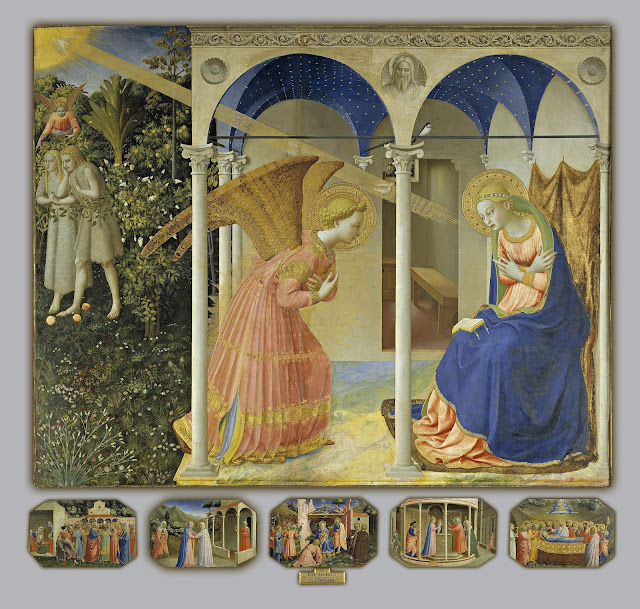
Annunciation


 Fra Angelico
Angelico, fra, approximately 1400-1455. Annunciation, from Art in the Christian Tradition, a project of the Vanderbilt Divinity Library, Nashville, TN. https://diglib.library.vanderbilt.edu/act-imagelink.pl?RC=47865 [retrieved December 8, 2021]. Original source: https://commons.wikimedia.org/wiki/File:Angelico,_prado.jpg. 

In terms of social unrest today or 2000 years ago what happens to a young Palestinian woman unmarried who turns up pregnant? How can she safely carry the child to term? And then what happens to them? 


In Bethlehem a few years ago I listened to a French speaking nun from Lydda tell a group of us North American pilgrims what happens there at the orphanage where she serves.  They take in orphans, and raise them through their first school years. 


An 18-year-old man came to their door one day with a gift. It was a thank you gift: his first paycheck. Years before he was born and cared for and raised to school-age there at la Crèche de Bethléem. Kids grow up there, up to first grade, then go to foster programs and schools until they are full grown. 


Where did these kids come from? Some are children found abandoned, or placed temporarily by social services due to serious social unrest or problems within their families. And others? Their mothers were young unmarried women from villages in Palestine who became pregnant. 


A scandal, possibly fatal, would erupt if their pregnancy was discovered or they had a child in their hometown. So on the quiet they are brought to Bethlehem where the child is born and the mother is cared for. Then the mother returns to her village. Crisis averted: the child lives, the mother lives, violence is not done to either one. 


How different it was for Mary who knew her husband but not yet intimately. Customarily he would have severed the relationship if she were pregnant by another man, wouldn’t he? But he protects her and raises the child with her and so the holy family begins its journey. 


Pregnancy is risky, always risky when the child is unwanted, and if the child is wanted by a jealous king its peril is increased. Mary took on the risk, as did Joseph, and what we see in Mary is more than courage: it is humility and obedience. She sees herself as of lowly estate, as a simple daughter of a village family. 


She is not the daughter of the king, not a daughter of Herod and certainly not the child of Caesar Augustus who was called “son of God, King of Kings.”  (Read or watch “I Claudius'' and you’ll see just how wildly different two young women can be.) 


Mary is a woman of honor and great strength. To say, “Let it be done to me according to thy word,” is to take on a great burden and a great responsibility. 


Mary Holmes, art history teacher at Cowell College, said that the virtue our society needs now is obedience – and I think she meant it in the Marian sense of docility: accepting the reign of God and the power of the spirit is not passivity. 


“Docility is to have reverence and acceptance of God’s plan for our lives in order to experience fulfillment, true happiness and closeness to God.”


(https://ct.dio.org/item/4903-docility-to-the-holy-spirit.html) 


Mary is already empowered by her creator’s love and her sacrificial response. She will now know no ordinary life nor will her son. All that is changed now and forever. She is a woman clothed with the sun: made shining and glorious by her simplicity and her humility, her obedience and her courageous response: “Here I am, Lord.” 

And so that was an ordinary extraordinary young woman, two thousand years ago. Obedience, docility, not passivity, but openness to the leading of God and the power of the Spirit at work. 


How are we nowadays to accept the gift and the call of God? What extraordinary ordinary thing awaits us this coming Christmas season? 


Mary responded to the news from God’s messenger with more than simple acquiescence. She went on to sing: My soul proclaims the greatness of God. 


And God comes to humankind to liberate them from what en-toils them. 


500 years ago it was the oppression that came with occupation and an imposed cultural hegemony. On top of the good news they carried as if it were pollen on their clothes, the people of Spain arrived in the new world with a desire for gold and conquest. 


This included spiritual conquest as if the local people had nothing to add or to offer but simple passive submission to the foreign message. But one day not long after the conquest came a second change, a revolution in spirituality. 


Juan Diego encountered a vision of the Mother of God atop a hill that had been sacred for centuries. On it he saw not a nature goddess but the Queen of Heaven. 


He told the bishop. The bishop did not believe him. In that cold gray time of year roses should not bloom, but bloom they did, that day. Open your tilma and gather them in, she instructed. 


He took the cloak to the bishop and opened it. Flowers fell on the ground. What remained was an image of a dark-skinned Mary, an indigenous Mary, resplendent, on its inner surface. 


That became the sign that showed the way. God was not to stop at human borders or inhabit human prejudices. The way was open and all were welcome.


The point was not, she is ours. She is one of us. The point was, we are hers. We are hers. And she and we belong to God. Wherever we travel, God is with us. Emmanuel.


How will we now, 2000 years after Mary, and 500 after the vision of Guadalupe, receive the Christ child and the message of angels? What are we doing, called to do? 


Venture forth into the night bearing a small burden to a foreign land? It’s being done, now, across our own desert. Are we to welcome the stranger into the inn, and make room where none was found? It’s being done, here in our own town. 


Are we to follow the words of an extraordinary messenger to an unknown land, as so many patriarchs and matriarchs did, in Old Testament days? 


And perhaps it is the simple things, the daily things, that we do, to follow God’s pathway in our hearts, as best we may. To show kindness to strangers, sympathy to the distressed, tolerance to the uneasy, support to the weary, joy to the glad, and all this, to the end that God’s purpose on earth be known.


Perhaps it is just to stand still, upon a hill, and hear and join the angelic choir as they sing, “Glory to God!”


But there is work to be done. Mary did not stop with “Here am I.” She went on, as she visited her relative Elizabeth, to sing with joy of justice and redemption, of faith and hope and the lasting challenge, the commission even, of every child of God.


He has redeemed us. He has come to his people. And he has given us a job to do.


To join in the redemption of the world by our actions of justice, mercy, and compassion. The small things, yes, the big things too: the work of the people is to join in the salvation of the world. 


No, we are not deities. We are not divine. Neither is she. But we follow the one who is.


“Now, master, let your servant go in peace according to your word, because my eyes have seen your salvation. You prepared this salvation in the presence of all peoples. It’s a light for revelation to the nations and a glory for your people Israel.”


Luke 2:29-32 (CEB)


JESUS MAFA. The Annunciation - Gabriel and Mary, from Art in the Christian Tradition, a project of the Vanderbilt Divinity Library, Nashville, TN. https://diglib.library.vanderbilt.edu/act-imagelink.pl?RC=48278 [retrieved December 8, 2021]. Original source: http://www.librairie-emmanuel.fr (contact page: https://www.librairie-emmanuel.fr/contact). 

Oh, by the way, that 18 year old was sent out with a fond farewell by his foster parents but he was back at the door in moments. “Mom, could you give me money for the bus?” He had given them his whole paycheck and it was all he had.


Saturday, December 15, 2012

What then shall we do?

Third Sunday of Advent,
Zephaniah 3:14-20,
Canticle 9,
Philippians 4:4-7,
Luke 3:7-18,


If there is no forgiveness in us,
            there is no cause for celebration.”
– Ann Weems, “The Cross in the Manger”, Kneeling in Bethlehem, (Philadelphia: Westminster Press, 1980) 77.


Near the end of the gospel of Luke we come across the story of a pair of disciples who are refugees from disaster. After the trauma, loss and grief of Holy Week in Jerusalem, they set out for a village seven miles away from the city. On the way they cannot help but talk over everything that has happened. They look sad. And then they meet a stranger on the road.

What are you talking about?
Don’t you know? Are you the only one who hasn’t heard about what’s been happening?

What about?
About Jesus, they say: Jesus of Nazareth.

We really thought he was the One. That he would be the one to lead us – to redeem us – to be our savior.

We thought everything was going to be all right. This was going to be a peaceful place, free from danger and trouble.

And yet he stepped into the thick of it – and was crucified for his pains. And now we hear they cannot even find his body.

O my dear friends. Your minds have been darkened by grief. Haven’t you been paying attention to what is really going on?

Didn’t you know that Christ had to go through suffering and death, that the road of Jesus leads to the Cross – and only then to glory?

God made us mortal
         because he loves us
         because he loves us
God became one of us
         in Christ Jesus
he shared our nature
         our sorrows, our grief, our joys –
and he is with you now!
         walking beside you
though you may not know it
         or see that it is he
until you share
in the brokenness
and the outpouring of compassion
that is his supper
that is the supper he presides over
a thanksgiving and a memorial meal

This is my body, broken for you. This is my blood, poured out for you.

All this he spoke: good news
to two people attempting to flee from the wrath that had come.

Afraid, alone, discouraged, in despair
 – but they had been baptized –
and so their eyes are opened
and they turn
         toward home
to spread the news.

The people who went out to John in the wilderness:
why did they go?

To be baptized, sure, to see a miracle, maybe,
and maybe to buy some fire insurance.

They could see bad times coming.

But why did they stay?

John offered no spiritual anesthesia.

Why did they say, “What then shall we do?”

These are the people who respond to the call to conversion.

What then shall we do? they ask –
if coming for a magic baptism is not it,
what are we supposed to do?

How are we to live?

John says it begins with honesty.

Be satisfied with your wages. Treat people fairly.

It begins simply,
with small actions
day to day
that turn you
into the right road.

And it continues in transformation –
which is painful: preparation for the new life to come.

In the midst of disaster – and these people knew disaster – these, newly baptized, would become the ones to bring hope and peace to a traumatized world, comfort to the people.

The first people to read this gospel of Luke were people who knew tragedy and disaster: the death of Jesus, the destruction of the Temple, the reduction of the holy city to rubble.

And yet, there was hope – not despite of, or in avoidance of, the pain of the world, but in sure knowledge that God is present with us in suffering and even in the midst of tragedy he is victorious. In the midst of it God is with us. 

O come Emmanuel – GOD WITH US – comfort your people. Build our strength.

Stir up, O Lord,
the wills of your faithful people;
that plenteously bearing the fruit of good works
they may herald the coming of your kingdom;
through Jesus Christ our Lord.


Serene Jones, Trauma and Grace: Theology in a Ruptured World, Louisville: Westminster John Knox Press, 2009) 23-42.


Saturday, December 12, 2009

seen from a mountain-top

Stir up your power, O Lord, and with great might come among us; and, because we are sorely hindered by our sins, let your bountiful grace and mercy speedily help and deliver us; through Jesus Christ our Lord, to whom, with you and the Holy Spirit, be honor and glory, now and for ever. Amen.

Collect for the xxv Sondaye after Trinity (1549, 1552, 1559)

STIERE [Stir] up we beseche thee, O Lord, the wylles of thy faythfull people, that they, plenteously bringing furth the fruite of good workes; may of thee, be plenteously rewarded; through Jesus Christe our Lorde. Amen.

Zephaniah 3:14-20

Sing aloud, O daughter Zion;
shout, O Israel!
Rejoice and exult with all your heart,
O daughter Jerusalem!
The LORD has taken away the judgments against you,
he has turned away your enemies.
The king of Israel, the LORD, is in your midst;
you shall fear disaster no more.
On that day it shall be said to Jerusalem:
Do not fear, O Zion;
do not let your hands grow weak.
The LORD, your God, is in your midst,
a warrior who gives victory;
he will rejoice over you with gladness,
he will renew you in his love;
he will exult over you with loud singing
as on a day of festival.
I will remove disaster from you,
so that you will not bear reproach for it.
I will deal with all your oppressors
at that time.
And I will save the lame
and gather the outcast,
and I will change their shame into praise
and renown in all the earth.
At that time I will bring you home,
at the time when I gather you;
for I will make you renowned and praised
among all the peoples of the earth,
when I restore your fortunes
before your eyes, says the LORD.

Canticle 9 (Page 86, BCP) The First Song of Isaiah, Ecce Deus (Isaiah 12:2-6)

Surely, it is God who saves me; *
I will trust in him and not be afraid.
For the Lord is my stronghold and my sure defense, *
and he will be my Savior.
Therefore you shall draw water with rejoicing *
from the springs of salvation.
And on that day you shall say, *
Give thanks to the Lord and call upon his Name;
Make his deeds known among the peoples; *
see that they remember that his Name is exalted.
Sing the praises of the Lord, for he has done great things, *
and this is known in all the world.
Cry aloud, inhabitants of Zion, ring out your joy, *
for the great one in the midst of you is the Holy One of Israel.
Glory to the Father, and to the Son, and to the Holy Spirit: *
as it was in the beginning, is now, and will be for ever. Amen.


Philippians 4:4-7

Rejoice in the Lord always; again I will say, Rejoice. Let your gentleness be known to everyone. The Lord is near. Do not worry about anything, but in everything by prayer and supplication with thanksgiving let your requests be made known to God. And the peace of God, which surpasses all understanding, will guard your hearts and your minds in Christ Jesus.

Luke 3:7-18

John said to the crowds that came out to be baptized by him, "You brood of vipers! Who warned you to flee from the wrath to come? Bear fruits worthy of repentance. Do not begin to say to yourselves, 'We have Abraham as our ancestor'; for I tell you, God is able from these stones to raise up children to Abraham. Even now the ax is lying at the root of the trees; every tree therefore that does not bear good fruit is cut down and thrown into the fire."

And the crowds asked him, "What then should we do?" In reply he said to them, "Whoever has two coats must share with anyone who has none; and whoever has food must do likewise." Even tax collectors came to be baptized, and they asked him, "Teacher, what should we do?" He said to them, "Collect no more than the amount prescribed for you." Soldiers also asked him, "And we, what should we do?" He said to them, "Do not extort money from anyone by threats or false accusation, and be satisfied with your wages."

As the people were filled with expectation, and all were questioning in their hearts concerning John, whether he might be the Messiah, John answered all of them by saying, "I baptize you with water; but one who is more powerful than I is coming; I am not worthy to untie the thong of his sandals. He will baptize you with the Holy Spirit and fire. His winnowing fork is in his hand, to clear his threshing floor and to gather the wheat into his granary; but the chaff he will burn with unquenchable fire."

So, with many other exhortations, he proclaimed the good news to the people.

* * * * *

Robert Louis Stevenson, “The Sea Fogs”, The Silverado Squatters, (London: Chattus & Windus, 1883)

One Sunday morning, about five, the first brightness called me… The sun was still concealed below the opposite hilltops, though it was shining already, not twenty feet above my head, on our own mountain slope. But the scene, beyond a few near features, was entirely changed. Napa valley was gone; gone were all the lower slopes and woody foothills of the range; and in their place, not a thousand feet below me, rolled a great level ocean. It was as though I had gone to bed the night before, safe in a nook of inland mountains, and had awakened in a bay upon the coast… Far away were hilltops like little islands. Nearer, a smoky surf beat about the foot of precipices and poured into all the coves of these rough mountains. The colour of that fog ocean was a thing never to be forgotten. For an instant, among the Hebrides and just about sundown, I have seen something like it on the sea itself. But the white was not so opaline; nor was there, what surprisingly increased the effect, that breathless, crystal stillness over all. Even in its gentlest moods the salt sea travails, moaning among the weeds or lisping on the sand; but that vast fog ocean lay in a trance of silence, nor did the sweet air of the morning tremble with a sound… An eagle, or some other very great bird of the mountain, came wheeling over the nearer pine-tops, and hung, poised and something sideways, as if to look abroad on that unwonted desolation, spying, perhaps with terror, for the eyries of her comrades. Then, with a long cry, she disappeared again towards Lake County and the clearer air.


John Steinbeck, The Grapes of Wrath (1939)

All night they bored through the hot darkness, and jackrabbits scuttled into the lights and dashed away in long jolting leaps. And the dawn came up behind them when the lights of Mojave were ahead. And the dawn showed high mountains to the west. They filled with water and oil at Mojave and crawled into the mountains, and the dawn was about them.

Tom said, "Jesus, the desert's past! Pa, Al, for Christ sakes! The desert's past!"

"I'm too goddamn tired to care," said Al.

"Want me to drive?"

"No, wait awhile."

They drove through Tehachapi in the morning glow, and the sun came up behind them, and then suddenly they saw the great valley below them. Al jammed on the brake and stopped in the middle of the road, and, "Jesus Christ! Look!" he said. The vineyards, the orchards, the great flat valley, green and beautiful, the trees set in rows, and the farmhouses.

And Pa said, "God Almighty!" The distant cities, the little towns in the orchard land, and the morning sun, golden on the valley. A car honked behind them. Al pulled to the side of the road and parked.

"I want ta look at her." The grain fields golden in the morning, and the willow lines, the eucalyptus trees in rows.

Pa sighed, "I never knowed they was anything like her."

The peach trees and the walnut groves, and the dark green patches of oranges. And red roofs among the trees, and barns rich barns. Al got out and stretched his legs.

He called, "Ma-come look. We're there!"

Ruthie and Winfield scrambled down from the car, and then they stood, silent and awestruck, embarrassed before the great valley. The distance was thinned with haze, and the land grew softer and softer in the distance. A windmill flashed in the sun, and its turning blades were like a little heliograph, far away. Ruthie and Winfield looked at it, and Ruthie whispered, "It's California."

Winfield moved his lips silently over the syllables. "There's fruit," he said aloud.

Casy and Uncle John, Connie and Rose of Sharon climbed down. And they stood silently. Rose of Sharon had started to brush her hair back, when she caught sight of the valley and her hand dropped slowly to her side.

Tom said, "Where's Ma? I want Ma to see it. Look, Ma! Come here, Ma." Ma was climbing slowly, stiffly, down the backboard. Tom looked at her. "My God, Ma, you sick?"

Her face was stiff and putty-like, and her eyes seemed to have sunk deep into her head, and the rims were red with weariness. Her feet touched the ground and she braced herself by holding the truck-side.

Her voice was a croak. "Ya say we're acrost?"

Tom pointed to the great valley. "Look!"

She turned her head, and her mouth opened a little. Her fingers went to her throat and gathered a little pinch of skin and twisted gently. "Thank God!" she said. "The fambly's here." Her knees buckled and she sat down on the running board.


+
The Third Sunday of Advent, Year C, RCL

Zephaniah 3:14-20, Canticle 9, Ecce Deus, Isaiah 12:2-6, Philippians 4:4-7, Luke 3:7-18.

+

Sunday, December 17, 2006

waiting for the delivery truck

C Advent 3 Gaudate Sunday 2006

Yesterday I observed a familiar holiday ritual: waiting for the delivery truck.

Today I want to read you a story about a group of people who were the recipients of a delivery they did not expect, from a person they never thought they'd see.

The Lion, the Witch, and the Wardrobe, Chapter Ten:
"always winter and never Christmas"
"Aslan is on the move!"
"Merry Christmas! Long live the true King!"

They were expecting not a delivery but deliverance, and they were on their way to meet their deliverer, when unexpectedly they met his fore-runner.

Like John the Baptist, he called the people to repent, to change direction, that is, and he called them to rejoice.

They are preparing for their meeting with the true King, and their preparation involves receiving gifts - not toys but tools - that they will need for their part in ushering in (or restoring) the real Kingdom.

Like these beavers and boys and girls in Narnia, we must prepare to meet the one true King.

Let every heart prepare him room!

We are given gifts - tools - to wield or wear as we prepare. We are given strange gifts - that seem curious or merely pleasant, until the time is ripe to use them.

John the Baptist preached a gospel of repentance for the forgiveness of sins. He gave practical, radical advice to each group that came to him. They wanted to get on the right side of God. Anticipating the wrath to come, they asked, "What shall we do?"

Produce fruits that give evidence of repentance, he said to them. He told them each to do something that showed indelibly that they were IN the Kingdom, that they were living as citizens of the real kingdom, and leaving the claims of Rome - of the earthly powers - as merely conditional, temporal, a means to an un-earthly end.

And John the Baptist warned the Baptized. He gave them the familiar washing, cleansing ritual, a sign that they were turning from their sins, reorienting their lives toward God.

But - after him is coming one who would change everything, just as fire transforms what it burns. The whole created order would be made new.

The fruits of the earth will be gathered - to be stored in heavenly barns.

He - he who is coming - will separate the wheat from the chaff.

We are asked to do no less in our own lives: to winnow out, with fan or fork, what we bring forth as the product of our turning, turning home - to God...

To leave aside, leave behind, everything that does not matter, not really: and, cleanse our hearts, make ready our homes,

-- Maybe even put out some cookies and a glass of milk -

For the unexpected visitor
We somehow still expect to arrive, in our hearts, this Christmas Eve.

Maranatha.


Sunday 17 December 2006
St. Paul's Church, Benicia, California.