 |
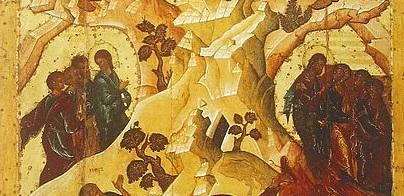
| Jesus and the disciples go up the Galilee side of the mountain and come down the Jerusalem side. http://edgeofenclosure.org/epiphanylastc.html |
You have to wonder how it felt there. He had walked with them a long way and talked with them and taught them many things and now he was going up the mountain, and he went up the mountain to talk to God. Then later, we learn, he came back down and had some more ordinary experiences, and they had some more ordinary experiences. We could be talking about Moses or Jesus.
When we’re talking about Moses on the mountain, he had lead the people through the desert in an exodus, a departure from Egypt and from slavery, and a departure into freedom and a new land and indeed a new relationship with God – because now their leader had spoken to God face-to-face… that is, had prayed, and then returned to them.
By the time of this episode he had already brought them the 10 “words” or 10 Commandments.
What we see in both this story and the story of the Transfiguration is that it is the experience of the followers, the people who followed their leader, that we are told about.
Moses did not know that his face was shining. They did.
Jesus did not pay any attention to his own appearance. They did.
Jesus like Moses had led his followers on a long wandering walk, and now had gone up the mountain to pray and talk to God.
When his disciples saw him, they saw that his clothes were whiter than an earthly laundromat could make them, and his face was shining.
That is what they saw. That is what they experienced.
And that is what we hear about in both of these two stories that have been read to us this morning. The experience not of the leaders but of their followers.
Like those followers, we recognize that what we have, what we own, is our own experience of what has happened and what it reveals about who our leader is and what their message is to us.
What is astonishing about the stories we heard today, about Moses and Jesus, was the agreement between witnesses, on what had happened and what it meant, though this did not come to them all in a rush at the very moment that it happened.
The disciples did not at the time even talk about what had happened. Peter, James, and John didn’t say a word to anybody until after Jesus was resurrected.
As you may recall, after they experienced the Resurrection, Mary Magdalene and the other women didn't say a word to anybody at first.
It took a while to figure out what was really going on below the surface of what had happened, what they had seen and heard and what it meant.
But they, like the men on the mountains, did come away with some experiences, reflected on them, and then taught their insights to others.
A historian at a recent academic conference evaluating a presidency said, “Not surprisingly, people mix their opinion of what they think should have happened with what really did happen.” It takes a while to sort it out.
There is another should that matters today and that is how we should respond to the stories and to what the leaders had passed on to their followers from what they had already taught them on the way and what they brought down with them from the mountain top experience.
And you have to have some sympathy for the leader.
On his first return from the mountaintop Moses found the people had strayed far from what he had taught them, threw down the first copy of the 10 Commandments in disgust and then had to go back up and ask for another set — from God.
And it was after his mountaintop experience that Jesus had to step in and do what he thought the disciples at this point should’ve been able to do for themselves and heal a child.
But however they responded, however they reacted, however they experienced or recollected their experience or related to it or understood it over time, the disciples of Jesus and the followers of Moses had some questions that would sound very familiar to us today.
Not just : what happened and what did it mean? But also : now what? What is next?
Of course we are not caught in the moment between ascending a mountain from Galilee and then descending toward Jerusalem, or ascending Mount Sinai and then descending toward the promised land.
When we are at an in-between place, it may not feel like a mountain top to us but rather a valley. Like the Israelites left to their own devices in the camp, or disciples waiting for the Big 4 to return from Mount Tabor.
In some ways, it can be very exciting to be on your own and trying to figure out what was that and what’s coming next.
In other ways, it can be disconcerting and provide a source of anxiety.
In the in-between time, we realize that who our leader was following is the one whom we really need to learn from.
Moses’ face shines as it reflects the glory of God; Jesus’ shines as he reveals the glory of God.
In both of the readings, with Moses and with Jesus, the person who led them on their long wandering, who then went up the mountain to pray to God, was revealed to them as the messenger of God chosen for that moment. In the first case, the leader was Moses, who brought them the 10 ‘words’ of the law. In the second case, it was Jesus who was himself the Word, the embodiment of the reign of God.
So what are we to make of it when leaders are with us for a time and then make their departure?
One thing we know for sure is that they have given us a model to follow, which is whether you up on a mountaintop or down in a valley, to turn our faces toward God – God, where the source of all that light reflected in their faces, shining faces, came from in the first place and we like them should pray.
There is a prayer written, especially for our kind of situation, a prayer for the calling of a new minister, and of course it’s a prayer for them as well as us. Now Moses was certainly not appointing his successor when he was on the mountain, and Jesus simply said after me will come an Advocate to help you and be with you forever—
What we are expecting is that we will be guided by the Spirit into the future with a new understanding of what we have learned not only from past leaders, but from our God, and we will continue in the teachings and in the prayers. That incidentally is how the disciples carried on. They continued in the teachings and fellowship, in the breaking of bread and in the prayers: so should we.
Almighty God, giver of every good gift: Look graciously on your Church, and so guide the minds of those who shall choose a rector for this parish, that we may receive a faithful pastor, who will care for your people and equip us for our ministries; through Jesus Christ our Lord. Amen.
At this point in the Christian year, we are at the hinge point, the bridge from the revelations of Epiphany season, when the reality of Jesus became more and more apparent; his true nature shining through and the disciples beginning to grasp it, and what happened once that truth was revealed in one extra extraordinary experience after another. Now crossing into Lent we accompany Jesus as he sets his face – so recently shining – towards Jerusalem and his mission to be accomplished there.
That mission will end not in defeat but in his glorification and the glory of God his father. And as we seek to follow Jesus, not up the mountain of shining faces but down the road to the events of Holy Week, we seek his face in the darkness of Good Friday as well as in the light of Easter. And God’s glory will be reflected in our faces.
***
Last Sunday after the Epiphany
https://www.nytimes.com/2025/02/26/arts/writing-history-biden-presidency-trump-era.html

