Showing posts with label Psalm 17:1-9. Show all posts

Sunday, October 30, 2022

All Hallows

Jesus said, “The fact that the dead are raised Moses himself showed, in the story about the bush, where he speaks of the Lord as the God of Abraham, the God of Isaac, and the God of Jacob. Now he is God not of the dead, but of the living; for to him all of them are alive." 

(Luke 20:37-38)

In the name of God, Father, Son, and Holy Spirit. Amen.


This is a time of sorrow, of remembrance, and sometimes of joy. It is the season, and the week, and in some homes the day, that we remember those who have died. We remember individuals close to us, loved ones, fellow worshipers, friends, and colleagues. We remember those far away. And we remember those long ago. 


Fresh it comes sometimes, the memory of the loss of someone dear to us, long ago. Or we are reminded, willy-nilly, by some random reference in a passing conversation, or news item. We pass the freeway exit. We taste something, or a fragrance comes to us, and we remember them.


We remember, too, those who are passing now, or recently, not only those we know personally, but those we hear about through news reports. This past weekend the headlines about a crush in a crowd in Korea and the murder of innocents in Mogadishu vied for space, while Ethiopia, Congo, Yemen, and other places were found further down the page, or on inside pages, or awaited their turn in our attention.


Some of us remember every day or every week those who have died coming through the desert, and we light a candle at a shrine, or remember them in our prayers.  


News items, or visitors, bring to mind tragedies of the past. Anticipated grief, expectation of loss to come, sometimes controls our consciousness. It looks like something is going to happen and we find ourselves getting ready to absorb it, or trying - in advance - to forget it, or address it, or both.


So we have a holiday or two, or three, this weekend and next. Monday is All Hallows’ Eve, the night before All Saints’ Day, Tuesday and Wednesday, November 1st and 2nd, we observe El día de Los Muertos*, and on Wednesday, All Souls, All Faithful Departed** - and next Sunday we continue our remembrances, as we listen to the gospel in which Jesus explains to cynical skeptics the resurrection of the dead and the hope it gives, as our God is the God of the living, ‘for to him all these are alive.’


That last is a hard and beautiful doctrine, hard to get your mind around and assimilate, for it is so different from our cultural messages, even well-meaning ones, and the consolations quickly offered at the time of grief. But it is good news, nevertheless. 


And well worth remembering. If the dead are alive to God, and we are alive in Christ, then especially when we come to church and take communion together, and especially these days, we should be able not only to mourn but to celebrate the lives of those who have lived before us, as they are alive in God.


* “Día de los Muertos acknowledges the symbiotic relationship between life and death. El día de Los Muertos is celebrated on November 1st and November 2nd, in which the spirits of the dead are believed to return home and spend time with their relatives on these two days.” https://www.mexicanmuseum.org/dia-de-los-muertos


** “This optional observance is an extension of All Saints' Day. While All Saints’ is to remember all the saints, popular piety felt the need to distinguish between outstanding saints and those who are unknown in the wider fellowship of the church, especially family members and friends. Commemoration of All Faithful Departed did not appear in an American Prayer Book until 1979, and it is celebrated on Nov. 2. It is also known as All Souls’ Day. Many churches now commemorate all the faithful departed in the context of the All Saints’ Day celebration.”

https://www.episcopalchurch.org/glossary/all-faithful-departed-commemoration-of/


Readings for Year C, Proper 27. The Third Sunday before Advent:


TRACK ONE

Haggai 1:15b-2:9

Psalm 145:1-5, 18-22

or Psalm 98

2 Thessalonians 2:1-5, 13-17

Luke 20:27-38


TRACK TWO

Job 19:23-27a

Psalm 17:1-9

2 Thessalonians 2:1-5, 13-17

Luke 20:27-38


A version of this essay was published in the Keeping the Faith feature of the Home + Life section of the Arizona Daily Star, Sunday November 13th 2022, page E3, under the title, "Celebrate loved ones lost." 

https://arizonadailystar-az.newsmemory.com?selDate=20221113&goTo=E03


Sunday, November 10, 2019

Children of the Resurrection


Children of the Resurrection

The service of Burial begins with, among other words, these:

I know that my Redeemer liveth,
and that he shall stand at the latter day upon the earth;
and though this body be destroyed, yet shall I see God;
whom I shall see for myself and mine eyes shall behold,
and not as a stranger.

Job (19:25-27a).

For me the key words in the Gospel lesson for today are “children of the resurrection” and, even more so, “to him all of them are alive.” 

As we approach the Lord’s Table we go to meet the Lord — who is alive and those too who are alive in Him, alive in the Resurrection. And even, I’ve been thinking, we go to meet those who are yet to come.  

Hope for the future, as well as peace about the past, and faith — both comfort and challenge — for the present, are all proclaimed to us in this gospel.

For in Christ we are in communion with all the saints, all who live and die and are raised with him. 

So as we go up to take communion we go up not for ourselves only but for all who share in the joy of the saints.

My professor Donald Nicholl worked this out while he was lay rector of the Ecumenical Study Institute in Jerusalem, a community comprising both Protestants and Catholics. He found that the Protestants would only be able to take communion with other Protestants, and the Catholics with Catholics. So at first his response was to take communion with neither. Then he realized, that will never work. I’m the leader of this community, and I’m never taking communion? So he decided, and said to the rest, that when he went up to take communion he would do it not just for himself but for everyone who could not come up themselves. 

Well, sometimes that would be all of us. And this is a sacrament that we take never so for much for ourselves as when we take it as members of the body of Christ: one bread, one body.

From Isaiah (25:6) we receive this vision of a feast at the end of time:

On this mountain the Lord of hosts will make for all peoples
   a feast of rich food, a feast of well-matured wines,
   of rich food filled with marrow, of well-matured wines strained clear.

The heavenly feast! Our practical idea of neighbors feeding neighbors is not far off. For what we do here on earth trains us for life eternal. Indeed, if we take resurrection seriously, a couple of things happen. 

For if we take resurrection seriously, we take each other seriously. How shall I regard you if I know you are an eternal being, that you will live forever, that in Christ you have a home in his heart? And how then shall I look at myself - at my own actions, at my self-regard or self- envy, my self-criticism or my downward looks, if Christ is real? 

“Eternal life starts here” could be written over the gates of your life - today, any day, as you enter the church, as you approach the communion rail, as you start again, today, to live life as you want it to be lived. 

***

Even the sorrow of life cut short — or spent badly — is redeemed in the resurrection. And its hope is in us, and we in it. So we can resist despair and live on, live now, in the fullness of that hope, the assurance of redemption.

Father Fuller (from St Frances Cabrini) said: “Our faith in our future resurrection must affect our lives now.” Knowing who we are and believing in the future changes how we treat each other, how we treat ourselves, how we approach life. 

We are called to live in the fullness of confidence that death is not the end — the end is in Christ — the finality of the goal of all life… as all things are gathered to him.

For love is strong as death (Song of Songs, 8:6). 

Death be not proud, the poet said, but death cannot conquer those whom Jesus loves. And that includes you in. 

***

To live now with the resurrection life before us means living now not only for ourselves but for others:
in our sacramental life,
in our workaday life,
in our home life,
in our social and political life…
How we treat one another, 
how we treat ourselves, 
how we live - 
is in the light of the life of Christ,
that frees us,
empowers us, and
leads us - into strange, new places.

Now, we may not all agree on particular actions — I’m thinking of the social-political realm — but we know of one another who sends us, why and what is behind our actions, the source of our motivations.

“To seek to serve Christ in all persons” — and uphold their dignity as children of God, affects how we conduct our public lives - not just how we vote, but in how we speak to others with whom we disagree. Our attitude of certitude or frustration or despair or even anger over public policy must be leavened with hope — with knowing that we are children of God.

How are we then to live? 
— as God’s children, 
— as transcendent beings of infinite value, 
— as creatures of dust and glory whose mortal acts of the moment are significant in light of 
our immortality, 
of the hope of the resurrection, that is, 
of our presence now in Christ. 

And this presence of Christ in us, which we enact and celebrate as we go up to communion, motivates us, not only to kneel or stand before him Sunday morning, but to stand with him in all the moments of our lives.

***


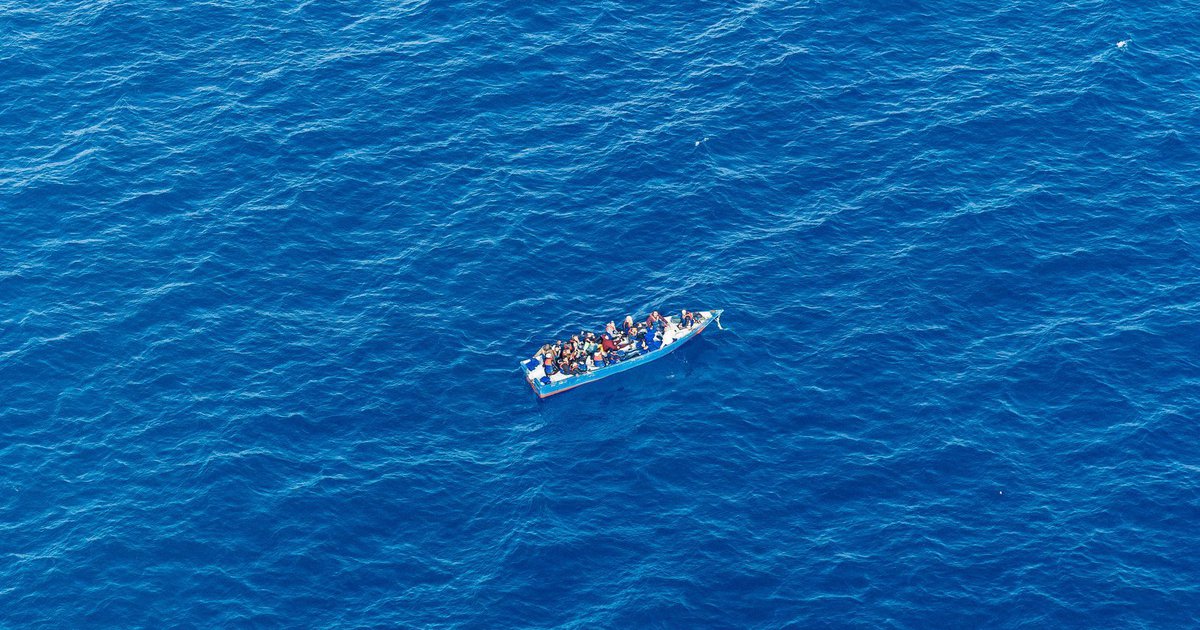
Last Wednesday evening at Grace Saint Paul’s church a representative of Sea-Watch, a humanitarian aid group working for refugees in the Mediterranean Sea, talk about the externalizing of frontiers, from Europe across the Mediterranean to the borders of Libyan territorial waters. 

And Scott Warren, a cultural geographer from Ajo, told us about the separation of people in that small community into American Town, Mexican Town, and Indian Village. 

But — one bread, one body. 

In Christ we are all one people. Using desert or water to separate us does not, ultimately, work. For we know that our redeemer lives, and on the last day he will triumph — and we with him. 

We begin to realize, as Christ draws all people to himself, that we are already one in the Spirit, and those boundaries we may seek to draw will all evaporate, dissolve, and blow away in the wind of the Spirit. That Holy Breath that in the Beginning moved across the face of the waters has not been still since creation’s dawn — it is still moving. And as it moves, what the world puts up against it will not stand.


***