Showing posts with label BProper8. Show all posts

Sunday, June 30, 2024

Ruth 3 : cloaks


 “Spread the skirt of your cloak over me”

“Take the cloak you are wearing and hold it out”

She came up behind him and touched his cloak.

“His banner over me was love”


    Same cloak? It would've been cool if the cloak Boaz filled with grain for Ruth to take home to her mother-in-law was the same cloak he had spread over her. It does seem that in both cases he is offering her exceptional protection and providing. His cognizance of her, his concern for her, has gradually raised her in his eyes. And he responds generously and thoughtfully. This developing relationship between them grows from respect and dignity, grace and gratitude,  to trust and a warmer current. I don’t know if we can fit it into modern romantic-love plot lines, but we can see for certain an arrival on common ground. Ruth is no longer dependent, in the same way as she was before; she has come into her own. She who referred to herself as servant is called by Boaz daughter, and warmer terms await. It is a shift of status  much like that of Jesus’ followers of whom he said, ‘I do not call you servants any longer, …but I have called you friends.’ (John 15:15)  Before we rush on to the happy ending it is well to pause the movie a moment and reflect on the cloaking device. “Spread the skirt of your cloak over me” says Ruth, bring me under your protection, and act as my redeeming kinsman. The garment is a symbol of the gesture that is much larger: bringing under protection, as under the wings. 

    I am reminded of a song we sang at a coffeehouse gathering in high school, with the refrain “his banner over me is love” - it is from the Song of Songs, the Song of Solomon. It is a bride’s song of her beloved, so it will fit well with the fate of our once-lonely once-stranger; but it is more; it is a symbol and manifestation of coming under the protection, as under the shadow of the wings, of God. There will be found shelter, there will be found mercy, there will be found protection, there will be found - home.

    The whole point of Ruth’s journey for us may be that we too may find ourselves bereft, widowed or orphaned, and in need of a new home. We may discover in the depths of loss a newfound dignity in continuing to care for another, and eventually to receive care. Dignity and respect are restored; the story of Ruth is a story of restoration, in the sense of coming home to a place she has never known. In his Christmas oratorio, in a passage that has been worked into a hymn, W. H. Auden foretells, “You shall come to a place you have never been before and they shall welcome you home.” 

“He is the Way.
Follow Him through the Land of Unlikeness;
You will see rare beasts, and have unique adventures.
He is the Truth.
Seek Him in the Kingdom of Anxiety;
You will come to a great city that has expected your return for years.
He is the Life.
Love Him in the World of the Flesh;
And at your marriage all its occasions shall dance for joy.”

W.H. Auden, For the Time Being: A Christmas Oratorio


    Like the weary travelers in our tale, who have traveled through an unlikely land, from Moab to Bethlehem, at a time of deep anxiety, we can find a new life, a new home, as we are received into the family of the people of God, a family like no other, one that welcomes us without kinship ties but with kindness, that recognizes in steadfast loyalty and kindness a true affinity deeper than blood relations.

    The seeking of protection, of healing and wholeness, of restoration to a place in common life, in community, is what the woman with hemorrhages seeks from Jesus. He is never just about physical healing, even when that is what is sought and given; there is a healing of the whole person, and a wholeness of community, that comes from his actions. His acts are both practical compassion and symbolic manifestation. Something is going on here: the coming of the kingdom of God.

    The kingdom of God, which turns out to be much more than the kingdom of one nation, is known to us through the truth, character, compassion, dignity, wisdom, and piety of its people.* As we grow into those gifts we grow into his kingdom. 

The takeaway for Ruth in chapter 3 was more than the grain she could carry in the cloak she had borrowed; and the takeaway for us is more than romantic expectations. She found under the shadow of the wings of the Lord, and in the care of a near kinsman, provision and care. We find, as we place ourselves within the circle of the covenant of God with humankind, that we are now explicitly part of something greater than human community: we are part of a kingdom of loyalty and steadfast caring that is exhibited most fully in the person of the one whose garment the lady with the hemorrhage touched, the embodied love of God that is Jesus.
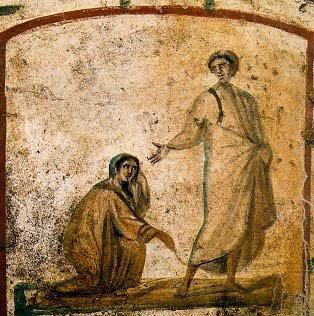

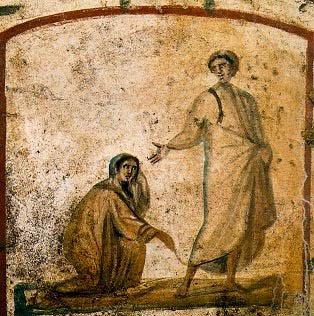
Woman touching Jesus' hem, fresco, Catacomb ofSaints Peter and Marcellinus, 3rd century


Suzanne Guthrie: “I love the profound simplicity of this catacomb fresco. Here is the image as it appears in the woman’s memory: no pressing crowd to obscure her, surrounded by silence, the background washed away by insignificance, she reaches forth to touch and knows immediately that she’s healed.  Here is a picture of the inside of prayer - intimacy magnified.”


http://edgeofenclosure.org/proper8b.html


*(See jimwallis.substack.com June 27, 2024 https://jimwallis.substack.com/p/six-ways-to-prepare-for-the-first)

Ruth 3 : the Hallmark version


https://i.pinimg.com/originals/b7/4a/0b/b74a0bbe0399aa226b694f5253496b3b.jpg


June 30th 2024, Santa Cruz Lutheran Church, Tucson, Arizona.

First Reading: Ruth 3
Canticle: Ecclesiastes 3:1-8
Second Reading: 2 Corinthians 8:7-15
Gospel: Mark 5:21-43


In the third chapter of Ruth, she asks Boaz to ‘spread his cloak’ over her. In the fifth chapter of the gospel of Mark, a woman with a hemorrhage touches the hem of Jesus’ cloak and through her faith she is healed.

[In both cases, what is really going on is that the people in the story are under the protection, that is, covered by the sheltering and healing garment, of divine providence. Can this be our story too?]

—-///-////-//

Back in New York years ago, I used to be the standards and practices screener for the Odyssey channel. It doesn’t sound like much except it means I was the enforcer of standards, the censor, for what is now the Hallmark Channel, which meant I watched the television programming, especially the religious programming, but also other programming on the Odyssey channel, which became Hallmark Channel, which is now best known for the Hallmark movie, especially the Hallmark Christmas movie, which is shown over and over beginning around Halloween or possibly the Fourth of July. 

In that movie, titles vary, as do actors and characters, but the essential story remains the same. If you tune in to the Odyssey channel, excuse me, the Hallmark Channel, five minutes before the hour you see that she has finally met the right guy, there will be grandchildren and grandma is happy; now you go off for five minutes to wait through the commercials and the movie begins again; and there is what is called a ‘meet cute’: you introduced to her, the woman who it’s high time she got married, and the guy, and they have some sort of connection which can be fairly eccentric. 

Then you can go to dinner, then come back nearly 2 hours later for the last five minutes and you see the happy ending again. In between is a mild conflict or complication that must be resolved. Eventually that is resolved, there will be grandchildren, and grandma is happy. So: boy meets girl, boy gets girl. 

This ‘boy gets girl, boy loses girl, boy gets girl back’ formula, in the famous words of the Hollywood producer Samuel Goldwyn, is a tried and true way to tell a story.

Well here we are in chapter 3 of Ruth and it is definitely the in- between time, because we’ve had at last the ‘meet cute’ but unlike the Hollywood version or the Hallmark version, they had actually known something about each other before and developed some respect, her for him and him for her. 

Attentive readers will recall the story so far: Ruth accompanied her mother-in-law Naomi back to Naomi’s hometown after both had lost their husbands. They hope to find a home again where once Naomi lived and had family. It is harvest time. Ruth begins to glean in the fields to gather something to eat. Providentially, she gleans in the field of Boaz, a near kinsman of Naomi, who notices her. He admires Ruth’s steadfast loyalty and care for her mother-in-law, and extends his protection to her, allowing her to glean in the field he owns, then sharing the noonday meal with her, and finally undertakes to execute the duty, and exercise the right, of a near kinsman, and takes her to wife.

Now, it occurred to me that this is not the least weird nor the most weird of all the many ‘meet cutes’ - or courtships - in the Old Testament. If you look at the way the relationships begin, look at the guy who labored seven years for the daughter he didn’t get and then another seven years for that daughter and then another seven years… so he ended up with both sisters, Rachel and Leah. And don’t get me started on Samson. 

These are descendants of those people. It all seems crazy, but somehow God works with these people. God works in these people, through these people, and the result is something beyond just their relationship or even just a romantic movie. 

In fact it has a meaning for all of us. I think the ‘takeaway’ for the book of Ruth generally is the inclusiveness of God: you’ve got in this case the redemption, but basically the takeaway is that God includes them and you and me and everyone in  his family. And as Samuel Goldwyn might say, “Include me in.” 

We see this total outsider, Ruth, who becomes a member of the family that is the people of God: in her case it’s the people of God who are ancient Israel. 

Sarah and I just watched an old movie called ‘Crazy Rich Asians,’ which begins when the guy and the girl are already dating and have been dating for at least a year. They have passed the ‘meet cute’ moment whatever that might’ve been. They have met each other, they are someone involved, but they have yet to encounter that necessary complication, that conflict, which drives the plot forward to the happy ending, so that there will be grandchildren and grandma will be happy and it’s about time. 

[To our joy many characters who decorate the story are actually a lot more fun than him and her, couple number one. This is often the case: when you watch “Much Ado About Nothing” by Shakespeare, you realize that couple number one is nowhere near as much fun as the comic relief, couple number two. Not to mention the supporting characters. Often, it’s just like that.] 

The main point is that God loves us and all the rigamarole in between meeting and the resolution, the conflicts and the complications, shows us just how it is that God loves us. How it is that two total strangers can become family, and not just their own small human family, but part of the whole wide family of God. 

It is much more difficult for us outside the story, which after all, we know, ends happily, to get ahold of and to trust the promise, in that we are just learning to see the length to which God will go and has gone and has succeeded in going, to invite us and incorporate us and bring us and welcome us into the family of God. 

God has brought us into his family. That is the best story; it is a true story. And we are here today to celebrate because it is true. 


Woman touching Jesus' hem, fresco, Catacomb ofSaints Peter and Marcellinus, 3rd century
http://edgeofenclosure.org/proper8b.html

Mark 5:25-34

Now there was a woman who had been suffering from haemorrhages for twelve years. She had endured much under many physicians, and had spent all that she had; and she was no better, but rather grew worse. She had heard about Jesus, and came up behind him in the crowd and touched his cloak, for she said, ‘If I but touch his clothes, I will be made well.’ Immediately her haemorrhage stopped; and she felt in her body that she was healed of her disease. Immediately aware that power had gone forth from him, Jesus turned about in the crowd and said, ‘Who touched my clothes?’ And his disciples said to him, ‘You see the crowd pressing in on you; how can you say, “Who touched me?” ’ He looked all round to see who had done it. But the woman, knowing what had happened to her, came in fear and trembling, fell down before him, and told him the whole truth. He said to her, ‘Daughter, your faith has made you well; go in peace, and be healed of your disease.’


Thursday, June 28, 2018

contagious wholeness


It all began when a father pleaded for the health of a child, a woman slipped through a crowd to touch a man’s cloak, and a little girl got out of bed.

There was a story told centuries ago of a placid bucolic country with an ordered simple round of life - disrupted by a contagion of fear, an epidemic of anxiety, a famine of hope. I am not sure the peaceful countryside was ever as isolated as it appeared - even to the preacher’s daughter who told the story. For she wrote what she knew and described what she saw, and left to our imaginations what was going on in the wider world. That story was written in a time of war - the nearly thirty years of revolution and invasion of the era of Napoleon, and Jane Austen.

In her world things began to turn around when people who had initially regarded each other with distrust and suspicion, pride and prejudice, began to discover respect and trust, encouragement and support, and learned to love. That began between people, individually, in her story - but it begs to begin between peoples, nations - as well.

Seventy-five years ago there was an Episcopalian who knew his Prayer Book - who knew the phrase “free to worship him without fear” from the Song of Zechariah he’d have said every day in Morning Prayer, a song of redemption and hope. He drew on his Prayer Book at times of crisis - and when he wrote a speech - and he spoke of a world beyond hate and fear, anxiety and aggression, a world of hope and purpose, a world with four freedoms.

Freedom of speech and expression - everywhere in the world.

Freedom of worship - everywhere in the world.

Freedom from want - everywhere in the world.

Freedom from fear - everywhere in the world.

Four freedoms - not just for his own beloved country, his land of the free - but everywhere in the world.

He spoke of a vision - “the supremacy of human rights everywhere” - and asserted a power: “Our strength is our unity of purpose.”

It began simply, so imply, the in-breaking dawn of this kingdom of peace, of freedom, of justice. It began with a desperate father pleading for the life of his child, an itinerant preacher who answered his call, a woman who sought one last hope beyond the scope of her society, and a little girl who listened to a voice and got out of bed.

Darkness dispelled, anxiety relieved, hope dawned. Hearts mended. Souls healed.

Neither the women who endured 12 years of shame and isolation, nor the girl of 12 years who lay a corpse - neither was clean in their religion’s eyes. Both were unclean, contagious, in a sense unholy and so cut off from life by disease and death - and fear.

But each of them was reached - made contact with - a love stronger than death, a wholeness more contagious than disease - in the person of Jesus. He brought more than respect and trust, encouragement and support; he brought hope and love, a perfect love that casts out fear, a freedom that knows no bounds save justice, mercy, and the humility to walk with God.


Lord God Almighty, you have made all the peoples of the earth for your glory, to serve you in freedom and in peace: Give to the people of our country a zeal for justice and the strength of forbearance, that we may use our liberty in accordance with your gracious will;

Almighty God, kindle, we pray, in every heart the true love of peace, and guide with your wisdom those who take counsel for the  nations of the earth, that in tranquility your dominion may increase until the earth is filled with the knowledge of your love; through Jesus Christ our Lord, who lives and reigns with you, in the unity of the Holy Spirit, one God, now and forever. Amen.

--from the Book of Common Prayer. page 256.


Sunday, July 1, 2012

flocked again

 
-->
We got flocked. Again. The second time this month. This time we were at the zoo. When we came home – we saw some real, live Chilean flamingos – there was a flock on our lawn – of pink plastic flamingos. There was a note by the door: “You’ve been flocked!” — by Abby and Ben, from Greater Edmonds Young Life! A request for a contribution was with the note. Since I first really heard the good news of Jesus through a Young Life club I am a good candidate for a flocking.

The first time we were flocked I caught them in the act. I looked out the window one misty evening and there was my friend Joe running by the window. And there were girls in the trees, placing flamingos among the branches. Eventually they all climbed into the tree house next door, while we talked with Joe’s mom.

Sharing the gospel requires a couple of things – and some of them may seem like crazy pranks. One is to take a risk and reach out – and let your neighbors know about Jesus. Another is to help share in the cost of discipleship – the cost of evangelism and the cost of teaching about the good news, and what it means to us. So both those things were happening, that night. Take a risk and reach out – and give to support our common goal.

Our common goal is no less than the kingdom of God – the reign of God made real, on earth as in heaven, not only in our imaginings but in our lives.

I saw this earlier in the week – last Sunday evening, in fact: Meredith Bee was at Camp Huston. We were there to see her confirmed – her family, her friends, including Verity, and her community. We celebrated this moment together – when a bishop in a long line of bishops laid hands on her, with us beside him, and prayed for her. As she affirmed her faith in Christ we undertook to support her in that faith. And we gave thanks to God in Christ as we made our great thanksgiving together – the Eucharist, the Holy Communion.

No less than the kingdom – the kingdom, here on earth as it is in heaven. That’s our goal.

Paul writes to the Christians at Corinth. They are still new to this good news, still figuring it out. What it means for them. What it means for us. And so Paul reminds them: when they give, when they contribute to the mission of the church, they do so not out of guilty compliance with a past promise, but out of gratefulness – and out of common purpose.

Our real security does not lie in worldly wealth. It rests in the hands of God. That is the message we get from the gospel. The woman who had suffered for twelve years, the twelve year old who had suffered death, both were in need of the healing grace of Christ. And Jesus came to them – and they (or in the girl’s case, her father) put their trust in him.

He did not fail them. He came in time, and he healed. He healed – that is, he made whole, what was broken, what was faulty, what was in need of completion. It was more than physical healing that the woman needed. As she had been stricken down with physical illness, the very symptoms made her ritually unclean. And so nobody would touch her.

Nobody would risk it; nobody would get near her. They tried to stay clean. Nobody, that is, except Jesus. He sought her out, asked her: was it you? – addressed her as Daughter, daughter of Abraham – and assured her that her faith had made her well; had restored her. And then he said, peace, go your way with blessing: you are restored to the community.

Peace! Shalom. It is more than just a word. It means wholeness, life in abundance, and life in community, in relationship. The relationship with God that Jesus establishes allows us to reach out to each other in fellowship in a new way.

We are all in this together now; this life we have we have in God and we are called to relate to each other in this light.

And so Paul says to the people at Corinth, you are part of something larger than yourselves. You are part of a worldwide community, a new fellowship of love that knows no boundaries or barriers that cannot be overcome, and you are bearers of the message, that the offering of God’s healing and restoring grace is for everybody, everywhere.How God acts in Christ toward us is how we should act toward all people.

How God acts in Christ is this: that one who was born into untold wealth, the ultimate richness that is one-ness with God, was willing to share in the life of the world that we, impoverished in the absence of that God-fellowship, might come to share it through him.

All we who were in desperate need – substantial members of the community like Jairus, the father of the twelve year old girl; or marginal and poor and outcast, like the woman with the twelve years’ hemorrhage – found our salvation in one who was rich, one who is life in abundance, who came to us, broke down all the barriers, to bring healing to all.

And so we are called, to share in that life, that abundance in grace. We do so when we share with each other in the joy and gratitude that we express in the holy meal at the Lord’s Table, and we share that life when we go forth in peace, to bring peace to the world. Shalom!

Do not fear; only believe.


Let's close with some prayers from Christine Sine's blog GODSPACE:


Jesus you say
Peace, rest in me,
Peace, hold firm to me,
Peace, trust in me.
You are the way the truth and the life,
May we trust in you and never be afraid.
God of love and compassion,
God of hope and promise,
God of faithfulness and truth,
May we in all things see your face today,
That we might trust and obey
.

Life is a gift from God,
Let us cherish it
Love is the language of God’s kingdom,
Let us practice it,
Jesus is the way to God’s heart,
Let us follow him.
————————–

 —Christine Sine

http://godspace.wordpress.com/2012/06/30/prayers-for-the-journey-37/

BProper 8 - July 1st, 2012 - Fifth Sunday after Pentecost
Wisdom of Solomon 1:13-15; 2:23-24 
Lamentations 3:21-33
2 Corinthians 8:7-15 
Mark 5:21-43

http://sites.younglife.org/sites/greateredmonds/default.aspx

Flamingo (Chilean) - Woodland Park Zoo Seattle WA

http://www.zoo.org/page.aspx?pid=1846 

JRL+

Sunday, June 28, 2009

world of wonders

She would not wait; she would not hold back.

Jesus was on his way, to heal someone else – an urgent message, a plea from a desperate father – Come: save my daughter – she’s dying!

And yet the woman pressed forward, touched his cloak, the hem of his garment.

The bleeding she had suffered under for a dozen years had made her ritually unclean;

at this point she should not be touching anybody—

But there she is, defiling him, making him unclean, just as she was—

If only, if only—

She thought only of this: that his touch would heal her, however unworthy, however unwell, however unclean she was.

And so it was – he felt the power go out of him – the power to heal.

Her faith had opened a channel, a way, for his healing power to move to her and do its work.

‘Who touched me?’ he exclaimed.

C’mon, Rabbi, everybody touched you.

But it was something more, not a jostle in the crowd, a deliberate reaching out, in faith, that she might be well, whole, saved… in secret—

But the secret was out: and in fear and trembling she confessed. It was I.

For twelve years she had suffered – as many years as the number of the tribes of Israel, as many years as the number of the Apostles –

She was unclean, maybe unwelcome—even cast out; but now she was restored: to health, to wholeness— completed in the love of Christ.

But what had saved her?

He said: your faith has made you well.

It wasn’t magic. It wasn’t power. It was trust, trust in God— so that God could work, in her, a miracle: a renewal of life.

So Jesus paused: and moved on, to the home of Jairus, a leader of the synagogue, where his daughter lay—

Don’t bother him now. It’s too late; she’s gone.

CLEAR THE ROOM

They left him, with the girl, her father and mother, and his friends: the only witnesses, to what was about to occur.

This girl— all of twelve— again, that number, as if she were Israel, sickened unto death— lay there, apparently dead, as dead as dry bones in a riverbed—

And he said, she’s sleeping

And they laughed.

And he said, 'Little girl, WAKE UP!'

And she did.

As Israel would, as we will, —as people of God, his people— WAKE UP

We wake up— to new life, given us in Christ, as we follow him, trusting him on the way, trusting him to BE the way, and the truth, and the life.

God’s life-giving power, as Tom Wright points out, comes to us when we open the channel of faith. Through that opening God’s kingdom bursts in, to our world, bringing life, abundant and eternal, working through the everyday things of life, redeeming them, turning them to a new depth of purpose.

Bread and wine, body and blood; water and oil, baptism and unction; everyday things turned to a new depth of purpose work in us a world of wonders: God’s world –

God’s world at last is here, among us, working already, if we are open to it.

If we watch for it, waiting with hope and expectation, we will see that new day dawning; as we wait for the Lord, more than they that watch for the morning; as we call to the Lord, out of the deep places of the soul; more than prisoners in a dungeon led into the light, we will be free.

There is more to come. Being the people of his redemption we are set free not for ourselves alone but set free to be in the world the sign of hope, to open the channel for redemption: to allow faith to enter into other lives.

As Rita Bennett will tell you, we are now ‘the hem of his garment’. We are the visible presence of God’s graceful power in the world, the agents of love’s redeeming work. As faith begins to flower, we testify to the work of love in our own lives; as we carry on, bearing forth his gospel, we bring the good news of Christ to the world.

What we do, what you and I do, individually, collectively – a bunch of us going in together on some common project, or communally – as a work of we the people of God as a whole congregation; as we do God’s work in the world, and come together as his people, we witness to his power at work among us, making us the people who show his faithfulness, his truthfulness, his lack of guile or subterfuge, his kindness, his steadfast love— keeping faith with us.

May he revive us, restore us, to fullness of life. May we witness to the power of his redeeming love. May we follow him, in the way of justice and peace. Amen.


Fourth Sunday after Pentecost (The Third Sunday after Trinity)
Proper 8: Year B, RCL

2 Samuel 1:1, 17-27
Psalm 130
2 Corinthians 8:7-15
Mark 5:21-43

%^)