Showing posts with label Psalm 99. Show all posts

Sunday, March 2, 2025

with shining faces

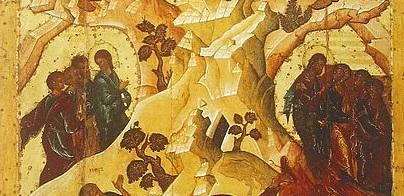
Jesus and the disciples go up the Galilee side of the mountain and come down the Jerusalem side.
http://edgeofenclosure.org/epiphanylastc.html


You have to wonder how it felt there. He had walked with them a long way and talked with them and taught them many things and now he was going up the mountain, and he went up the mountain to talk to God. Then later, we learn, he came back down and had some more ordinary experiences, and they had some more ordinary experiences. We could be talking about Moses or Jesus.


When we’re talking about Moses on the mountain, he had lead the people through the desert in an exodus, a departure from Egypt and from slavery, and a departure into freedom and a new land and indeed a new relationship with God – because now their leader had spoken to God face-to-face… that is, had prayed, and then returned to them.


By the time of this episode he had already brought them the 10 “words” or 10 Commandments.


What we see in both this story and the story of the Transfiguration is that it is the experience of the followers, the people who followed their leader, that we are told about.


Moses did not know that his face was shining. They did.


Jesus did not pay any attention to his own appearance. They did.


Jesus like Moses had led his followers on a long wandering walk, and now had gone up the mountain to pray and talk to God.


When his disciples saw him, they saw that his clothes were whiter than an earthly laundromat could make them, and his face was shining.


That is what they saw. That is what they experienced.


And that is what we hear about in both of these two stories that have been read to us this morning. The experience not of the leaders but of their followers.


Like those followers, we recognize that what we have, what we own, is our own experience of what has happened and what it reveals about who our leader is and what their message is to us.


What is astonishing about the stories we heard today, about Moses and Jesus, was the agreement between witnesses, on what had happened and what it meant, though this did not come to them all in a rush at the very moment that it happened. 


The disciples did not at the time even talk about what had happened. Peter, James, and John didn’t say a word to anybody until after Jesus was resurrected.


As you may recall, after they experienced the Resurrection, Mary Magdalene and the other women didn't say a word to anybody at first. 


It took a while to figure out what was really going on below the surface of what had happened, what they had seen and heard and what it meant.


But they, like the men on the mountains, did come away with some experiences, reflected on them, and then taught their insights to others.


A historian at a recent academic conference evaluating a presidency said, “Not surprisingly, people mix their opinion of what they think should have happened with what really did happen.” It takes a while to sort it out.


There is another should that matters today and that is how we should respond to the stories and to what the leaders had passed on to their followers from what they had already taught them on the way and what they brought down with them from the mountain top experience.


And you have to have some sympathy for the leader. 


On his first return from the mountaintop Moses found the people had strayed far from what he had taught them, threw down the first copy of the 10 Commandments in disgust and then had to go back up and ask for another set — from God.


And it was after his mountaintop experience that Jesus had to step in and do what he thought the disciples at this point should’ve been able to do for themselves and heal a child.


But however they responded, however they reacted, however they experienced or recollected their experience or related to it or understood it over time, the disciples of Jesus and the followers of Moses had some questions that would sound very familiar to us today.


Not just : what happened and what did it mean? But also : now what? What is next?


Of course we are not caught in the moment between ascending a mountain from Galilee and then descending toward Jerusalem, or ascending Mount Sinai and then descending toward the promised land. 


When we are at an in-between place, it may not feel like a mountain top to us but rather a valley. Like the Israelites left to their own devices in the camp, or disciples waiting for the Big 4 to return from Mount Tabor.


In some ways, it can be very exciting to be on your own and trying to figure out what was that and what’s coming next.


In other ways, it can be disconcerting and provide a source of anxiety.


In the in-between time, we realize that who our leader was following is the one whom we really need to learn from.


Moses’ face shines as it reflects the glory of God; Jesus’ shines as he reveals the glory of God.


In both of the readings, with Moses and with Jesus, the person who led them on their long wandering, who then went up the mountain to pray to God, was revealed to them as the messenger of God chosen for that moment. In the first case, the leader was Moses, who brought them the 10 ‘words’ of the law. In the second case, it was Jesus who was himself the Word, the embodiment of the reign of God.


So what are we to make of it when leaders are with us for a time and then make their departure?


One thing we know for sure is that they have given us a model to follow, which is whether you up on a mountaintop or down in a valley, to turn our faces toward God – God, where the source of all that light reflected in their faces, shining faces, came from in the first place and we like them should pray.


There is a prayer written, especially for our kind of situation, a prayer for the calling of a new minister, and of course it’s a prayer for them as well as us. Now Moses was certainly not appointing his successor when he was on the mountain, and Jesus simply said after me will come an Advocate to help you and be with you forever— 


What we are expecting is that we will be guided by the Spirit into the future with a new understanding of what we have learned not only from past leaders, but from our God, and we will continue in the teachings and in the prayers. That incidentally is how the disciples carried on. They continued in the teachings and fellowship, in the breaking of bread and in the prayers: so should we.


Almighty God, giver of every good gift: Look graciously on your Church, and so guide the minds of those who shall choose a rector for this parish, that we may receive a faithful pastor, who will care for your people and equip us for our ministries; through Jesus Christ our Lord. Amen.


At this point in the Christian year, we are at the hinge point, the bridge from the revelations of Epiphany season, when the reality of Jesus became more and more apparent;  his true nature shining through and the disciples beginning to grasp it, and what happened once that truth was revealed in one extra extraordinary experience after another. Now crossing into Lent we accompany Jesus as he sets his face – so recently shining – towards Jerusalem and his mission to be accomplished there. 


That mission will end not in defeat but in his glorification and the glory of God his father. And as we seek to follow Jesus, not up the mountain of shining faces but down the road to the events of Holy Week, we seek his face in the darkness of Good Friday as well as in the light of Easter. And God’s glory will be reflected in our faces.


*** 

Last Sunday after the Epiphany

http://edgeofenclosure.org/epiphanylastc.html


* These are the same readings as for the feast of The Transfiguration (August 6) except on that day the Epistle is: 2 Peter 1:13-21 *

https://www.nytimes.com/2025/02/26/arts/writing-history-biden-presidency-trump-era.html


Saturday, August 3, 2013

changes


Transfiguration 2013

Up the mountain to a vision of glory. Down the mountain and back to work. That is where he led them.

Jesus had just been having a conversation with them. What are people saying about me? He’d asked.

They say you’re Elijah or one of the prophets come back. Come back to save us, come back to lead us.

But who do you say that I am? You are the Messiah.

And then he tells them that it means that he will suffer and die. Are you with me? Will you follow me?

Peter, James, and John, three apostles, go up the mountain with him. It is time for prayer.

And then he goes on ahead, and they see the vision.

Among the ancient prophets of Israel, Moses and Elijah stand out, as ones who spoke with God. Jesus is there with them. All three clothed in white.

And Peter thinks he gets it. He’s close. He sees that Jesus is one of the great prophets of Israel.

It is like the feast of booths – the one where you set up tents to dwell in, while you celebrate God’s presence with the people in the wilderness.

So why not stay here for a while?

But that is not what happens. The cloud descends.

The cloud signals – and covers – God’s presence.

It is the cloud of obscurity, the cloud of unknowing.

It is the cloud of revelation, the cloud of glory.

So no wonder they’re afraid.

When the cloud descends, everything is hidden.

And out of the cloud a voice speaks.

And what it says it said before: this is my chosen Son.

Listen to him!

God calls to them to a higher understanding, a higher purpose, than the one they knew.

They were friends of Jesus, followers of his way. And now they knew who he really was, what he would do.

Jesus was the redeemer of Israel – and more.

This was the midpoint of the story of Jesus’ ministry.

Baptized in the Jordan, calling the disciples and embarking on the mission in Galilee: all that was behind him.

Ahead of him: Jerusalem. The cross, the passion, death.

And then resurrection and ascension.

Glory.

Here they were at the midpoint, at the crisis point, of Jesus’ vocation.

Would he accept the glory and the passion, the pain and the joy?

Jesus freely accepted the call of God. And he went forward.

To Jerusalem, and glory.

What happened on the mountain was a transfiguration, a change in appearance, one that revealed a reality beyond common knowing.

What happened on the mountain was a transformation, a change in being, which revealed the purpose of God.

We are called into that purpose. We are called into that transformation.

We are called to take our place in the larger purpose of God.

For we do not proclaim ourselves, we proclaim Jesus Christ as Lord. For it is the God who said, “Let light shine out of darkness,” who has shone in our hearts to give the knowledge of the glory of God in the face of Jesus Christ. (2 Cor 4:5a, 6)

And all of us, with unveiled faces, seeing the glory of the Lord as though reflected in a mirror, are being transformed into the same image from one degree of glory to another; for this comes from the Lord, from the Spirit. (2 Cor 3.18)

We too are in the middle of the story, in the confusion that precedes every transformation. We are in the middle of the story, from baptism to resurrection, from creation to Glory, to the completion of God’s purpose, when our faces will shine as we reflect that image of the invisible God who is found in Christ Jesus, as the light of Christ illuminates us and shines forth from us to a newly lightening world.

Jesus came to embrace humankind in the love of God. He came to proclaim and embody the coming of God’s reign.

And he came to call us into that work.

We are called, ourselves, to be transformed, to be fully his people.

We are called, individually, that we individually might be transformed into the image of the likeness of God.

That we might, in other words, become God’s people as he made us to be, as we are called to become.

We are called, together, that we together might become the agents of transformation, heralds of the presence of God in the world.

We are called, that the world God has made might be transformed into the joyful kingdom it was meant to be.

We are called to be a community of transformation.

We are called to call others. We are called to be church, first, for others – and then, for our fellowship together.

We are called into this holy mystery that we might take part in its working out in the world; as it works out in us, in our lives, in our words and acts.

So we are called for a purpose greater than ourselves. And we are called to live into that great calling which is ours in Christ Jesus.

It starts here.

The kingdom of heaven starts here.

Phil 2.1-4

If then there is any encouragement in Christ, any consolation from love, any sharing in the Spirit, any compassion and sympathy, make my joy complete: be of the same mind, having the same love, being in full accord and of one mind. Do nothing from selfish ambition or conceit, but in humility regard others as better than yourselves. Let each of you look not to your own interests, but to the interests of others.

Phil 3.1, 4.4-9

Finally, my brothers and sisters, rejoice in the Lord.

Rejoice in the Lord always; again I will say, Rejoice. Let your gentleness be known to everyone. The Lord is near.

Do not worry about anything, but in everything by prayer and supplication with thanksgiving let your requests be made known to God. And the peace of God, which surpasses all understanding, will guard your hearts and your minds in Christ Jesus.

Finally, beloved, whatever is true, whatever is honorable, whatever is just, whatever is pure, whatever is pleasing, whatever is commendable, if there is any excellence and if there is anything worthy of praise, think about these things.

Keep on doing the things that you have learned and received ... and the God of peace will be with you.

Phil 4.19-20

And my God will fully satisfy every need of yours according to his riches in glory in Christ Jesus. To our God and Father be glory for ever and ever. Amen.


The Transfiguration, Exodus 34:29-35 , Psalm 99 , 2 Peter 1:13-21 , Luke 9:28-36 , transitions, Phil 2:1-4, Phil 4:4-9, JRL+

Sources and resources include: Greg Rhodes, Massey Shepherd, John Forman, Susanne Kromberg, Paul Mitchell,  Tom Wright, Herbert O'Driscoll, Rob Voyle, ...

Sunday, March 6, 2011

a high point

March 6th, Last Sunday after Epiphany

* Exodus 24:12-18
* Psalm 2 or 99
* 2 Peter 1:16-21
* Matthew 17:1-9

In the name of God, Father, Son, and Holy Spirit. Amen.

Late in the 19th Century the Marshall family of St Paul, Minnesota, decided to take a vacation. They had heard about the Brule River Valley in northern Wisconsin; that it was a good place to fish and camp. They knew it was out there in the north woods someplace west of Ashland. And so they took the train to Ashland, and there they found a local guide.

-- Oh, sure, I know the Brule. I can take you there.

So off they went. Into the wilderness.

After a while it became abundantly clear that the 'guide' knew nothing about the Brule - he did not know where they were.

So he got demoted. The father of the family had been in the army during the Civil War and learned some orienteering skills. It was time to put them to use. He led the family to the highest point around. There they were able to see where they were, and get their bearings. He plotted a route out. So when they plunged back into the forest, they knew where they were going. And he led them back to safety and civilization.

They did eventually find their way to the Brule, known of old to the voyageurs who used it as a route from the Great Lakes to the the Mississippi River Valley and to the LaPointe band of Lake Superior Ojibwe and to the Brule Sioux. With the help of these local people they got to the Brule River and camped. And they found the trout.

They liked it so much they still go there to fish and camp.

What Mr Marshall had done for his family - leading them to a high point where they could see where they were and get their bearings, then leading them out to safety - was a gift. They got the lay of the land - and with that they knew what to do.

***

Moses received a greater gift when he went up the mountain, first with the elders of the tribe, then alone. He was alone up there for forty days.

He received the gift of the law - a letter of agreement, if you will, solemnizing the covenant that God had made with the people of Israel.

The gift of the Torah, the Law, did not show them the bearings or the map coordinates for their passage through life, but it gave them the compass they needed to find their way.

The Torah told them who they were and where they were going - by showing them the ways in which they were to go.

And it assured them of God's presence all along the way.

What they had was a covenant relationship; the gift of the faithful presence of God.

They received more than a compass bearing, more than a GPS device; more than anything they received the gift of the presence of the holy one.

They got more than they expected.

For there on the mountain - it was who was revealed on the mountain, who chose to be revealed, that mattered.

From then on, they knew their way.

After that, they plunged back into the wilderness. It was still a long road - a long road from Exodus to freedom, from bondage to liberation, from sorrow into joy. It was a long road to the land of promise - as it is for all of us. We are still on the road.

And we still have the presence of God to guide us on our way.

***

When Jesus and his friends went up the mountain - when he took Peter and James and John with him and led them up to a high point, they were on a journey into the presence of the holy. And they got more than they expected.

We all have images of God, and of Jesus - of who Jesus is. And so we can treat the Gospels like a historical Jesus coloring book.

We have a sketch outline, like a coloring book, and we fill it in with our favorite colors - the ones we have and know.

To put it another way, we see a figure, white like a movie screen, and we can project images onto it - like the screen from a projector, we use Jesus as a place to show our own images of what God is like, what life is like, and how we are to live.

Then we encounter the reality.

His face shone like the sun and his clothes dazzled them with unearthly brilliance.

Brighter than any screen, sharper and clearer than any familiar image we can project - more gracious and greater than any we could conceive - we see Jesus transfigured.

God is present.

Peter started to get the idea and had a practical religious response. He suggested the building of tabernacles, booths, for three holy men of God - Moses and Elijah had been to the mountain top before, and now Jesus had joined them.

Is Peter trying to comprehend the infinite - to enshrine it, to find a limit to it, so that its meaning becomes finite? Its challenge manageable? Just a little bit familiar?

Then the voice spoke out of the cloud.

This is my Son, the Beloved. With him I am well pleased. Listen to him.

The voice of Sinai, the voice of the desert, the voice of the mountain top glory - the voice once still and small - and yet irresistibly great - spoke to them.

John the Baptist had seen it before them, when he baptized our Lord - and he knew who was with him. Now the disciples heard the voice and they knew. In Jesus, the living God was present.

And then the command came - from One they knew:

Get up and do not be afraid.

Get up and make your way back down the mountain. You have your bearings now. You know where you are. You know the way. I am the Way.

He is the Way, and the One you are to follow. From here on - from the moment on the mountain top - you have something better than a guide, better than a map, better than a compass: you have God's living presence. And you have his love.

His love is shown in the gift of life - in the gift of his life, his death.

His glory is revealed anew in the Resurrection - the Ascension - and Pentecost.

Moses was on the mountain for forty days - as Jesus was in the wilderness forty days.

And we are about to enter the season of Lent - a yearly observance, forty days long, of a season of preparation. For this mountain top experience, this high point at the end of Epiphany, is not the end of the journey. We are still on the road. We are still making our way toward God and the land of his promise. On the other side of Lent are -

still greater things: the gift of Holy Week, Maundy Thursday, Good Friday, and Easter. The gift of God's atoning work - and the experience beyond death of the resurrection.

The disciples witnessed the Ascension - and then received the gift of the Holy Spirit.

All this, every year, we remember - as it lies before us, ahead of us, in the coming year, it is what we already know - and are sure of - the loving presence of God.

How are we to deal with this? How shall we respond? Shall we build three booths? Shall we fall on our faces, overcome by fear, knowing we are in the presence of the holy? Or shall we - taking him at his word - find courage in his touch, and walk with him again?

Down the mountain the disciples walked with their Lord - and plunged back into the wilderness of life, with a long road to follow - but now they knew the way.

Be with us Christ every step of the way. Shed your light - be with us, before us, behind us, above us: renew us in the breaking of the bread, the pouring out of the wine. Be with us in the sharing of the sign of peace, and the offering of our selves to you. Be with us as we go out the door, to love and serve you. And reveal yourself to us - not only shining on the mountain, but in the gift of each other and the world you came to save.

+

Sunday, February 18, 2007

It will be different when you get down off the mountain...

Transfiguration 2007
(The Last Sunday of Epiphany)

Exodus 34:29-35, Psalm 99, 2 Corinthians 3:12-4:2, Luke 9:28-36 (37-43a)

Yesterday at the cathedral I overheard some retreat leaders practicing the
traditional sendoff for the end of the weekend, a warning:

It will be different when you get down off the mountain. It will be different
when you get home and this peak experience becomes a memory. How will you carry
it with you?

On the Sunday of Labor Day weekend in 1977, three men from an office in San
Francisco set out to climb Mount Darwin, on the crest of the High Sierra. We
came close. We climbed the peak just south of it, a mountain 12,125 feet high
that went unnamed in Starr's guidebook: we called it Three Musketeers Peak.

We musketeers had toiled all day to climb that mountain. We hugged boulders,
climbed talus slopes. Just short of the top, which proved to be one last too-big
boulder, we paused. An eagle alighted on a rock just above my head.

Jim said, look. I turned, and the eagle exploded into motion. Three images
burned into my brain (well, four, if you count Jim): the eagle at rest, the
eagle all pinfeathers and wings bursting into the air wheeling at once, and the
bird soaring in the air suddenly far above the ground.

We began to trudge back down the mountain. Then, listen: a flute. Looking up to
the left, to the side ridge sloping eastward away from the summit and the crest,
we saw a hippie (this was 1977) strolling along below the ridge top, in shorts
and boots, playing a flute and enjoying the summery day.

Doggone it! This was our mountain! And don't you realize this is supposed to be
WORK?

Well, it was a fine summery day after all, just before the fall. So you couldn't
really blame the guy. You could just - enjoy him.

We clambered on down and found our way to camp alongside Hungry Packer Lake.

You cannot stay on the peak forever. It gets cold up there. Imagine it now,
today, in the middle of February. Maybe with Alpine expedition gear you could
stay up there for a few hours; with Sherpas to re-supply you, maybe for a few
days. But no, you cannot live up there for long.

No point in building three booths, Peter. We have to come down off the mountain.
Go back to work. Up betimes and to the office. Or, in Jesus' case, back to
healing, and on to Jerusalem, where the real hard cold mountain climb awaits.
Jesus warns the disciples, the son of man will be put in the hands of sinners,
but they don't get it. They do follow him, but they just don't get it. Not yet.

Perhaps that is why they said nothing at the time about what they saw on the
mountain. There is Jesus, on the mountain, transfigured - with two other figures
shining just as bright, whom they somehow know to be his kin in prophet-hood.
They recognize Moses and Elijah, each of whom made his own way out of the
familiar human condition into God's own country.

Jesus is to follow them there: he is preparing to make, to accomplish, his own
departure. And yet, he is greater than these: "This is my Son, my Chosen one,"
the voice from within the cloud proclaims: "Listen to his voice."

As Herbert O'Driscoll has pointed out, Andrew must have seen something in his
brother's face when Peter came down from that mountain. That is often how we
perceive the holy: God's light reflected in another's face.

Paul reminds us we see now the glory of the Lord reflected as in a mirror - and
that we, in turn, are changed into that same likeness, the living icons of the
glory of God.

It may be that we are not the ones on the mountaintop - like Andrew, brother of
Peter, we may see the light shining in another's face.

* * * * *

Where do you experience the presence, and the glory, of God?

Where do you find the mountain? Where do you hear the voice?

Do you see the shining face of Our Lord in a moment of conversion, a sacramental
moment?

Do you recognize him in an unexpected moment, person, or event?

Have you seen the glory of God reflected in another's face, in familiar,
ordinary people, and even, unexpectedly, in ordinary things?

Has someone surprised you with kindness, kindness shown to another that you
could not yourself have shown such kindness?

Have you seen his grace reflected in forgiveness, in a moment of reconciliation-
and found yourself changed?

The encounter with God really changes you!

In this coming season, this Lent, seek the Lord where he wills to be found:

-- Seek Christ in others, in sacraments, in ordinary days and ordinary ways.

(Perhaps my Lenten discipline this year will be as simple as the ordinary acts
of ordinary days - but with a difference... a difference in how I approach these
ordinary acts: to see in them an opportunity to see God reflected.)

-- Seek Christ in mountains, too. If we look at you funny, don't be surprised.


John Leech+
Saint James of Jerusalem, Yuba City
February 18, 2007.