Showing posts with label Lutheran Church of the Foothills. Show all posts

Sunday, December 12, 2021

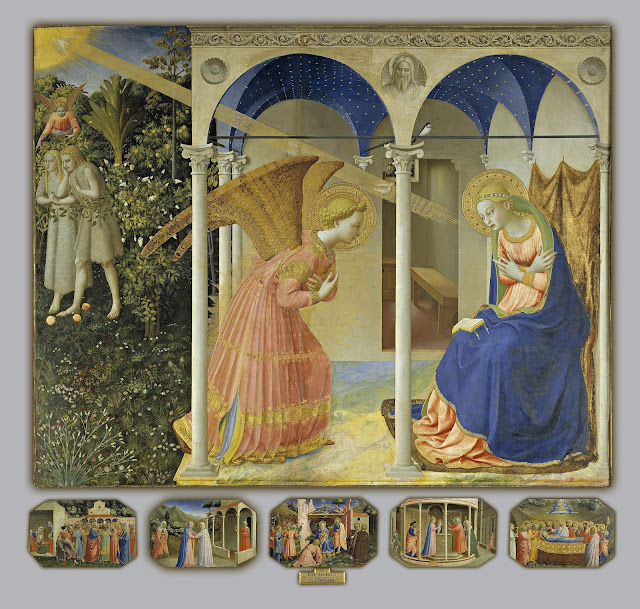
Annunciation


 Fra Angelico
Angelico, fra, approximately 1400-1455. Annunciation, from Art in the Christian Tradition, a project of the Vanderbilt Divinity Library, Nashville, TN. https://diglib.library.vanderbilt.edu/act-imagelink.pl?RC=47865 [retrieved December 8, 2021]. Original source: https://commons.wikimedia.org/wiki/File:Angelico,_prado.jpg. 

In terms of social unrest today or 2000 years ago what happens to a young Palestinian woman unmarried who turns up pregnant? How can she safely carry the child to term? And then what happens to them? 


In Bethlehem a few years ago I listened to a French speaking nun from Lydda tell a group of us North American pilgrims what happens there at the orphanage where she serves.  They take in orphans, and raise them through their first school years. 


An 18-year-old man came to their door one day with a gift. It was a thank you gift: his first paycheck. Years before he was born and cared for and raised to school-age there at la Crèche de Bethléem. Kids grow up there, up to first grade, then go to foster programs and schools until they are full grown. 


Where did these kids come from? Some are children found abandoned, or placed temporarily by social services due to serious social unrest or problems within their families. And others? Their mothers were young unmarried women from villages in Palestine who became pregnant. 


A scandal, possibly fatal, would erupt if their pregnancy was discovered or they had a child in their hometown. So on the quiet they are brought to Bethlehem where the child is born and the mother is cared for. Then the mother returns to her village. Crisis averted: the child lives, the mother lives, violence is not done to either one. 


How different it was for Mary who knew her husband but not yet intimately. Customarily he would have severed the relationship if she were pregnant by another man, wouldn’t he? But he protects her and raises the child with her and so the holy family begins its journey. 


Pregnancy is risky, always risky when the child is unwanted, and if the child is wanted by a jealous king its peril is increased. Mary took on the risk, as did Joseph, and what we see in Mary is more than courage: it is humility and obedience. She sees herself as of lowly estate, as a simple daughter of a village family. 


She is not the daughter of the king, not a daughter of Herod and certainly not the child of Caesar Augustus who was called “son of God, King of Kings.”  (Read or watch “I Claudius'' and you’ll see just how wildly different two young women can be.) 


Mary is a woman of honor and great strength. To say, “Let it be done to me according to thy word,” is to take on a great burden and a great responsibility. 


Mary Holmes, art history teacher at Cowell College, said that the virtue our society needs now is obedience – and I think she meant it in the Marian sense of docility: accepting the reign of God and the power of the spirit is not passivity. 


“Docility is to have reverence and acceptance of God’s plan for our lives in order to experience fulfillment, true happiness and closeness to God.”


(https://ct.dio.org/item/4903-docility-to-the-holy-spirit.html) 


Mary is already empowered by her creator’s love and her sacrificial response. She will now know no ordinary life nor will her son. All that is changed now and forever. She is a woman clothed with the sun: made shining and glorious by her simplicity and her humility, her obedience and her courageous response: “Here I am, Lord.” 

And so that was an ordinary extraordinary young woman, two thousand years ago. Obedience, docility, not passivity, but openness to the leading of God and the power of the Spirit at work. 


How are we nowadays to accept the gift and the call of God? What extraordinary ordinary thing awaits us this coming Christmas season? 


Mary responded to the news from God’s messenger with more than simple acquiescence. She went on to sing: My soul proclaims the greatness of God. 


And God comes to humankind to liberate them from what en-toils them. 


500 years ago it was the oppression that came with occupation and an imposed cultural hegemony. On top of the good news they carried as if it were pollen on their clothes, the people of Spain arrived in the new world with a desire for gold and conquest. 


This included spiritual conquest as if the local people had nothing to add or to offer but simple passive submission to the foreign message. But one day not long after the conquest came a second change, a revolution in spirituality. 


Juan Diego encountered a vision of the Mother of God atop a hill that had been sacred for centuries. On it he saw not a nature goddess but the Queen of Heaven. 


He told the bishop. The bishop did not believe him. In that cold gray time of year roses should not bloom, but bloom they did, that day. Open your tilma and gather them in, she instructed. 


He took the cloak to the bishop and opened it. Flowers fell on the ground. What remained was an image of a dark-skinned Mary, an indigenous Mary, resplendent, on its inner surface. 


That became the sign that showed the way. God was not to stop at human borders or inhabit human prejudices. The way was open and all were welcome.


The point was not, she is ours. She is one of us. The point was, we are hers. We are hers. And she and we belong to God. Wherever we travel, God is with us. Emmanuel.


How will we now, 2000 years after Mary, and 500 after the vision of Guadalupe, receive the Christ child and the message of angels? What are we doing, called to do? 


Venture forth into the night bearing a small burden to a foreign land? It’s being done, now, across our own desert. Are we to welcome the stranger into the inn, and make room where none was found? It’s being done, here in our own town. 


Are we to follow the words of an extraordinary messenger to an unknown land, as so many patriarchs and matriarchs did, in Old Testament days? 


And perhaps it is the simple things, the daily things, that we do, to follow God’s pathway in our hearts, as best we may. To show kindness to strangers, sympathy to the distressed, tolerance to the uneasy, support to the weary, joy to the glad, and all this, to the end that God’s purpose on earth be known.


Perhaps it is just to stand still, upon a hill, and hear and join the angelic choir as they sing, “Glory to God!”


But there is work to be done. Mary did not stop with “Here am I.” She went on, as she visited her relative Elizabeth, to sing with joy of justice and redemption, of faith and hope and the lasting challenge, the commission even, of every child of God.


He has redeemed us. He has come to his people. And he has given us a job to do.


To join in the redemption of the world by our actions of justice, mercy, and compassion. The small things, yes, the big things too: the work of the people is to join in the salvation of the world. 


No, we are not deities. We are not divine. Neither is she. But we follow the one who is.


“Now, master, let your servant go in peace according to your word, because my eyes have seen your salvation. You prepared this salvation in the presence of all peoples. It’s a light for revelation to the nations and a glory for your people Israel.”


Luke 2:29-32 (CEB)


JESUS MAFA. The Annunciation - Gabriel and Mary, from Art in the Christian Tradition, a project of the Vanderbilt Divinity Library, Nashville, TN. https://diglib.library.vanderbilt.edu/act-imagelink.pl?RC=48278 [retrieved December 8, 2021]. Original source: http://www.librairie-emmanuel.fr (contact page: https://www.librairie-emmanuel.fr/contact). 

Oh, by the way, that 18 year old was sent out with a fond farewell by his foster parents but he was back at the door in moments. “Mom, could you give me money for the bus?” He had given them his whole paycheck and it was all he had.


Sunday, November 14, 2021

buildings & grounds


Do you see these great buildings?

And now a word from our building committee…

Do you see these great buildings?


Well, guess what…


It’s a heck of a time to bring up such things. This is Stewardship Season, after all. So it’s a good thing it is also Gratitude Season. 


Traditionally this time of year is called, with some derision, the October Ask-a-thon. That is because once a year congregations plan their budgets and how to meet them. And so, modeling on the old sobriety pledge, many congregations ask for a simple commitment, based on faith, that will guide their financial movements during the next year. 


This causes some anxiety. After all, who knows what is going to happen? And who knows, really, if they will be able to meet any promise they make ahead of time?


Piled on top of that are the real worries that gather. Personal tragedies, uncertainties, infirmities. Social and public problems. Extreme weather events that make the inconvenient truth of climate change all too real. It is scary. 


And there is frustration. But we are not the first to face these fears. The people of God have experienced fear before.


Anticipations and predictions of the end of all things are not new. 

For the people huddled around the reassuring, well somewhat reassuring, figure of Jesus, there was personal impoverishment, the oppression of an occupation under the Roman Empire, and the frequent rumors of revolutionary change.


Since their time, there have been times of plague and times of war. Empires rose and fell. Strange new places have become home. And familiar places have been transformed.


Through all these times there has been a thread of hope. We sing the songs of ancient times, brought forward into the present, because they remind us of things that last, that remain true.


We pray. We sing. We celebrate the Eucharist, we baptize the new to faith and welcome the stranger. We tell the story of love.


We can see beyond our anxiety and predictions of destruction to something that lasts. And that is God’s faithfulness.


“My heart exults; my strength is exalted in my God;” even, “my mouth derides my enemies”, all these are words of praise and even joy from Hannah which we hear echoed from Mary in the Magnificat when she sings “my soul magnifies the Lord”. 


Hannah says “those were full now scrounge for bread” and Mary says “the rich he sends empty away”--  these are words of joyous praise for that they are certainly words of assurance of God’s faithfulness and vindication.


The letter to the Hebrews assures us that having been forgiven and accepted by God we can approach his throne -- and we can approach life -- with confidence: for he has perfected for all time those who are sanctified. He is faithful and our hope is sure.


And so we pass from gratitude to confidence in knowing that the promise of the one in whom we put our trust is sure: he is faithful and this gives us the attitude, the fortitude, the ---,  to face the new possibilities that come with troubled times. He is faithful: confidence, gratitude, Steadfast hope.


Martin Luther put his finger on something we do well to remember today. We do not give out of fear or obligation, we do not obey in order to be safe: we are saved. That single offering by Christ has once for all made our hopes sure and our faith complete.


We respond to God’s grace with gratitude and in gratitude we respond with our lives, our hearts, all we have to offer; and this is what it means to say all things come from God and of his own I have given him. For he is the source of all being and from him is the satisfaction of our hearts: all we do in gratitude is from the eternal words spoken for all. “You are my beloved child.”


When David dedicated the site of the temple he offered the first fruits of the harvest in thanksgiving. Even of the building materials he brought to the site he said “all this abundance we have provided for a house for your holy name comes from you and is all your own”. In that new confidence in the love of God the gifts, the faith in the Lord, and obedience of a faithful servant, are all offerings given freely and joyfully.


Over and over again we hear in the Hebrew Scriptures, including the Song of Hannah that was our response to the first reading today, of God’s steadfastness. We hear of the grace of God and love of God that last forever. And we hear also of how the people of God have responded with gratitude and love. 


And we hear of how God has vindicated the downfallen, protected the poor, and liberated the oppressed. And the people of God have been the hands of hope that have fashioned the future.


In other words (and council, cover your ears) what really lasts is not our structures, or even our achievements, but the love of God and our love for God and of each other and all of creation.


But don’t shred that pledge card yet!


It still has a purpose.


For the living church that is built is built out of our hearts, our hands, and our response of gratitude for all that God is accomplishing – including in us and through us … and despite us.


Christ’s work in us is not on some ethereal, ideal, unreal plane, but is accomplished here and now, where we can see it.


Indeed, we recall the apostle who said, “I speak to you of what I have seen and heard and held in my arms.”


“We declare to you what was from the beginning, what we have heard, what we have seen with our eyes, what we have looked at and touched with our hands, concerning the word of life—” (1 Jn 1.1)


God’s love is physical – manifest – at work in the world. That this world is made by God and saved by God and charged with the power of God is what Incarnation is all about.


For God so loved the world that he gave his only Son, so that everyone who believes in him may not perish but may have eternal life. (Jn 3.16)

Therefore we acknowledge that all is gift: every day is a gift, every breath, even all we accomplish, comes as a gift from God and so we pray, along with the ancient servant of God, “…all things come of thee, and of thine own have we given thee.” (1 Ch 29:14b)


That familiar prayer of offering comes from the first book of Chronicles, from the story of how David, at the end of his long and eventful life, came within an inch of his dream, to build a house for God, and indeed laid the foundation for what his son Solomon would accomplish. The building of the first Temple, the magnificent structure and opulent furnishings the Torah describes.


That Temple was destroyed, the people it sheltered scattered and dispersed among the nations surrounding them. Assyria, Babylon, Persia, and forgotten lands beyond, became the new homes of a generation of pilgrims, of refugees that would never see what they had left behind. 


Instead their children and grandchildren who returned found a lot of work to be done, to reclaim what they could of what had been lost, and to build a shallow replica of what had gone before.


Among them also were those who did the more glorious work of reclaiming the spiritual heritage, bringing back with them solid achievements of preserving past teachings and developing new understanding of the living truth of the love of God for humankind.


And the Temple that was eventually built was grand indeed, great indeed, and its builders were put to the work by a king himself called Great, Herod, whose monuments still rear above the inhabitants of Palestine and Israel. His tomb, his retreat at Masada, the Temple remnant we now call the Western Wall. 


When Jesus asked, “Do you see these great buildings?” it was those proud structures he was talking about. 


What was happening, on the surface, was an occupation, an oppression, a time of turmoil, disturbance, and woe. But what was really going on, deep in the hidden purposes of God, was the building of a new Temple, a new house of God, that is his people.


Those are the living stones: the people to whom Jesus preached and ministered and brought salvation. And it is the building up of that living Temple, not made by hands, to which we are called. 


Direct our hearts to you O God:


For you are the source of all being, eternal word and Holy Spirit. Amen.


November 14th 2021

BProper28(33) 


https://www.lectionarypage.net/YearB_RCL/Pentecost/BProp28_RCL.html


Daniel 12:1-3

1 Samuel 2:1-10

Hebrews 10:11-14 (15-18) 19-25

Mark 13:1-8


Sunday, October 31, 2021

Reformation Sunday 2021

Kondo the Church!


As it was said to me over dinner Thursday night, you know you have arrived when your name becomes a verb. 


Marie Kondo, who apparently lives in a small apartment in Tokyo, gives advice on how to get rid of stuff, and organize what you have left. Hence the verb “Kondo”. 


Sounds like a plan. In fact, 500 years ago the church held a gigantic rummage sale. It got rid of a lot of stuff, some of it good, some of it as awful as my neighbor’s amateur paintings and the busted furniture that sits in their carport awaiting the HabiStore truck.


It was Mark Sisk who said, ‘every 500 years or so the church holds a gigantic rummage sale’ and Phyllis Tickle who quoted him in her book, “The Great Emergence.” Phyllis was hopeful that there was more to it than just getting rid of stuff. In fact, the discovery of what really matters, what amongst the detritus of centuries are the “keepers”, is what it is about. Not what you lose, but what you gain.


I lost a few pounds a few years ago, and gained by it. I emerged healthier. It wasn’t what I lost, it was what was essential for continuing life. (And living more joyfully as a result.)


That is in part what the Reformation of 500 years ago was about. Loss and gain. 


Of course everybody lost something. In fact what was sought was security: in part freedom, freedom to worship without fear (as John the Baptist’s father put it), and in part simply freedom from fear. For the great fear of that time, apart from physical violence and depredation, was the loss of one’s eternal soul.


And so the question that came to the fore, that propelled some real abuses and powered some deep insights, was simply this: what must I do to be saved?


In some ways it is the same question we ask now, using different words: instead of salvation we choose security, instead of providence we choose prosperity, instead of grace we choose … greed - or do we?


It doesn’t have to be that way - because we have faith in a faithful God - and that faith can lead to action. However blessed we are, we know our faith is founded on something more solid than solid ground.


As Martin Luther said, 

 “Faith is God’s work in us. It changes us and makes us to be born anew of God. This faith is a living, busy, active, mighty thing. It is impossible for it not to be doing good works incessantly. Faith is a living, daring confidence in God’s grace, so sure and certain that believers would stake their lives on it a thousand times.” 


            https://elca.org/Faith/ELCA-Teaching/Luther-and-Lutheranism


What must I do to be saved? Somewhere in a stack of unsorted papers near my desk is a pamphlet that J. Lee Jagers gave me when I was sixteen years old. It was entitled simply that: “What must I do to be saved?” It listed all the different Scripture passages that answered that question. Remember somebody asked Paul and Silas that, and they gave an answer, somewhat along the lines of “Believe on the Lord Jesus Christ and you shall be saved.” (Acts 16:31) 


Sometimes it was “Believe on the Lord Jesus Christ” - and be baptized. Often it was like that, “Believe and…”


“Believe and…” do something. Show something. Show somehow that you got the message, that you received the Spirit, that you are saved. Tell somebody, shout, seek baptism, something. Act it out and make it real.


Is that enough? Let’s come back to that.


At the time, all those years ago, I was relieved to hear that what I had already done was enough. I did not also need to fulfill this guy’s requirements, this guy at the same Boy Scout camp, who handed me a pamphlet printed all in red and said, you need to be baptized in the Holy Spirit. You need to speak in tongues. Why would you deny this gift?


Now I will tell you I was fortified, I was somewhat prepared, as the same Lee Jagers who sent me the pamphlet had already taught me and others the Biblical passages about spiritual gifts. I could see for myself that speaking in tongues (unknown, ecstatic or interpreted) was just one of the gifts. It was not required for salvation. In fact it came after salvation. 


Just as I later learned that we do not do anything to inherit eternal life. It does not work that way. It is already too late. You cannot do anything about it. God is already at work before you are born, before you even think about it. He is there. Searching for you, seeking you out, searching you out, knowing you. And that is as old as time. Actually much older. Why would God wait around? 


The one who creates us is the one who redeems us is the one who empowers us.


There is truth to the saying “Believe and…” in that once and as grace dawns upon us we begin to respond to its light. We begin to respond. To God’s light. 


It is already day. We just need to open our eyes and live into it.


This is hard to see in the depth of night. And the darkest hour is well before dawn, when temperatures are low, body metabolism is at its quietest, and the chances men and women knew long ago of death are there a breath away. 


And the chances we know, of death, from illness or catastrophe, or malevolence, are a breath away from us too. Not that we think about it much on a cheery fall morning. 


Unless it is all we, one of us or some of us, think about. Some among us of course have it on their minds all the time. Perhaps someone near to them is in distress or dying. Perhaps they are behind the eight-ball on a mortgage or rent and may lose their home. Perhaps a child is in jeopardy through illness, mistreatment, or disease. 


But even though, even then, when the darkness of evil or the sadness of sickness or the shame of defeat, are upon us and surround us, we are beheld in a greater love.


That is what we believe in, that is what we love, when we love Jesus, when we love God. And that is the love that saves us, heals us, makes us whole, despite and in the midst of our brokenness. 


And that is what will lead us home.


JRL+ 5:42 AM Thu Oct 28 2021


October 31 Reformation Sunday  (Jeremiah 31:31-34; Psalm 46; Romans 3:19-28; John 8:31-36). Lutheran Church of the Foothills, Tucson.

Sunday, October 24, 2021

Bartimaeus

 The first passage we translated from Greek in seminary was this one. And the imperative, urgent nature of the request of the blind beggar, Bartimaeus, was apparent, once you saw it in the Greek.


“Lord, that I might see again!” is an accurate translation. He wasn’t deferential, he was in a hurry.


And he discarded everything to follow Jesus. Without being asked.


Jesus is turning toward Jerusalem. His disciples have trudged in his path all the way from north of the Sea of Galilee. Down the Jordan River they have trod, until they have arrived at the foot of the long climb, from the ancient well-town of Jericho on up to Jerusalem. 


And here at this turning point, sitting by the side of the road, is a would-be sighted man. All around him people pegged him as a beggar, blind, consigned to the rubbish heap of life. 


But he did not accept that. That was not his fate. That is not what God called him to be. That is not what God made him. God made him his own child, beloved, and a miracle.


A miracle, we know, of restored sight, but also a miracle of forgiveness, grace, and healing.


He did not hesitate. He did not quit. He did what he was not supposed to do. He cried out. And revealed the truth about the one passing by, whom he, son of Timaeus, was first to address as son of David.


What does the son of Timaeus have to do with the son of David? What do they share?


Life - the gift of life - and the redemption of body and soul in the light of the kingdom’s dawning.


For the dawn is upon them, just beyond night; just beyond the darkness of Calvary, Easter comes.


And they are ready, first for the one, and then for the other. The unimaginable other.

Perhaps it is easier to see if you have once been blind. But now, you see.


***


It's a simple story, there's a lot left out. We don't know why he was blind. There have been speculations that his father was blind so that he'd always been a beggar.


But what he asked Jesus, is simple and direct. Rabbi - master, teacher, Lord - that I might see, again, that my sight might be restored. Probably, then, not born blind. Now, in this story there's no speculation, either that he deserved it, that God was punishing him, that he was a bad person, or that he got what he deserved. There is none of that. 


In fact, the other morning, I heard the second chapter of the Book of Tobit, where a good man, doing a good thing, is made blind. And God is the one who heals him: who releases him from the captivity of his blindness. Who saves him.


Save: that's the word that is used in Greek, for how Jesus explains what happens to the man he heals is, literally, saved: Your faith has saved you. It’s a word Mark uses a lot. It means salvation, health, liberation. Your faith has healed you, released you, saved you, from the bondage, not of sin, but of this blindness, this affliction. 


And so this story is part of the story of God's glory revealed, not because someone is bad or wrong, or being punished. None of those assumptions are made here. 


In other stories, Jesus asked the crowd, Why do you think this man has this condition? Why do you think he's lying there? They're trying to guess, they're trying to say it's because he did something bad. And God is punishing him. 


And no, Jesus says, no. 


This is an occasion when God is going to show His glory. That leaves a lot of questions unanswered, but it does tell you what is going on here is not punitive. It's not the end of a penal sentence. 


This is compassion. This is faith. Jesus is there to proclaim what God is doing. What is God doing through faith for Bartimaeus. 


Bartimaeus, the blind man, gets it. He knows what is really going on. He may not be able to see, but he knows who Jesus is. Son of David, Have mercy on me, Son of David, that is, Messiah - and savior, redeemer, liberator.


He knows who he's talking to, he knows what he's asking, and he will not be stopped. At first people are telling him to just keep quiet, but he will not. Once Jesus calls him, once he is recognized, then they say, Take heart, take heart. He is calling you. 


And so then Bartimaeus casts aside his cloak, just throws it to the winds. Maybe, maybe it's true, maybe somebody picked it up for him and brought it along because the journey from Jericho to Jerusalem is long, and the night is cold, and it may not be a friendly place, when he arrives, maybe somebody did that for him, we don't know; we don't know a lot of things. 


We do know that he called out to Jesus, that he called out to have his sight restored and we know that Jesus called out to him. And then he followed Jesus. All the way. 


The words for crying out - as Bartimaeus cried out to Jesus - and to have one’s sight restored, then I might see again - in ancient Greek those two words, anaboaó, anablepsō, are right next to each other in the dictionary. And those two words are right next to each other in this story. He cried out, and his sight was restored. And then he followed.


ἀναβοάω (anaboaó)

ἀναβλέψω (anablepsō)


Something else to note about Bartimaeus. He didn’t have any social status. Because he was blind, because he was a beggar, he was on the outside of society. Now, having his sight restored, as it would be for any one healed by Jesus, could restore him to his place in society. But that is not what he wanted, as it turns out. He wanted more and better: he wanted to follow Jesus. And that is what he did.


You know sometimes I wonder if someone has come to church out of social aspirations. Sometimes I wonder if I had. Rather than to follow Jesus or to hear the good news or to learn how to act upon it. Sometimes I wonder. And I know that sometimes it is the only place I can be.


You have the words of life, Lord; where else can we go?


Bartimaeus seems to feel that way. Where else is there to go, when you can follow Jesus?


***


https://youtu.be/IN05jVNBs64

President Obama sings Amazing Grace (C-SPAN)


October 24th 2021

Twenty-Second Sunday after Pentecost

Proper 25 Year B

Lectionary 30


Jeremiah 31:7-9

Psalm 126

Hebrews 7:23-28

Mark 10:46-52


http://edgeofenclosure.org/proper25b.html

https://enterthebible.org/passage/mark-1046-52-blind-bartimaeus-is-given-sight

https://diglib.library.vanderbilt.edu/act-imagelink.pl?RC=54181


JRL+