Showing posts with label Jesus Calls the First Disciples. Show all posts

Sunday, January 14, 2024

calling


Samuel

Here I am.


Samuel.


Imagine.


A boy. Alone. 


In a cold room.


Not alone. Not dark. Not really.


There is a dim lamp, still just burning. It hasn’t gone out yet.


So you can see, a glimpse, of what else is in the room. What else is in that room, but not in any other.


The Ark of the Covenant. 


Alone. But not alone. 


There is a voice.


It is not the voice of the old man. After all.


He heard the voice three times. Three times the old man said, I did not call you, go back to sleep. He tried. But the voice persisted. 


Samuel.


And the old man finally understood.


This old strange room where nothing unexpected happened, not for a long time. Where the routine had gone on for a long time, as if it would matter. Routine duties performed routinely.


The boy had learned the routine. He had routine duties, chores. Later that day, when it was day, he would open the door. Perhaps he swept the place out. Found oil for the lamp. Cleaned up after the sacrifices. But nothing happened. Nothing unexpected. Nothing unwanted. It was not as if the LORD were really there. Was it?


Samuel.


And the old man understood.


It was the LORD. The LORD was calling the boy.


It was not calling the old man, the high priest, or his wayward sons, his heirs to the post. No, his family was done.


This was something new, and very old.


Take off your shoes for this is holy ground. 


Here in this dark room in the middle of the night, where you might most expect it, and expected it the least.


It had been a long time since anyone had heard from God, and God had heard from anyone.


But now, 


Samuel.


And so the old man said, say something back. Say, here I am, LORD, your servant is listening. And the boy did.


And so it began. The LORD had something to tell him that day. A message for him to pass on. Something not so pleasant, but something true. And the boy said it. 


And it came to pass. And the boy grew up, and continued to say, and do, the things the LORD commanded, pleasant or no.


Among other things he anointed a king.  He found a young man, the youngest of eight brothers, and brought him out from among the flock he had been tending, and – from now on you will be shepherding people.


Centuries later it was just a story. A good story, but nevertheless. Shepherding people. Where was that shepherd king now? Now that we needed him. But what we had was an occupier. A terrifying overwhelming military force. There was no king, but Caesar. 


Was there? 


“We have found him.”


We have found the anointed one, the one to take the place of that ancient story. We have, and you should come see.


There were people by the side of a lake, mending nets. And to them came the man. From now on you will be fishing for people.


That ancient story was not so ancient anymore. The boy who had been tending sheep was pulled away to be king. The people who had been mending nets were pulled away to serve a king.


Not a king like any other, of course. Not one you could quickly see, as king. He was an ordinary man, maybe good looking (as that young shepherd had been), probably sweaty from hard days working as a carpenter’s son. Calloused hands. Dirty feet. 


Compelling voice. 


Not “Samuel” this time. But names came nevertheless. 


“Philip.” “Nathanael.” And “James” and “John” and “Andrew” and “Peter” and all the rest that followed.


Follow me, he said. Follow me, and the world will change. 


Follow me, and your life will change. 


And from that, all else will follow.


***

Come and see.


And from that all else would follow.


Those simple fishermen, as the song says, were the first. 


The first of many, from that small group of people, men and women and children in small villages by a small sea, and in the hills around, the message would spread. 


And become dangerous. And change things.


We should not be afraid, should we, if one small boy who slept in the dark cold strange sanctuary of the forgotten God, was not afraid, not afraid enough not to answer. 


We should not be afraid, should we, if a couple of guys hanging out by the beach a man approaches and says, I know what you were doing, I saw you, and now I call you.


We should not be afraid, should we, if the sanctuary lamp is nearly out, but not yet, if the occupation troops are nearby, if the Messiah has been expected for two thousand years, to come back, to us, in the silence of the midnight temple, in the glare of the lakeside beaches, in the simple moments of ordinary lives, made extraordinary, by that calm voice calling once more, should we?


Should we then be afraid if like old Eli we do not hear the voice, if like others we do not see the man, or hear his call, or have him come to us along the lakeshore as of old? 


We should not be afraid, should we, if we simply have the message, the news, the need, to be the ones to follow? 


Our task, our calling, our charge, is not so simple, or so scary, as the calling of Samuel in the Temple, David in the fields, or the disciples at the lakeshore. Perhaps. We are not often called to leave everything, at once or over time, that we have known, to strike out in a new direction, with new responsibilities and burdens. 


Sometimes a new calling would be a relief. Leave those nets un-mended, leave those sheep untended. Let that lamp go out. Drop everything and just – go. Light out for the territories. Pump the gas, fill the tires, wipe the windshield, and throw away the map. 


But it does not always work that way, does it? Perhaps not even for those disciples, those followers, that prophet, that king.


Samuel still had to sweep the temple, open the door, tend the lamp. But now he also had to tell the truth, the uncommon truth, uncomfortable truth, that he had to tell.


David could leave the sheep on the hill, but now he had to put up with Saul, with the onerous scut work duties of an apprentice king who could not call himself king or reveal himself king – if he knew himself that was his calling.


Philip, Nathanael, Andrew, Peter, James, John – they had a task to learn, a duty to fulfill, one no one had done before. Nobody had been in this situation before. The Messiah had not come before. (Keep it quiet!) 


Nobody has been in our situation before either. 


The lamp kept trimmed and burning, or sputtering out. The people demanding a king who get a shepherd boy.

The fishermen who expect nothing good out of Nazareth.


Would not we like they like things to be the way they were before? Before the pandemic, before the lost job, before the fall, before the call? But we too are called, perhaps not so simply or dramatically, perhaps not all at once, perhaps not so painfully, but we are called, too, to follow, as the first disciples were, to tell the truth, as the prophet was, to look after people, as the shepherd was. 


All of those, all of their duties and callings, are in us too, as the people of God. Together we have all those duties, those callings, and more: we have the tasks before us for our day.


How will we tend his sheep, fish for people, tell the truth? 


That is our challenge, to find out, and follow, today.


JRL+

Sunday, January 22, 2023

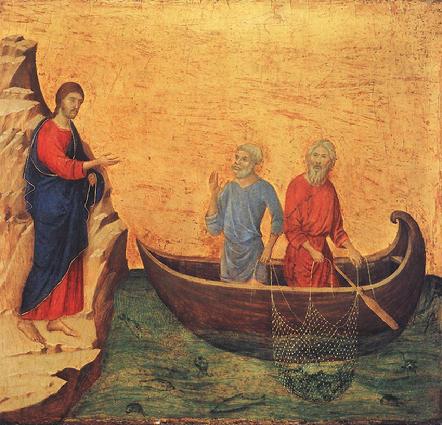
Are you in the boat or out of the boat?

The Calling of Peter and Andrew, Duccio, 1308-1311

http://edgeofenclosure.org/epiphany3a.html  https://www.nga.gov/collection/art-object-page.282.html

GOD’S IMPERIAL RULE : Right now or not yet?


I’ve been watching a lot of TV shows lately - old shows on DVDs - about hegemony, about rule, about domination, about empire. These shows are about events within the living memory of some of us - as Jesus’ life was to Matthew as he was writing his gospel. Two of them are: “Yellowstone” and “The Queen.” I’d say “the kingdom of heaven is like –” not this! 


And I’ve watched two BBC series, about resistance to an oppressive overlord or invader, “Resistance” and “World on Fire,” set during the German invasions of Poland and France. 


A friend of mine grew up within walking distance of Runnymede - the riverside meadow where King John agreed to the Magna Carta, only, oh, about eight centuries ago. That time is about as far distant from our present as the time of Isaiah was from the time of Jesus. Imagine if that kind of event seemed once again current news. Or imagine a land war in Europe - a World War Two type invasion by an oppressive hostile power, of a sovereign nation that it had invaded before. 


The message of the gospel of Matthew (4:12-23) takes the prophetic message of Isaiah (9:1-4), and makes it personal, makes it immediate, makes past history - and future history? - present.


Isaiah was talking about great events of his time, back in 732 BCE, when Assyria, based in Damascus, was the overbearing regional power, that indeed drove an army right across Israel, through the Northern Territories known to Jesus and his hearers, seven and a half centuries later, as Galilee - or home: that is, right where they were standing. 


And here they were again, the people of God, invaded and lorded over by a hostile power.


Right where they were standing, right where the events of  Isaiah’s prophecy took place. Matthew tells us that “When Jesus heard that John had been arrested, he withdrew to Galilee.” But Jesus’ move to Capernaum after John’s arrest was no retreat to safety, as it put him right where Herod Antipas ruled, the king whom John the Baptist had denounced, the king who had John arrested. 


This would be like moving to an embattled region of Ukraine, as the Northern Territories of Naphthali and Zebulon, and Galilee, were occupied like Crimea and the Donbas provinces.


At the very beginning of his ministry, Jesus, in Capernaum, a small fishing village on the Sea of Galilee, says to his disciples, get ready, for the real ruler is coming. The one that makes all others subjects. In fact, it is already upon us: it’s here, right here, if you know how to look, how to act. 


Later in the gospel of Matthew, Jesus’ disciples asked him, “teach us to pray”. And what he said can be translated this way: “Enact your will on earth as you have in heaven” (Matthew 6:10, SV) 


You can see why they might be ready for that.


When we pray, we are not without hope. And here’s why:


God’s victory is already won. The main battle is over. What we are called to do are the ‘mopping-up operations’ as military veteran C. S. Lewis called them. 


Bishop Weisenburger, in his remarks on Wednesday at the opening service of the week of prayer for Christian unity, quoted Christopher Hall, who compared our situation to that of the allies of World War Two after the storming of the beaches of Normandy. After June 6, 1944, the end of the war was assured. But work remained. It was not time to quit. There was much to do. 


And our time, in the great struggle, the ongoing struggle, to bring to earth the kingdom that is in heaven, there is much to do. And we are called to take our place in that great work.


So we are called, but we are not alone. God is with us. In the struggle of life we can be sure that the light has come into the world, that God illuminates me and you, and that in that light we see life, and love, and hope. And we see a call, to follow him who is the light of all life.


Arise, shine, for your light has come, *

    and the glory of the Lord has dawned upon you.

For behold, darkness covers the land; *

    deep gloom enshrouds the peoples.

But over you the Lord will rise, *

    and his glory will appear upon you.

(Isaiah 60:1-3)


How does he call us? How does he come to us? 


“He comes to us as one unknown, without a name, as of old by the lakeside He came to those men who knew Him not. He speaks to us the same word, ‘Follow thou me,’ and sets us to the tasks which He has to fulfill for our time. He commands, and to those who obey Him, whether they be wise or simple, He will reveal Himself in the toils, the conflicts, the sufferings which they shall pass through in His fellowship; and, as an ineffable mystery, they shall learn in their own experience Who He is.” (Albert Schweitzer, The Quest of the Historical Jesus, 1906)


The call to discipleship goes out to two sets of brothers, to the rich young man (19:16-22), to a toll collector (9:9-13), to the women who followed him (27:55), to Joseph of Arimathea (27:59). 


And it goes out to us: We are charged to go forth together in the one Spirit, with a common purpose: to bear the word and be the good news of Jesus Christ, in this time, in this place, to the people whom God has gathered here around us.


How shall we respond to God’s call? What will it look like in our time? What are the challenges facing us? How will the kingdom of heaven, of God, show in our lives, words, and deeds? How will we proclaim it, in our conduct to each other - Paul’s primary concern in today’s epistle - and how we are active in the society, and the created world, around us? We know that we are called, not to follow the literal footsteps of Jesus along the shore of Galilee, but to follow as the first disciples followed, with trust, with knowledge and the joy of discovery, that Jesus’ disciples are following the one true way, the one true ruler, and the one kingdom that is the one that lasts.


Glory to God whose power, working in us, can do infinitely more than we can ask or imagine: Glory to him from generation to generation in the Church, and in Christ Jesus for ever and ever.  Amen.  (Ephesians 3:20, 21. BCP)


https://sermonoats.blogspot.com/2014/02/heart.html


1 They cast their nets in Galilee
Just off the hills of brown;
Such happy, simple fisher-folk,
Before the Lord came down.

2 Contented, peaceful fishermen,
Before they ever knew
The peace of God that filled their hearts
Brimful, and broke them too.

3 Young John who trimmed the flapping sail,
Homeless, in Patmos died.
Peter, who hauled the teeming net,
Head down was crucified.

4 The peace of God, it is no peace,
But strife closed in the sod.
Yet, brothers, pray for but one thing--
The marvelous peace of God.

The Hymnal 1982‎#661 


“He comes to us as one unknown, without a name, as of old by the lakeside He came to those men who knew Him not. He speaks to us the same word, ‘Follow thou me,’ and sets us to the tasks which He has to fulfill for our time. He commands, and to those who obey Him, whether they be wise or simple, He will reveal Himself in the toils, the conflicts, the sufferings which they shall pass through in His fellowship; and, as an ineffable mystery, they shall learn in their own experience Who He is.” (Albert Schweitzer, The Quest of the Historical Jesus, 1906)

“My Lord God, I have no idea where I am going. I do not see the road ahead of me. I cannot know for certain where it will end. Nor do I really know myself, and the fact that I think that I am following your will does not mean that I am actually doing so. But I believe that the desire to please you does in fact please you. And I hope I have that desire in all that I am doing. I hope that I will never do anything apart from that desire. And I know that if I do this you will lead me by the right road though I may know nothing about it. Therefore will I trust you always though I may seem to be lost and in the shadow of death. I will not fear, for you are ever with me, and you will never leave me to face my perils alone.”― Thomas Merton, Thoughts in Solitude.

JRL+

Sunday, January 22, 2012


It's a walk of nine hours and a quarter from Nazareth to Capernaum: do you think Jesus walked it before that day he called the fishermen? 

Mark 1:16-20

As Jesus passed along the Sea of Galilee, he saw Simon and his brother Andrew casting a net into the lake—for they were fishermen. And Jesus said to them, ‘Follow me and I will make you fish for people.’ And immediately they left their nets and followed him. As he went a little farther, he saw James son of Zebedee and his brother John, who were in their boat mending the nets. Immediately he called them; and they left their father Zebedee in the boat with the hired men, and followed him.

He comes to us as One unknown, without a name, as of old, by the lake-side; He came to those men who knew Him not. He speaks to us the same word: ‘Follow thou me!’ and sets us to the tasks which He has to fulfill for our time. He commands. And to those who obey Him, whether they be wise or simple, He will reveal Himself in the toils, the conflicts, the sufferings which they shall pass through in His fellowship, and, as an ineffable mystery, they shall learn in their own experience Who He is.

Albert Schweitzer, The Quest of the Historical Jesus (New York: MacMillan, 1956), p. 403.

Luke 5:1-11

Once while Jesus was standing beside the lake of Gennesaret, and the crowd was pressing in on him to hear the word of God, he saw two boats there at the shore of the lake; the fishermen had gone out of them and were washing their nets. He got into one of the boats, the one belonging to Simon, and asked him to put out a little way from the shore. Then he sat down and taught the crowds from the boat. When he had finished speaking, he said to Simon, ‘Put out into the deep water and let down your nets for a catch.’ Simon answered, ‘Master, we have worked all night long but have caught nothing. Yet if you say so, I will let down the nets.’ When they had done this, they caught so many fish that their nets were beginning to break. So they signalled to their partners in the other boat to come and help them. And they came and filled both boats, so that they began to sink. But when Simon Peter saw it, he fell down at Jesus’ knees, saying, ‘Go away from me, Lord, for I am a sinful man!’For he and all who were with him were amazed at the catch of fish that they had taken; and so also were James and John, sons of Zebedee, who were partners with Simon. Then Jesus said to Simon, ‘Do not be afraid; from now on you will be catching people.’ When they had brought their boats to shore, they left everything and followed him.