Showing posts with label Isaiah 25:6. Show all posts

Sunday, February 19, 2023

Church is church.


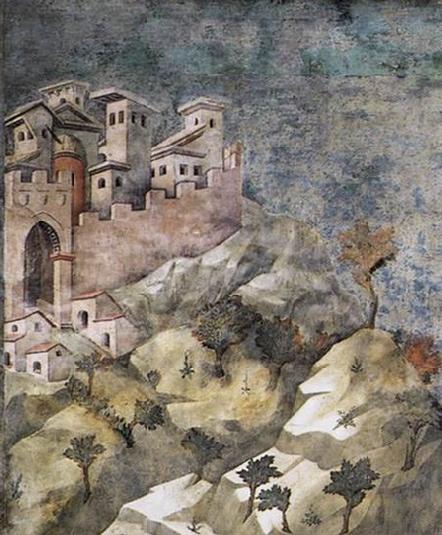
"A City Built Upon a Hill Cannot Be Hid" Giotto, Legend of St. Francis, 1297-99, detail,

(http://edgeofenclosure.org/epiphany5a.html)


“For we must consider that we shall be as a city upon a hill. The eyes of all people are upon us. So that if we shall deal falsely with our God in this work we have undertaken, and so cause Him to withdraw His present help from us, we shall be made a story and a by-word through the world.” –John Winthrop, 1630. https://www.americanyawp.com/reader/colliding-cultures/john-winthrop-dreams-of-a-city-on-a-hill-1630/


At Tucson’s Rogue Theatre not long ago I saw a play about a small group of people in an isolated community who shared a common, if strictly limited faith, and therefore a common, if strictly limited, attitude toward life.

Into their community comes a free spirit, a refugee from another country, someone who brings a different sense of the joy of life and of the possibilities of life to them despite her own long-standing grief. 


P.S. Babette can cook.


The name of the story is “Babette’s Feast” and as a result of the sumptuous Feast that Babette prepares for the people of the small community, they begin to embrace Joy and Grace a little more warmly than they have before. 


As they gather and share the meal they talk and reconcile; old grudges drop away as love emerges. 


They begin to embrace joy, and grace, a little more warmly than they have before – in fact, a lot more warmly, so that it is as if for an hour, they’ve had a glimpse of heaven. 


The prophet Isaiah (25:6) gives us a vision of a heavenly banquet:


   a feast of rich food, a feast of well-matured wines,

   of rich food filled with marrow, of well-matured wines strained clear.


In the midst of this story’s unfolding, I recalled the reflection “church is church” – as the members of the close little community bicker with each other, and at the end, when they embraced each other, and reached a moment of grace, I said to myself again, “church is church.”


That is, both the good and the bad, the happiness and the bickering, and the possibility of the release of mercy based on God‘s own infinite mercy— are church.


Actually, that’s the point made by one of the characters: we are surrounded by God’s infinite mercy. Let’s open our hearts to it. 


The feast helped.


The phrase “church is church” I heard in a group of ministers in about 2010 where a black church musician and pastor was listening to people from very different faith backgrounds from his own talk about what was going on in their congregations and how they were feeling about it and in a moment of recognition he said “church is church.” 


We all have these experiences, as pastors, as church members, as people of God. Even in other contexts– at work, at home, with friends, there is the blessing of community in experiencing both conflict and grace together. As the Psalmist (85:10,12) says,


Mercy and truth are met together :

 righteousness and peace have kissed each other;

The Lord will also give us all that is good :

 and our land shall yield its plenty. 


We have a lot of the same ways of being with each other, the ways we behave, in the way we treat each other and feel about each other, in the congregation, regardless of denomination. In fact, I remember “church is church” when I have spoken with Sufi leaders and Sikh leaders, as well as Christians of my own and other denominations.


Church is church, and we embrace the grace as well as the grit of life together. 


The Rev. Dr. John Leech is a priest associate at the Episcopal Church of Saint Matthew in Tucson.


Published under the title, "The blessing of community", in the Arizona Daily Star, Sunday February 19th 2023, E3. 

https://tucson.com/lifestyles/faith-and-values/the-blessing-of-community/article_882e2f64-a31e-11ed-a8e8-630de1ae0383.html



Sunday, November 20, 2022

to him all of them are alive

Jesus said to them, ‘Those who are considered worthy of a place in … the resurrection from the dead … cannot die any more, because they are like angels and are children of God, being children of the resurrection. And the fact that the dead are raised Moses himself showed, in the story about the bush, where he speaks of the Lord as the God of Abraham, the God of Isaac, and the God of Jacob. Now he is God not of the dead, but of the living; for to him all of them are alive.’ (Luke 20:34-38)


For me the key words in this Gospel passage are “children of the resurrection” and, even more so, “to him all of them are alive.” 


As we approach the Lord’s Table we go to meet the Lord — who is alive and those too who are alive in Him, alive in the Resurrection. And even, I’ve been thinking, we go to meet those who are yet to come.  


Hope for the future, as well as peace about the past, and faith — both comfort and challenge — for the present, are all proclaimed to us in this gospel.


For in Christ we are in communion with all the saints, all who live and die and are raised with him. 


So as we go up to the altar to take communion we go up not for ourselves only but for all who share in the joy of the saints.


This is a sacrament that we take never so for much for ourselves as when we take it as members of the body of Christ: one bread, one body.


From Isaiah (25:6) we receive this vision of a feast at the end of time:


‘On this mountain the Lord of hosts will make for all peoples

   a feast of rich food, a feast of well-matured wines,

   of rich food filled with marrow,

   of well-matured wines strained clear.’


The heavenly feast! If we take resurrection seriously, a couple of things happen. 


For if we take resurrection seriously, we take each other seriously. How shall I regard you if I know you are an eternal being, that you will live forever, that in Christ you have a home in his heart? And how then shall I look at myself - at my own actions, at my self-regard or self- envy, my self-criticism or my downward looks, if Christ is real? 


“Eternal life starts here” could be written over the gates of your life - today, any day, as you enter the church, as you approach the communion rail, as you start again, today, to live life as you want it to be lived. 


Even the sorrow of life cut short — or spent badly — is redeemed in the resurrection. And its hope is in us, and we in it. So we can resist despair and live on, live now, in the fullness of that hope, the assurance of redemption.


Father Fuller (from St. Frances Cabrini) said: “Our faith in our future resurrection must affect our lives now.” Knowing who we are and believing in the future changes how we treat each other, how we treat ourselves, how we approach life. 


We are called to live in the fullness of confidence that death is not the end — the end is in Christ — the finality of the goal of all life… as all things are gathered to him.


To live now with the resurrection life before us means living now not only for ourselves but for others: in our sacramental life, in our workaday life, in our home life, in our social and political life…


How we treat one another,  how we treat ourselves, how we live— is in the light of the life of Christ, that frees us, empowers us, and leads us — into strange, new places.


Now, we may not all agree on particular actions — I’m thinking of the social-political realm — but we know of one another who sends us, why and what is behind our actions, the source of our motivations.


The Baptismal Covenant calls on us “to seek to serve Christ in all persons” — and uphold their dignity as children of God, affects how we conduct our public lives — not just how we vote, but in how we speak to others with whom we disagree. Our attitude of certitude or frustration or despair or even anger over public policy must be leavened with hope — with knowing that we are children of God.


How are we then to live? as God’s children, as transcendent beings of infinite value, — as creatures of dust and glory whose mortal acts of the moment are significant in light of our immortality, of the hope of the resurrection, that is, of our presence now in Christ. 


And this presence of Christ in us, which we enact and celebrate as we go up to communion, motivates us, not only to kneel or stand before him Sunday morning, but to stand with him in all the moments of our lives.


In Christ we are all one people. Using political divisions or election anxiety to separate us does not, ultimately, work. For we know that our redeemer lives, and on the last day he will triumph — and we with him. 


We begin to realize, as Christ draws all people to himself, that we are already one in the Spirit, and those boundaries we may seek to draw will all evaporate, dissolve, and blow away in the wind of the Spirit. That Holy Breath that in the Beginning moved across the face of the waters has not been still since creation’s dawn — it is still moving. And as it moves, what the world puts up against it will not stand.


The Rev. Dr. John Leech serves as priest associate at the Episcopal Church of Saint Matthew, Tucson.


The Arizona Daily Star published a version of this essay in the Keeping the Faith feature of the Home + Life section on Sunday, November 20th 2022, page E3, under the title “Stand with him in all moments.”

Wednesday, October 19, 2016

Climate Change Forum 2016: Daily Bread

A Religious Response to Climate Change – III: Our Daily Bread
Saturday, October 29, 2016. St. Michael and All Angels Church. Tucson.

As a religious people, who pray for our daily bread, we seek understanding, wisdom and courage to take informed actions as good stewards of God’s creation.


Theological reflections: spiritual context for environmental actions

Sherman Johnson, our New Testament professor, taught a prayer he was sure that Jesus prayed:
Baruch atah Adonai, Eloheinu melech haolam, hamotzi lechem min ha-aretz.


We praise You, Eternal God, Sovereign of the universe, who causes bread to come forth from the earth.


That is the prayer over the bread, at a passover supper. “He took the bread, blessed it, broke it, and gave it to his friends…” So it is part of our tradition, too. When Jesus blessed God in this prayer he was giving thanks to the Creator, the One from whom all our blessings come forth.


Jesus, we are told, taught his disciples another prayer, which included the petition, “Give us this day our daily bread.” We do not live on bread alone, but we sure need it. Like words from the mouth of God, it is necessary for our lives. We are dependent on God, for everything from the words of Scripture to the morsels and crusts we may gather on our worst, most desperate, days.


Jesus was however the proclaimer of a kingdom not of scarce resources but of abundance. And out of that abundance we are grateful and receive our sustenance. Not for ourselves only, but for the whole of the human race, and the whole of creation. All beings require sustenance from God. God is the only source of life.


And this is our only planet. (At least until 2030 if NASA’s new dreams come true.) So we better take care of it. Treat it as a gift - a gift to steward and cherish and care for. For now we are the generations with this responsibility. And we are the ones who will pass on the joy of that care.


Here are some Scripture passages to reflect on together during our lunch break, and to discuss at our tables.


Genesis 1: 9-13  And God said, ‘Let the waters under the sky be gathered together into one place, and let the dry land appear.’ And it was so. God called the dry land Earth, and the waters that were gathered together he called Seas. And God saw that it was good. Then God said, ‘Let the earth put forth vegetation: plants yielding seed, and fruit trees of every kind on earth that bear fruit with the seed in it.’ And it was so. The earth brought forth vegetation: plants yielding seed of every kind, and trees of every kind bearing fruit with the seed in it. And God saw that it was good. And there was evening and there was morning, the third day.


What does it mean to be born amid such splendor? What does it mean to us to be part of this creation? What does it mean, that God called it good?


Genesis 1: 28-30 God blessed them and said to them, “Be fertile and multiply; fill the earth and master it. Take charge of the fish of the sea, the birds in the sky, and everything crawling on the ground.” Then God said, “I now give to you all the plants on the earth that yield seeds and all the trees whose fruit produces its seeds within it. These will be your food. To all wildlife, to all the birds in the sky, and to everything crawling on the ground—to everything that breathes—I give all the green grasses for food.” And that’s what happened.


What does it mean to be stewards of the earth? What does it mean to be told to “take charge” of other creatures of God? What does it mean to receive as gifts the fruit of the earth to eat?


Isaiah 25.6: On this mountain the Lord of hosts will make for all peoples
  a feast of rich food, a feast of well-matured wines,
  of rich food filled with marrow, of well-matured wines strained clear.


Mark 14: 22 While they were eating, Jesus took bread, blessed it, broke it, and gave it to them, and said, “Take; this is my body.”


1 Corinthians 11: 24 After giving thanks, he broke it and said, “This is my body, which is for you; do this to remember me.”


What bread did he lift up? Why was it sacred? What were they expecting it to mean that day? And what transformation took place? In them? Can we any longer be indifferent to our role as stewards of the earth? Can we look upon the gift of bread as ordinary, knowing whom it meant?


This morning already some of us at eight o’clock or soon thereafter took into our hands a tiny wafer, a symbol of the holy meal Christ shared with his first disciples. When Mary and John and James and Andrew and Peter and the rest of them received the bread from his hands, what did they make of it? And what did it make of them?


What does it make of us?


And what are we to make of our world, knowing what we know? Of it, of its condition, of our charge of stewardship? Of the sacredness of the ground, the water and the sky? Knowing what we know, what action are we called to take? Today or for ever? Practical or symbolic? How shall we now live, with this ‘actionable knowledge’ of the earth’s condition, and our survival?


Are we dependent creatures? Are we powerful actors in our own lives, and the lives of others? Are we not both.


Jesus took the bread and broke it and gave it to his disciples and said: This is my body.

All are welcome at the Lord’s table.