Showing posts with label Matthew 20:1-16. Show all posts

Saturday, September 23, 2017

Is that fair?


Jonah does not like the people of Nineveh - the Assyrians who conquered the northern kingdom of Israel. He does not like them at all. The city of Nineveh, where Mosul is now, was a capital of the Assyrian empire, the people who conquered the northern kingdom of Israel and sent them into exile - the “ten lost tribes of Israel”. So it is a big thing for him to carry God’s message to them. He knows what kind of God Yahweh is - the kind who might stay his hand if they repent. Indeed, this is the God whose mercy always prevails over his wrath. And so it proves.


When Jonah finally shows up at Nineveh he walks a third of the way into the city (its walls were eight miles in circumference, enclosing 1800 acres) and delivers his message. And they do repent.


Gah!


The reluctant prophet indeed.


What this reminds me of is my first automobile. Of course. In one incident I was backing out of a parking lot in Washington DC in the dark - and backed right into a VW bug. The fender of a 1964 Pontiac Tempest is impervious to something so tin-like as the fender of a Volkswagen. As I already knew from previous occasions with other people driving. So it was dark and it was raining and it was late. And I left a note on the windshield of the other car. In Flair pen! Talk about a reluctance to do the right thing. And a few days later the other driver called and thanked me: he called my insurance company and they made good on the claim ($84). And he said, I’d done the Christian thing. Gah! After I hung up, I grumbled to myself. The reluctant Christian.


Sometimes you do the right thing. When you do not want to, Sam I am.


So Jonah. Got himself a ringside seat, under a booth, and sat back to watch the city destroyed.


God ‘sent’ - as God sent Jonah to Nineveh - a vine to grow up and shade him, then wither.


God showed mercy in a small thing to his reluctant prophet, shading every hair of his steaming angry head. And then God disappointed him. God showed mercy in the most outrageous way.


Showed mercy to Nineveh - the people who brought total destruction to Israel.


Let that be a lesson to you. I guess.


God’s mercy seems to be infinite and not under our control. At all.


And now Jesus turns the world on its head again. This week by telling the story of a master who is totally unfair.


There are a bunch of guys hanging around a Shell station or a city gate or a park south of downtown Tucson. And farmers show up to hire them for the day. It is harvest time - and workers are needed. (Hint: it is surely harvest time now, Jesus is pointing out, for the kingdom of God.)


The pay is good. A day’s wage. All you need to live on - to feed your family.


It’s enough. It’s not riches, but it is all the bread you need for today. Kind of like manna. Kind of very like manna, the bread in the wilderness, that God provided the wandering people of Moses. Kind of like the ‘daily bread’ God provides for us, in the Lord’s Prayer.


So there they are working away in the vineyard. All day long. It’s hot in the vineyard. Sunny. The grapes are ripe and full of juice. By the way it’s harvest time now, in the wine regions of the West. Across the valleys the aroma of the ‘crush’ of the harvest fills the air. It is a good time.


And these workers are part of it. Valued and paid.


And then other guys show up in the vineyard. At this hour and that hour and the close of the day.


They get paid too. Seems fair. Until - the all day workers get paid for a day’s wage - and no more.


Give us this day our daily bread - and a little extra, how about it? We worked all day!


Deserve has nothing to do with it. Apparently. This upside down story has a farmer who is willing to pay every body, each and every one, the day’s wage. Whether they have worked a full day or not.


Is that fair?


You tell me.


Is it fair to spare the Syrians who have - or are going to - prove a mortal threat to Israel?


Surely security comes first!


But God - God - allows them to live, when they repent.


That is the upside down story of Jonah.


Is it fair? Is it wise?

God forgives us.

Is it fair?


* * *


But what were they arguing about, anyway, these day laborers of Jesus’ parable?


Abundance - even the luxury of surplus - and enough, sufficient for the day.


“Give us this day our daily bread” is very much the moral background of this parable.


What would that look like, in today’s world? An oddly placed hint comes to us from a review in a recent issue of a magazine, of a book by an anthropologist, James Suzman, entitled, Affluence Without Abundance: The Disappearing World of the Bushmen, (Bloomsbury USA, 2017, reviewed by John Lanchester, “How Civilization Started”, The New Yorker, September 18, 2017, 22-26.)
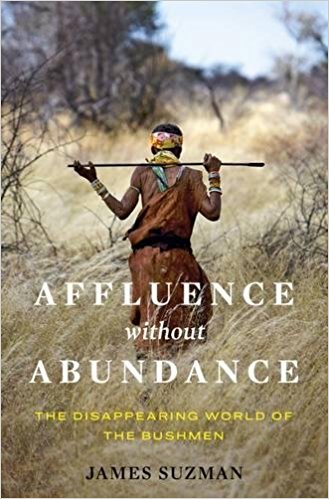


The Bushmen of the Kalahari, we learn, have in various groups assimilated into more mainstream culture, but in other groups stayed with their traditional hunter-gatherer lifestyle.


“It turns out that hunting and gathering is a good way to live. A study from 1966 found that it took a Ju/’hoansi [Bushman] only about 17 hours a week, on average, to find an adequate supply of food; another 19 hours were spent in domestic activities and chores.” … Ju/’hoansi do not accumulate surpluses. They get all the food they need, and then stop. They exhibit what Suzman calls ‘an unyielding confidence’ that their environment will provide for their needs.”


“ … the hunter-gatherer’s ability to live a life that is, on its own terms, affluent, but without abundance, without excess, and without competitive acquisition. The secret ingredient seems to be the positive harnessing of the general human impulse to envy.”


This is the thing which the Lord hath commanded, Gather of it every man according to his eating, an omer for every man, according to the number of your persons; take ye every man for them which are in his tents.
And the children of Israel did so, and gathered, some more, some less.
And when they did mete it with an omer, he that gathered much had nothing over, and he that gathered little had no lack; they gathered every man according to his eating.
And Moses said, Let no man leave of it till the morning
. (Exodus 16:16-19)


It’s when they get greedy that they get into trouble. Try to store it and it rots.

But when they trust that “The Lord will provide” as my generous friend Marjorie used to say, they find that their good shepherd provides all they have needed.


As Henry Baker wrote in his hymn based on the 23rd Psalm,


The King of love my Shepherd is,
Whose goodness faileth never,
I nothing lack if I am His
And He is mine forever.


For abundance read superfluity, for affluence read sufficiency. For what the anthropologist calls ‘an unyielding confidence’ read “a steadfast faith” or “a founded hope”.


This story is an illustration of the abundance of God’s mercies, the certainties of his provision.


Manna, the bread from heaven, is used as well to mean an unexpected benefit, or, spiritual nourishment, especially the Eucharist.


The farm workers of Jesus’ parable certainly some of them receive an unexpected benefit. Their daily bread descends without anticipation. (And some are jealous.)


And we - we receive that manna of the last meaning, for we do indeed receive the ultimate gift of the bread from heaven that is manifested in the Eucharist, that is, Jesus, himself; as he said, “I am the bread of life.” The one who trusts Jesus receives from him life - and that abundantly. Abundantly - beyond needful measure.


Is that fair?


AProper20 Pentecost XVI … September 24, 2017 … St Paul’s, Tombstone.


Thursday, September 18, 2014

everybody welcome

A day's wage ... how does that relate to hospitality?

A landowner recruits some day laborers. He goes down to the marketplace - or the Shell station. There are people standing around, hoping someone will hire them that day, give them a chance to get their daily bread.

Give us this day our daily bread...

So the landowner takes whom he can find and sends them out to work in the vineyard.

It is a hot day, we are told; perhaps they are in Sonoma - or Arizona.

In the heat of the day - here in America - workers get a lunch break. They take it in the shade of the trees by the side of the road. You see them on the way to the tasting room. 

How did they get here? Today - you know. This season - perhaps they live here, perhaps they have green cards, perhaps they "entered the United States by a legal point of entry." 

Perhaps they are among the one-third of vineyard workers who have no papers to show.

But they come and work, anyway.

Are they welcome?

The wine industry, one vineyard owner told me, would collapse without them.

A long time ago there was a harvest in another field. It was the barley harvest and the landowner was Boaz. It was his family farm - near Bethlehem. 

He saw someone out in his field, following his work crew, picking up the grains that had fallen, that they'd missed.

- Who is that gleaning in the field?
- It is a stranger, a foreigner, who walked across the desert, for several days, from the mountains of that other country. 

She is here, a widow, destitute.
- She came alone?
- No, she came with her mother-in-law, to look after her. Naomi.
- Naomi. My cousin.

We are all cousins here, Steven Talmadge the Lutheran bishop said. All of us here along the Borderlands. And in Tucson sometimes you feel that's true. We are all related - to the land, to each other, to our common situation.

Sometimes we are the stranger, welcomed or not. And sometimes we are the host.

Boaz put down his hoe, ran his hand across his forehead, and thought a minute. 

- Let her glean - among the sheaves ... even pull out some grain for her. And let no one bother her - tell the men that.

Later he saw her, and said, 

- I have heard about you, about all you have done for your mother-in-law, since you left your own country and came here to a land you did not know. You sought shelter under the wings of Yahweh. Bless you!


I was a stranger ... did you welcome me?


A stranger comes to town, a man goes on a journey: two stories  - the only two, some say - but they are really one.

Once some years ago I went to call on Cele Peterson in her store. She said she only had twenty minutes as she was expecting a visitor. In the time we had she said of the border, "We've got to stop doing this" - and she held her hands palms-out as if fending off a stranger - "and starting doing this" - and she faced her hands towards each other and interlaced the fingers. And then I opened the door to Gabby.

You shall also love the stranger, for you were strangers in the land of Egypt. 

For the Lord your God is God of gods and Lord of lords, the great God, mighty and awesome, who is not partial and takes no bribe, who executes justice for the orphan and the widow, and who loves the strangers, providing them with food and clothing .... You shall fear the Lord your God; him alone you shall worship; to him you shall hold fast, and by his name you shall swear.  

(Deuteronomy 10:19, 17-18, 20)

In Scotland, in Duddingston Village, I was the guest - and invited to a Queen's Jubilee wine-and-cheese party. (We were about a mile from Holyroodhouse and she was in residence.) There in the garden someone introduced me and someone identified me ... Oh, you're the foreigner ... strange feeling.

When the priest takes your offering, you shall make this response before the Lord your God:

"A wandering Aramean was my ancestor; he went down into Egypt and lived there..." (Deuteronomy 26:5)

I was a stranger and...
 ... you welcomed me.
 ... you did not welcome me.
(Matthew 25:35, 43) 

Who are we welcoming? By the oaks of Mamre Sarah and Abraham pitched their tent. In the heat of the day three strangers approached. Come stay with us. Let us prepare you something to eat. Here, let me wash your feet. You must be tired...

When an alien resides with you in your land, you shall not oppress the alien. The alien who resides among you shall be to you as the citizen among you; you shall love the alien as yourself, for you were aliens in the land of Egypt; I am the Lord your God.

Over and over in the Old Testament we hear stories of hospitality, of welcome to strangers; Lot, in Genesis 19; the father of Gideon, in Judges 6; the father of Samson in Judges 13. Like the father of Isaac (to be) they welcome strangers...

Who are we welcoming?


In the story of Abraham and Sarah and the three men at the oaks of Mamre, what do we see as the ideal of hospitality?

In the story of Ruth, who is the stranger? 

What does the story of the vineyard tell us about the abundance of God? 

In a time of harvest plenty, or of famine, what is fair? just? generous?

What do these stories tell us about fear, hope, longing, joy?

What do they tell us about home?

Come down, Zacchaeus, for tonight I must stay at your house.


"God of unfailing generosity, making no distinctions of wealth or ability, root out from us the spirit of envy and greed, and transform our bitterness into an open-hearted welcome of those we are tempted to despise. We pray this after the pattern of Jesus and in the power of the Spirit." -- collect prayed at the Come and See service, St Philip's in the Hills, Tucson, 4pm Sunday 21 September 2014. (from Jim Cotter, http://cottercairns.co.uk)

These are notes for a leading a reflection on the gospel on Sunday 21 September 2014 at the 4pm Come and See service at St Philip's in the Hills, an Episcopal Church in Tucson, Arizona. JRL+


Saturday, September 20, 2008

bread

Bread from Above
Bread for the Journey
Bread for the World

In the name of God, merciful Father, compassionate Son, Spirit of wisdom.

The people of God wander in the wilderness. They long nostalgically for the ‘fleshpots of Egypt’ – for the familiar, however uncomfortable, however impossible to recover.

God has drawn them out of bondage – led by Moses, whose very name means “he who draws out” or “he who has been drawn out” (both true of Moses).

By a pillar of cloud and a pillar of fire, God has led them into the wilderness. They follow – but they grumble.

For they are on an adventure.

And as Michael Chabon, author of The Amazing Adventures of Kavalier & Clay, says,

“Adventures are a logical and reliable result – and have been since at least the time of Odysseus – of the fatal act of leaving one’s home, or trying to return to it again. All adventure happens in that damned and magical space, wherever it may be found or chanced upon, which least resembles one’s home. As soon as you have crossed your doorstep … you have entered into adventure, a place of sorrow, marvels, and regret.

“For better or worse it (the story of the Jews) has been one long adventure – a five-thousand-year Odyssey – from the moment of the true First Commandment, when God told Abraham lech lecha: Thou shalt leave home. Thou shalt get lost. Thou shalt find slander, oppression, opportunity, escape, and destruction. Thou shalt, by definition, find adventure.”

Michael Chabon, Gentleman of the Road (Ballantine, 2007) 201-202, 203.

Now the people of God are embarked upon a great adventure. They are seeking – home, but a new home, which is their true home, their only home; they are seeking the land of promise where God dwells with them.

God has pitched his tent among them - but God has promised: this is only a way station. You are on a pilgrimage, a journey, to the place where you really belong: the place that I prepare for you.

So. They are walking here. They are walking in the desert. And they are getting hungry.

The people of God cry out – and God hears them.

So, God provides. Quail in the evening, manna in the morning. Day after day after day. Forty years of it. They are sick of it within a week. (Just wait till they run out of water.)

What have they got? They have

Bread from Above – Bread from Heaven.

The Holy One has provided them with what they need.

Notice: he provides them just what they need. As it turns out, no matter how anyone gathers, each person finds they have just enough for the day – or to tide them over during the Sabbath. There is nothing left over, nothing you can hoard: it turns bad by morning.

What do they have?

They have the bread that the Lord has given them. They might want to sing:

All I have needed thy hand has provided; great is thy faithfulness, Lord, unto me.

They are able to go on, as the God who has called them forth from the familiar fleshpots on the way of the great adventure, as God leads them forward to the place of his purpose.

The bread from above is bread for the journey.

***

In the story of the laborers in the vineyard, the bread from heaven appears again – as the daily bread, the bread we need.

Imagine hanging around the Shell station all day, waiting for a job. Nobody has hired you and it is getting on toward 5 o’clock. How will you explain to your family you have nothing for them? There is nothing to eat. Nobody picked you and now you have nothing.

Then a man in a truck says, get in -- you’re hired.

And at the end of the day, he pays you a full day’s wages.

After all that waiting, all that wondering, worrying, it is like – bread from heaven.

You might be a little surprised to hear what the other guys say after you leave: “Hey! That’s not fair. We worked all day. Through the heat. And all you give us is –

“A day’s wages. As agreed.”

Each of them, however much they’d gathered or hoped to gather, has their daily bread.

They have it from God.

Whether this seems like abundant providence or stinginess – they have the staff of life.

God provides it: not from merit, but from – something else.

Because the complaining laborers are thinking about what is right, what is due, for each. But the landowner is concerned with what is right for all: the welfare of the whole community, the whole people of God.

And that is a pretty big group.

Last year Sarah and I went to a class taught by Art Simon, founder of the Christian citizens’ group Bread for the World. The course had been billed as how to preach on behalf of the poor to the rich – but he quickly threw out the title. We are all in this together. Rich and poor, we are all one people. God’s people.

So the bread from above is bread for the world.

We are given this bread, and it is bread from heaven.

It is for us to bless it, break it, share it among ourselves, and pass it on.

How will you receive the bread from heaven this week? How will you take in the body of Christ, the bread of Heaven, to be renewed and energized? How will you take the bread from above, blessed and broken, and extend your hand to offer it to another?

There are very practical ways: in the past weeks, we’ve taken up offerings for local food banks – and we’ve learned how to help with hurricane relief.

There are other opportunities for mission and service ahead – from working in local direct assistance programs to supporting mission work far away.

There is the citizenship side of the poverty issue. We, without regard to party, can become advocates for the work of relief and development.

There is our own good work, done in the course of getting a living, done for the glory of God.

We can continue to develop our mission and our outreach as a community – finding the ways each of us and all of us together are called to serve – and to discover what our own place is, in the sacred story of the people of God.

Show us your way, Lord, as you showed the men and women and children in the desert of Sinai, the way to worship you and to serve you, and to become your people in the midst of the world. Provide us with the bread we need; and give us the grace to become part of your gift: bread from above, the bread of heaven – bread for the world.

Amen.


Proper 20, Year A - Pentecost XIX
Exodus 16:2-15
Psalm 105:1-6, 37-45
Philippians 1:21-30
Matthew 20:1-16

+